The global trade environment for B2B drinkware importers has shifted from "recalibrated" to "aggressive" following the April 2, 2026, presidential proclamation. For brand owners and procurement directors sourcing 2026 US tariffs stainless steel cups, the rules of the game have changed overnight. This is no longer just about a few points of duty; it is about a fundamental shift in how the U.S. government values imported steel articles under Section 232 of the Trade Expansion Act of 1962.
The 2026 Tariff Reality: What You Need to Know
- Valuation Surge: Effective April 6, 2026, tariffs apply to the full transaction value, effectively doubling the tax burden for many categories.
- Critical Deadlines: July 31st for Annex III firms; September 29th for the general market.
- Double-Layering: Simultaneous enforcement of Section 232 (Steel) and Section 301 (China Policy) is now the norm.
- Supply Chain Shift: MOQs for recycled content (rSteel) are rising to 2000+ units due to smelting batch requirements.
The Mechanism: From "Metal Value" to "Full Value"
To understand why your 2026 US tariffs stainless steel cups are about to become 15-20% more expensive, we must look at the underlying mechanism of the April 2026 proclamation. For years, savvy importers utilized a "recalibrated" valuation system where duties were often calculated based solely on the raw metal value of the product, excluding labor, branding, and manufacturing overhead. The 2026 proclamation has closed this loophole.
By mandating that Section 232 tariffs apply to the full transaction value (the FOB price paid to the factory), the U.S. government has effectively transformed a steel tariff into a finished-goods tax. For example, a $5.00 vacuum-insulated tumbler previously might have been taxed on its $1.50 steel content. Now, the 25% duty applies to the full $5.00, raising the tax from $0.37 to $1.25—a 237% increase in the per-unit tax burden.
Why the Change? (The "Mechanism")
The U.S. Department of Commerce has determined that previous "target" duties failed to sufficiently incentivize domestic production because they ignored the "value-added" components of imported goods. By taxing the full value, the 2026 policy aims to make domestic manufacturing—where labor and branding are not subject to import duties—more competitive against low-cost overseas factories. This forces B2B buyers to rethink their "Landed Cost" models entirely.
The Math of 2026: Landed Cost Impact Analysis
| Component | 2025 Model ($) | 2026 Model ($) | Sourcing Change |
|---|---|---|---|
| Wholesale Price (FOB) | $5.00 | $5.00 | Unchanged |
| Sec 232 Duty Basis | $1.50 (Metal Only) | $5.00 (Full Value) | +233% Valuation |
| Effective Duty Rate | 15% ($0.22) | 25% ($1.25) | +10% Rate Hike |
| Total Tax (including 301) | $1.47 | $2.50 | +$1.03 Per Unit |
The Double-Layered Trap: Section 232 Meets Section 301
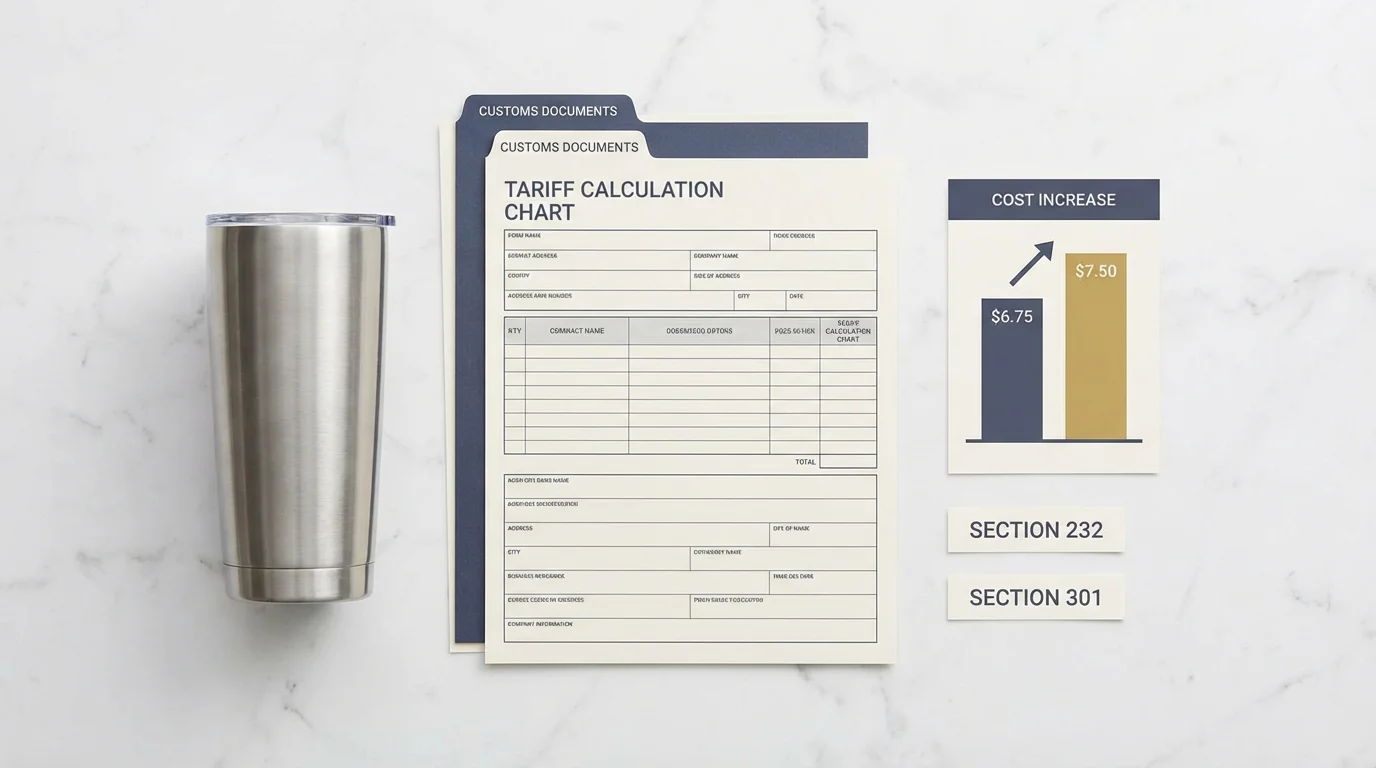
For B2B importers sourcing 2026 US tariffs stainless steel cups from China, the challenge is compounded by the simultaneous application of Section 301 duties. While Section 232 is a "National Security" tariff focused on the metal content, Section 301 is a "Trade Policy" tariff focused on technology and IP. These duties are additive.
In 2026, most stainless steel drinkware from China faces a 25% Section 301 duty PLUS a 25% Section 232 duty. Even with "de minimis" or specific exclusions, the aggregate duty burden can reach 35-50% of the FOB value. This is the "Double-Layered Trap" that is forcing many mid-sized importers to reconsider their entire 2026 sourcing calendar.
Supply Chain Impact: Beyond the Tax
The 2026 tariff environment doesn't just impact your wallet; it impacts your operational workflow. We are seeing three major "domino effects" in the supply chain:
1. Rising MOQs for "GRS Recycled Steel"
To mitigate some tariff risks and appeal to ESG-conscious buyers, many brands are switching to GRS-certified Recycled Stainless Steel (rSteel). However, rSteel requires dedicated smelting batches to ensure purity. For factories, this means a "Heat Lot" minimum. As a result, MOQs that were previously 500 units are now being pushed to 2000+ units. Small-scale B2B importers must now consolidate orders or face "material surcharges" that further erode margins.
2. Extended Compliance Lead Times
Customs and Border Protection (CBP) has increased its focus on "Country of Origin" (COO) for 2026. Every shipment must now include a "Certificate of Melt and Pour" for the steel content. Obtaining these documents from Tier-2 suppliers and getting them verified can add 7-10 days to your factory lead time. B2B buyers must account for these "compliance buffers" to avoid stockouts.
3. The Cash Flow Squeeze
With duties reaching 35%, the amount of working capital tied up at the port is significant. For a shipment of 50,000 tumblers, the duty bill alone can exceed $125,000. Many importers are shifting from L/C (Letter of Credit) to DDP (Delivered Duty Paid) terms to force the logistics partner or factory to share the financing burden, though this often comes with a 3-5% service premium.
Mitigation Strategies: The B2B Sourcing Toolkit
While the 2026 US tariffs stainless steel cups environment is hostile, it is not inescapable. Successful B2B importers are utilizing a "Multi-Stage" mitigation toolkit:
HS Code Optimization: The 1% Advantage
Review your product classifications under Chapter 73 of the HTSUS. Minor design differences—such as the integration of specific vacuum technology or the type of lid—can sometimes move a product from a 25% duty category to a 10% or even 0% duty category under specific trade agreements. We recommend a formal "Ruling Audit" every 6 months.
The "First Sale" Rule (FSR)
The First Sale Rule allows you to pay duties based on the price the middleman (e.g., a sourcing agent) paid the factory, rather than the price you paid the middleman. In a "Full Value" environment, this can reduce your taxable basis by 10-15%. However, FSR requires a transparent supply chain and rigorous documentation that not all factories can provide.
Bonded Warehousing and Deferral
Utilizing Foreign Trade Zones (FTZ) or Bonded Warehouses allows you to store inventory without paying duties until the product is "entered" for consumption in the U.S. This provides a critical cash-flow buffer, allowing you to pay the 35% duty only as you sell the product, rather than all at once upon arrival.

Anti-Hype: The Fallacy of "Tariff-Free" Sourcing
Many sourcing agents are currently promoting Vietnam, Thailand, or India as "Tariff-Free" alternatives to China for 2026. This is often a trap for the unwary. While these countries may bypass Section 301 China-specific duties, the Section 232 Steel Tariffs apply globally. If the steel used in your "Made in Vietnam" cup was smelted in China or India, it is still subject to the 25% Section 232 duty under the "Substantial Transformation" rules of 2026. Avoid any supplier who cannot provide a "Melt and Pour" certificate for the steel content.
FAQ: Sourcing for Compliance and Profit
Q: Which HS codes are most affected by the 2026 Section 232 modification?
A: Chapter 73 items (Stainless Steel articles), specifically 7323.93.00 (Table, kitchen or other household articles) and 9617.00.10 (Vacuum flasks and other vacuum vessels).
Q: Can I avoid these tariffs by sourcing from Mexico or Canada under USMCA?
A: Only if the steel itself is melted and poured in North America. Sourcing a Chinese-steel cup assembled in Mexico will not bypass Section 232 under the 2026 "Region of Origin" enforcement rules.
Q: How does this impact MOQs for sustainable products?
A: Recycled stainless steel (rSteel) requires dedicated smelting batches to ensure GRS compliance, which often pushes factory MOQs from 500 units to 2000+ units for custom orders.
Q: Is there any hope for tariff exclusions in 2026?
A: Very little. The 2026 proclamation has tightened the "domestic non-availability" criteria to an extreme degree. Exclusion requests now have a success rate of less than 5% for standard consumer drinkware.
Conclusion: Strategic Resilience in 2026
The 2026 trade environment for stainless steel drinkware is characterized by "High Compliance, High Risk." For B2B importers, the ability to adapt to these new 2026 US tariffs stainless steel cups regulations will be the primary differentiator between growth and stagnation. By optimizing HS codes, leveraging trade rules like First Sale, and partnering with transparent, high-quality manufacturing partners, you can successfully navigate these challenges and protect your margins.
As we approach the September 29th general deadline, early action is your best defense. Stay updated with our latest industry guides and trade insights to ensure your supply chain remains resilient, compliant, and profitable in 2026.
Protect Your 2026 Wholesale Margins
Don't wait for the September deadline. Partner with a factory that understands 2026 compliance and strategic sourcing.
Get a Tariff-Optimized Quote