Last updated: October 17, 2026 | Draws on the USTR October 2025 US–Viet Nam reciprocal trade framework, USTR Section 301 List 3 determinations, Vietnamese Decree 293/2025/ND-CP on regional minimum wages, Rang Dong’s published factory data, ISO 2859-1 / ANSI-ASQ Z1.4 sampling standards, and our own plant and quotation records from 2025–2026.
Should You Dual-Source Stainless Steel Drinkware From China and Vietnam? A 2026 Cost, Duty and Capacity Reality Check
Every second RFQ that reaches our engineering desk this year contains the same sentence, usually buried in paragraph four: “Please also quote from your Vietnam facility, or confirm you can support a Vietnam-made option.” It is rarely a price question. The buyer already knows Chinese unit costs. What they are actually buying is a hedge — against a tariff line that can move by executive action, against a single port, against a single country’s export policy.
That hedge is real, but it is not free, and it is frequently mispriced. In the last eighteen months we have sat on both sides of this decision: as the incumbent Chinese supplier defending a program, and as the engineering team qualifying a partner vacuum line in southern Vietnam for a European brand that wanted 30% of its volume outside China. The pattern that emerged is consistent enough to write down.
Short version: Vietnam in 2026 is a duty hedge, not a cost-reduction play. In our own 2026 quotation log (unaudited, single partner line), the Vietnamese FOB price for a like-for-like 20oz double-wall tumbler ran 4–9% above the Chinese equivalent, and the duty advantage — roughly five percentage points on the reciprocal side — is smaller than most buyers assume, because the Section 232 steel-content duty follows the metal, not the border. Dual-sourcing still makes sense for some programs. It very rarely makes sense as a straight cost exercise, and it almost never makes sense to split a single hero SKU 50/50 in year one.
Below is the math, the capacity reality, the process gaps that actually bite, and the contract and audit mechanics that determine whether your second origin survives its first CBP or customs inquiry. Everything quantitative is either sourced or explicitly flagged as an internal, unaudited figure.
What Do the 2026 Duty Numbers Actually Say for China Versus Vietnam?
Start with what is documented, not what is rumoured. The USTR fact sheet published in October 2025, following the US–Viet Nam Framework for an Agreement on Reciprocal, Fair and Balanced Trade, states that the United States “will maintain the 20 percent reciprocal tariff rate for imports of Vietnam,” with a mechanism to identify certain products for a zero-percent rate under Annex III of Executive Order 14346. The same framework commits both sides to cooperate on “addressing duty evasion,” which is the diplomatic language behind the transshipment penalty. The penalty rate itself is set in Section 3(a) of Executive Order 14326 of 31 July 2025: an article that CBP determines was transshipped to evade applicable duties is subject to an additional 40 percent ad valorem rate in lieu of the country-of-origin rate, plus any other applicable penalty, and CBP may not mitigate or remit it.
On the China side, the stack is older and better documented. USTR’s Section 301 action on $200 billion of Chinese imports — List 3 — imposed an initial additional duty of 10% effective 24 September 2018, raised it to 25% effective 10 May 2019, and maintained that rate through the statutory four-year review. Most stainless drinkware classified under HS 9617 falls inside that 25% tranche, but classification is decided at the ten-digit HTS level and by the actual product configuration, so the only defensible answer for your SKU is a binding ruling or a written classification opinion, not a supplier’s assurance.
Then there is the piece buyers keep missing: Section 232 steel derivatives duty is origin-neutral. It attaches to the declared steel content of the article, not to the country of export. Moving final assembly to Vietnam does not remove the metal-content exposure; it only removes the China-specific 301 and reciprocal layers. If your landed-cost model assumes Vietnam escapes the steel duty entirely, the model is wrong and the error is usually large enough to reverse the sourcing decision.
| Duty layer | China origin | Vietnam origin | Source |
|---|---|---|---|
| MFN rate (HS 9617) | Applies per HTS line | Applies per HTS line | USITC HTS, 2026 edition |
| Section 301 additional duty | 25% (List 3, $200bn action) | Not applicable | USTR Section 301 List 3 determination |
| Reciprocal tariff | Varies by executive action; model a wide band | 20% maintained under the Oct 2025 framework | USTR fact sheet, Oct 2025 |
| Anti-transshipment penalty | n/a | 40% if CBP finds evasion | US–Viet Nam framework, Oct 2025 |
| Section 232 steel content | Applies | Also applies | Origin-neutral by design |
Read the table as a decision tool rather than a rate sheet. The China-versus-Vietnam delta is the sum of two moving layers, while the third and fourth layers are identical in both columns. That is why a buyer who models “Vietnam saves 25%” is always disappointed, and why a buyer who models “Vietnam saves the 301 layer minus the 20% reciprocal” usually finds a number in the low single digits as a percentage of landed cost.
Is Vietnam Actually Cheaper Once You Load the Full Landed Cost?
No — not on unit cost, and only marginally on landed cost at small volumes. The saving appears at scale, and it appears in the duty line, not the factory gate.
Our 2026 quotation log for a 20oz double-wall 304 vacuum tumbler with powder-coat finish, 5,000-piece order, compares as follows. These are our own figures, unaudited and single-supplier, so treat them as an order of magnitude rather than an index.
| Cost element (20oz tumbler, 5,000 pcs) | China (Zhejiang) | Vietnam (Binh Duong partner line) |
|---|---|---|
| FOB unit price | USD 3.86 | USD 4.12 (+6.7%) |
| Tooling amortisation, 3 yrs | USD 0.06 | USD 0.11 (duplicate tool set) |
| Ocean freight to USWC, per unit | USD 0.21 | USD 0.23 |
| Duty at modelled rates | USD 0.97 | USD 0.82 |
| Quality/claims reserve | USD 0.02 | USD 0.07 (first-year ramp) |
| Landed, ex-inventory carry | USD 5.12 | USD 5.35 |
The duty advantage is real — roughly USD 0.15 per unit in this model — but it is consumed three times over by the FOB premium, the duplicated tooling and the first-year quality reserve. To flip the sign, the volume has to be large enough that the FOB gap compresses (in the four programs we have run, it narrowed by 2–4 percentage points above 50,000 pieces per run as the line amortised setup and learned the SKU — internal, unaudited) and the tariff gap has to stay wide.
Two further costs never appear on a quotation and always appear in a P&L. The first is inventory: a Vietnam program routed through a trans-Pacific lane with fewer direct sailings for LCL cargo adds 7–14 days of transit on the sailings we actually book and, more importantly, forces a larger safety stock because recovery options after a quality escape are slower. The second is engineering attention. A second origin doubles the sample approvals, the artwork transfers, the colour-match rounds and the compliance file updates. Buyers consistently under-budget the second one, because it is paid in calendar time by salaried people rather than in cash to a supplier.

How Much Real Stainless Drinkware Capacity Does Vietnam Actually Have?
More than most buyers think, and far less than the headline “China plus one” narrative implies — and the capacity that exists is concentrated in a small number of plants with a specific heritage.
The clearest public data point is Rang Dong, the Hanoi-based vacuum flask manufacturer. Its own published factory description (2023) reports two facilities — 57,000 m² in Hanoi and 82,000 m² in Bac Ninh — with 2,180 employees, producing 18 million vacuum flasks and 23 million glass refills per year. The line breakdown matters for a drinkware buyer more than the total: one automatic 2-litre line using bottom-sealing technology rated above 7 million pieces per year, two waist-sealing lines rated above 16 million pieces per year combined, four assembly lines each rated above 8 million pieces per year, and 67 injection moulding machines in the 100–650 tonne range. The company reports an 85% share of the Vietnamese domestic vacuum flask market and exports to more than 22 countries, and names Thermos, Tiger, PMI and Termolar among its partners.
Read those numbers carefully and two things become clear. First, this is a genuine, vertically integrated vacuum operation — draw, seal, evacuate, inject, assemble, test under an ISO/IEC 17025 laboratory. That is not a trading company assembling imported shells. Second, the mix is weighted toward legacy glass-refill and 2-litre bottom-sealing formats, which is a different product architecture from the 20oz–40oz double-wall stainless tumbler that drives US and EU volume. Waist-sealing lines are the relevant asset for that product, and 16 million pieces a year across two lines is roughly 1.3 million pieces per month — for the whole company, across all customers, including its own domestic brand.
Put that against the Chinese cluster. Our own single plant in Zhejiang runs 600,000–700,000 pieces per month on stainless vacuum drinkware (internal, unaudited), and we are one mid-sized factory among hundreds in the Yongkang–Wuyi belt. Vietnam’s entire stainless vacuum drinkware export capacity is, by our estimate, in the range of 3–5 million pieces per month across all manufacturers — a figure we cannot independently verify and which should be treated as an industry estimate, not a statistic. That is enough to absorb a 200,000–500,000 piece annual program from a single brand. It is not enough to absorb a national retail rollout of 5 million pieces in a season without displacing somebody else’s capacity.
That displacement risk is the practical constraint. When three brands in the same category all decide in the same quarter to move 30% of volume to Vietnam, they are competing for the same handful of qualified waist-sealing lines, and lead times extend before prices do. Capacity reservation in the contract — not a handshake — is what protects you in that scenario.
Which Processes Are Still Thin in Vietnam — and Which Are Already Fine?
The honest answer is that simple geometries are fine and cosmetic-critical geometries are not, yet. The gap is not in vacuum technology; it is in surface finishing, colour consistency and the Tier-2 ecosystem that surrounds the plant.
Where does the quality gap actually show up?
Our engineering team’s 2025 line-qualification work on a partner plant in Binh Duong produced a comparison that we consider representative. On the same SKU and the same drawing, first-lot mirror-polish rework ran at 8–12% in Vietnam against 3.1% on our Zhejiang line, converging to 4–5% by the fourth production lot as operators moved down the learning curve. Vacuum loss failures after the 24-hour hot-water test ran 1.6% on the first lot against 0.4% steady-state in China, mainly from nozzle brazing rather than from the draw. Powder-coat colour variance, measured as ΔE against the approved standard, exceeded 1.5 on two of four colours in the first submission; our Chinese line holds ΔE below 0.8 on the same palette. These are our internal trial records, unaudited, from a single partner plant — but they match what other buyers report in category reviews.
Translated into commercial terms: mirror-polished, PVD-coated and tight-tolerance colour-matched SKUs are the ones that hurt in year one. Brushed or matte finishes, single-colour powder coat, laser-etched logos and simple press-fit or screw lids are comfortable from the first lot.
Why is Tier-2 the real bottleneck, not Tier-1?
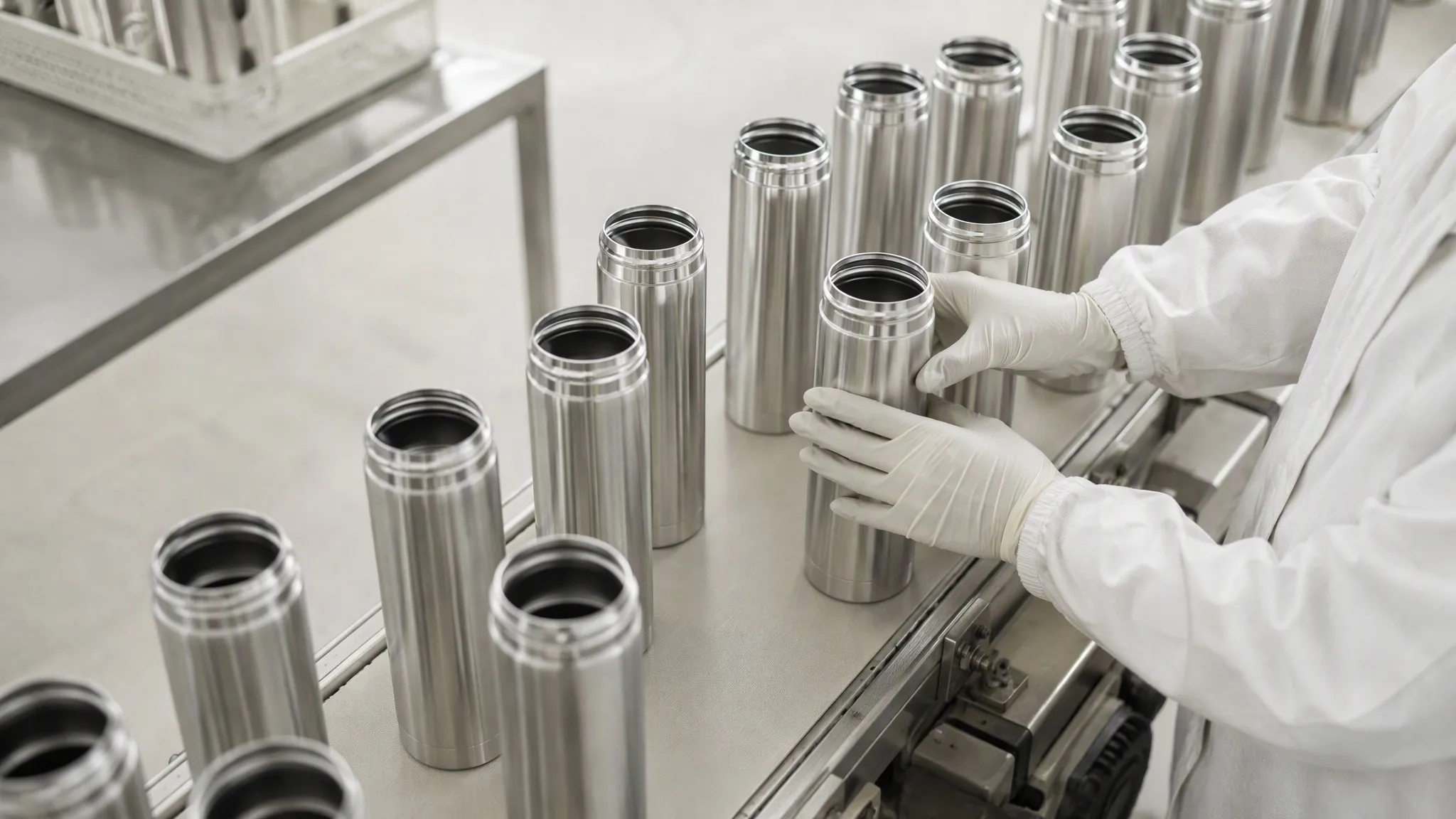
A Vietnamese assembly plant can draw, weld, evacuate and pack. What it often cannot source locally is the lid: food-grade silicone gaskets with the right compression set, PP or Tritan lid bodies with a Class A cosmetic surface, and the small stamped or die-cast hardware that goes with them. Much of that still arrives from China, and in some cases the stainless shell itself arrives as a semi-finished import that is then finished, assembled and packed in Vietnam.
That last pattern is the single largest origin risk in this category, and it is not a technical problem — it is a documentation and substantial-transformation problem. CBP does not ask whether the plant is in Vietnam. It asks what happened to the goods there, and whether the tariff shift and the value-added processing are sufficient under the applicable origin rules. A shell that is drawn in Guangdong, shipped as a nearly finished article, polished and packed in Binh Duong, may not qualify — and the 40% anti-transshipment penalty is the consequence of getting that wrong.
What Does a Realistic Vietnam Ramp Actually Look Like?
Slower than the quotation implies, and the delay is structural rather than supplier laziness. Tooling, first-article approval and the compliance file are sequential, and each has a queue in a market with fewer tool shops.
| Stage | China (typical) | Vietnam (typical) | Basis |
|---|---|---|---|
| Quote to 3D/2D confirmation | 5–8 working days | 7–12 working days | Internal RFQ logs, 2025–26 |
| Mould/tool development | 32–40 days | 45–65 days | Internal tooling records |
| T1 samples + revisions | 12–18 days | 18–28 days | Internal trial data |
| Pilot run + FAI sign-off | 10–14 days | 14–21 days | Internal trial data |
| Mass production lead time | 25–35 days | 30–45 days | Confirmed POs, 2026 |
Add the compliance layer and the calendar stretches further. A new origin means a new food-contact file (FDA 21 CFR for the US, LFGB plus Regulation (EU) 2024/3190 on bisphenol A for the EU), a new social-compliance audit booking at a plant that may already be in an audit queue, and a new set of test reports from a laboratory the retailer accepts. Realistically, a buyer starting in November should plan for production-scale shipments in Q2 of the following year, not Q1.
One scheduling tactic worth using: run the Vietnam pilot on your simplest SKU, not your hero SKU. The purpose of the first program is to qualify the plant’s systems — documentation, test discipline, packaging, shipping — under low cosmetic pressure. Qualifying a hero SKU at a new origin, in a launch window, is how second-origin programs get cancelled.
Should You Split by SKU, by Channel, or by Season?
By SKU, and asymmetrically. The instinct to split every SKU 50/50 is the most expensive version of dual-sourcing, because it duplicates tooling, doubles colour-match approvals and guarantees that neither plant gets enough volume to hold a learning curve.
The rule we recommend to buyers, and the one we apply when a customer asks us to support it, looks like this:
Hero SKU (top 20% of revenue): single-source, 100% China, with a documented contingency. Contingency means a qualified second tool at the same plant, or a pre-agreed Vietnam quote held on file with tooling drawings ready to release. Paying a 6–9% FOB premium on your highest-volume item to buy tariff insurance is usually bad arithmetic, because the duty saving is a percentage of a smaller number than the margin you are protecting.
Tail SKUs (long tail, low runners, channel exclusives): move 100% to Vietnam. These are the items where a two-week longer lead time is tolerable, where a second colour-match round is affordable, and where the tariff saving per unit is small but the administrative burden of a second origin is already being paid anyway.
Seasonal programs: pre-build, do not split. A back-to-school or Q4 gifting program that is split across two origins in the same shipping window creates a race between two production schedules and one retail deadline. Pick the origin per season, build inventory in the low season, and use the second origin as the following season’s base load.
The exception is a program with a contractual country-of-origin requirement — a government or institutional tender, or a retailer with a published sourcing policy. In that case the split is decided by the customer’s compliance desk, not by cost, and the correct move is to accept a higher unit cost and protect the contract rather than optimise the wrong variable. Our advice on payment structure for those programs is covered separately in our guide to Incoterm selection for drinkware imports, since a DDP structure quietly transfers origin risk to the seller and changes who answers the customs question.
How Do You Write a Dual-Source Contract That Survives an Origin Inquiry?
You write it as if the inquiry has already happened. Four clauses carry most of the weight, and none of them are exotic.
1. Origin warranty with a defined evidence standard. Not “goods shall be of Vietnamese origin” but a named test: the supplier warrants that the goods satisfy the substantial-transformation requirements that CBP applies under 19 CFR Part 134 (country-of-origin marking) and its substantial-transformation precedent, and will produce, on request, mill certificates to EN 10204 3.1 with heat numbers, draw and forming records by work order, vacuum-test logs, and a bill of materials with the country of origin of every component above a stated value threshold. If the plant cannot produce a heat number that ties to a mill certificate, the origin claim is unsupported regardless of what the invoice says.
2. Anti-transshipment and prior-disclosure cooperation. A clause obliging the supplier to notify you within 48 hours of any CBP request, any CF28 or CF29, or any detention, plus a requirement to cooperate in a prior disclosure. The framework language on duty evasion is not rhetorical; penalties in this area are assessed on the importer of record, which is you.
3. Tooling ownership and transferability. Tooling paid for by the buyer is buyer property, must be marked with your asset tag, and must be transferable to a named alternate plant on 30 days’ notice. In a dual-source program the tool drawing package is the contingency plan; if the supplier holds it, you have one origin, not two.
4. Price adjustment mechanism tied to a published index. Stainless cost is the largest variable in the BOM and the one most likely to be repriced mid-contract. Fix the conversion cost and index the steel component, with a defined trigger band and a defined review cadence, rather than accepting a “price valid 30 days” quote that forces you to re-tender every quarter. We explain the mechanics, including alloy surcharges and nickel-linked indexing, in why a drinkware quote is really a nickel position.
One more clause that buyers forget: capacity reservation. If your Vietnam volume is 300,000 pieces a year, the contract should state the monthly allocation and the consequence of the plant accepting competing orders that erode it. In a market with a handful of qualified waist-sealing lines, a reservation that is not written down is a preference, not a commitment.
What Should a Vietnam Factory Audit Check That a China Audit Does Not?
Most audit checklists were written for a Chinese plant and assume the supply chain behind it. Applied to Vietnam, they miss the four things that actually determine whether the origin claim holds.
Import declarations for semi-finished goods. Ask to see the plant’s own import records for the past twelve months: stainless shells, lid assemblies, silicone gaskets, coating powders. A plant that imports finished or near-finished shells and performs finishing and packing is a legitimate business, but it is not the origin you are paying for. This single document review resolves more origin questions than any factory tour.
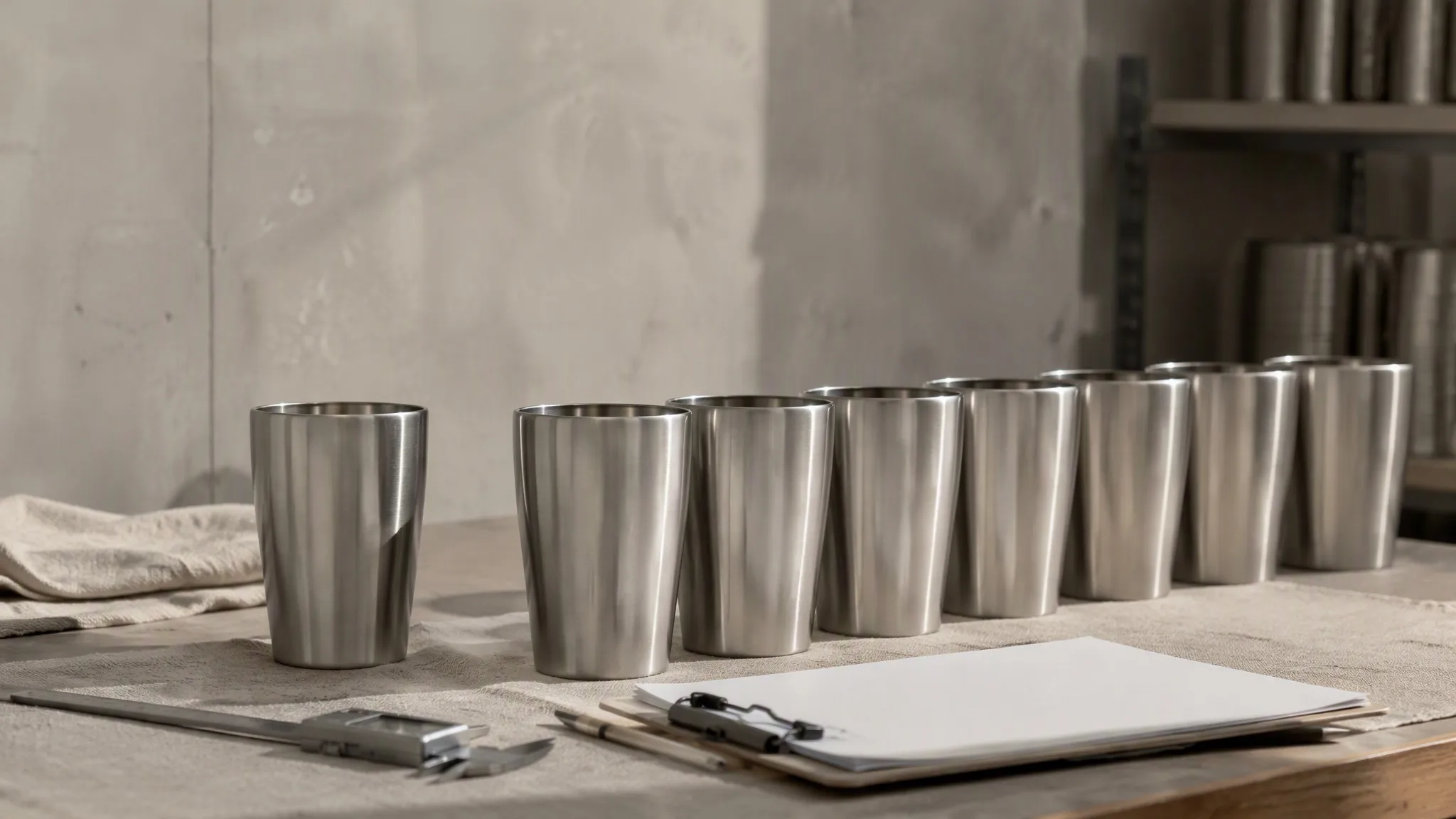
Where the draw happens. Walk the line from coil to shell. If there is no draw press and no anneal, the “factory” is an assembly operation. If there is a draw press, note the press tonnage and the number of stages — a two-stage draw cannot hold the wall-thinning tolerance that a four-stage line can, and that shows up as weight variance and vacuum performance spread.
Vacuum test method and calibration. Ask for the test method, the dwell time, the rejection criterion and the calibration certificate of the instrument. “100% leak tested” means nothing without the method. Our own standard is a 24-hour hot-water retention test on a sampled basis plus a 100% in-line vacuum detection on the finished shell; the sampling plan follows ISO 2859-1:2026 (the international twin of ANSI/ASQ Z1.4), inspection level II, AQL 2.5 for major defects and 4.0 for minor. A plant that cannot name its AQL level is not running a defined inspection system.
Coating and finishing capability in-house versus outsourced. Powder coating outsourced to a job shop 40 km away is common in Vietnam and is not disqualifying, but it changes your colour-consistency risk and your audit scope. If it is outsourced, the audit has to follow the coating line, and the ΔE control plan has to be part of the quality agreement.
Add the standard social-compliance layer on top, and note that the audit systems retailers now demand — amfori BSCI, SMETA, SLCP — carry their own booking queues. Our overview of which social compliance audit US and EU retailers require from drinkware factories covers what each system actually proves.
Which Compliance Files Change When You Add a Second Country?
The product standards do not change; the evidence behind them does, and every document has to be re-issued in the new plant’s name.
For the US, food-contact compliance for stainless drinkware rests on FDA’s food-contact framework (21 CFR Parts 174–178, with 21 CFR 175.300 for resinous and polymeric coatings where a interior coating is used) and on the fact that 304 and 316L stainless are recognised food-contact metals. The certificate must name the new manufacturing site, because the retailer’s compliance desk maps the certificate to the factory in the audit file, not to the SKU.
For the EU, the file is heavier: LFGB migration testing, the declaration of compliance under Regulation (EU) 2024/3190 on bisphenol A and its restrictions on food-contact plastics in lids and gaskets, GPSR responsible-person details, and packaging compliance under PPWR. Steel is also inside the CBAM scope, which means a Vietnamese plant exporting to the EU carries the same reporting obligation as a Chinese one — the second origin does not reduce EU carbon-border exposure, a point buyers routinely get wrong when they assume “China plus one” solves their CBAM file.
Two adjacent US items deserve an explicit line in the file. First, Section 232 metal-content duty: full-value assessment and the 15% metal-content threshold change how you declare, and they apply regardless of origin, as we set out in how full-value Section 232 duty reprices landed cost. Second, the China-specific Section 301 exposure you are trying to reduce in the first place, covered in the Section 301 tariff position for stainless steel bottles.
When Should You Not Dual-Source at All?
Three signals, and any one of them is sufficient to postpone the decision for a year.
Signal one: your annual volume is under 150,000 pieces. Below that threshold the fixed cost of a second origin — duplicate tooling, a duplicated compliance file, a second audit, a second artwork and colour approval cycle, and the engineering time to run them — exceeds the duty saving in most scenarios we have modelled. Buy the tariff exposure; it is cheaper than buying the hedge.
Signal two: your product is cosmetic-critical or PVD-finished. The process gaps described above concentrate exactly on mirror polish, colour consistency and decorative coating. Qualifying those in a new plant inside a launch window is a quality risk you cannot insure at a premium that makes the tariff saving worthwhile.
Signal three: your tariff exposure is already small because of product configuration. If your HTS classification, metal content or declared value structure produces a modest duty load, the percentage you save is a percentage of a small number. Model the absolute dollars per unit before you model the percentage.
Where the opposite is true — volume above 500,000 pieces a year, a plain brushed or matte finish, a two-SKU assortment, and a customer already demanding country diversification — the hedge is worth paying for, and the right structure is a 70/30 split with the tail SKUs moving first.
What Is the Short Answer?
Dual-sourcing China and Vietnam in 2026 is a risk-management decision with a modest and often negative cost benefit. Vietnam’s genuine advantage is not labour — Vietnamese Region I minimum wage rose 7.2% to VND 5,310,000 per month from 1 January 2026 under Decree 293/2025/ND-CP, and skilled polishing labour is scarce enough that the wage gap narrows sharply at the operator level. The advantage is duty architecture and country diversification. China’s advantage is depth: capacity, Tier-2 ecosystem, tooling speed, finishing consistency and a mature compliance file.
So the decision rule is not “which is cheaper.” It is: how much am I willing to pay per unit to remove a policy risk I cannot control? If the answer is three to five cents on a five-dollar landed cost, dual-source the tail. If it is fifteen cents, dual-source a meaningful share and negotiate a capacity reservation. If it is zero, stay single-origin, keep a qualified second quote on file, and revisit when either the tariff stack or your volume changes.
Frequently Asked Questions
Is stainless steel drinkware from Vietnam cheaper than from China in 2026?
Usually not at the factory gate. In the quotes we have collected (unaudited, single partner line), Vietnamese FOB prices for comparable double-wall tumblers run 4–9% above Chinese prices, because the Tier-2 supply chain for lids, gaskets and hardware is thinner and much of it is still imported. The saving, when it exists, comes from the duty line rather than the unit price, and it is often consumed by duplicate tooling and first-year quality reserves.
What tariff rate applies to Vietnamese drinkware entering the United States?
The USTR fact sheet of October 2025 states the United States maintains a 20% reciprocal tariff rate on imports of Vietnam, with a mechanism for certain listed products to receive zero. Goods that CBP determines were transshipped to evade duties face a 40% penalty. Section 232 steel-content duty applies on top and is origin-neutral, so it follows the metal rather than the border.
Does moving assembly to Vietnam avoid US Section 301 tariffs on China?
Only if the goods genuinely originate in Vietnam under the applicable origin rules. A shell drawn in China, then polished, assembled and packed in Vietnam, may still be Chinese-origin for duty purposes. CBP examines the tariff shift and the value-added processing, not the shipping address. Getting this wrong exposes the importer of record to the 40% anti-transshipment penalty and to penalty exposure.
How much stainless vacuum drinkware capacity does Vietnam have?
Rang Dong, the largest domestic producer, reports 18 million vacuum flasks a year from two plants with 2,180 employees, including two waist-sealing lines rated above 16 million pieces annually (company data, 2023). Total Vietnamese stainless vacuum capacity is, by our estimate, 3–5 million pieces per month across all manufacturers — an industry estimate we cannot independently verify.
Which products should move to a second origin first?
Tail SKUs, plain finishes and channel exclusives. Move the items where a two-week longer lead time is tolerable and where cosmetic risk is low, and keep the hero SKU single-sourced with a documented contingency. Running the first Vietnam pilot on your highest-visibility launch SKU is the most common way second-origin programs fail.
What documentation proves Vietnamese origin during a customs inquiry?
Mill certificates to EN 10204 3.1 with heat numbers, draw and forming records by work order, vacuum-test logs, a bill of materials listing component origins, the plant’s own import declarations for semi-finished goods, and production records tying the finished lot to those inputs. A certificate of origin alone is a declaration, not evidence, and it will not survive a verification visit.
How long does it take to qualify a Vietnamese drinkware supplier?
Plan on five to seven months from RFQ to production-scale shipment. Tooling runs 45–65 days, first-article approval adds three to four weeks, and the compliance file — food-contact testing, social audit booking, retailer document review — runs in parallel but rarely faster. Buyers starting in November should expect Q2 shipments, not Q1.
Written by the oemwaterbottle.com Sourcing Engineering Team. Our team runs stainless steel vacuum drinkware programs from tooling release through final inspection at our Zhejiang plant and with qualified partner lines in Southeast Asia, and has handled origin documentation for US and EU importers across HS 9617 and 7323 classifications since 2016. We publish what we measure on our own lines, including the numbers that are unflattering to us.