Last updated: October 26, 2026
You send one email to five drinkware factories. You get five numbers back: USD 4.82, 5.40, 5.05, 6.30, and 4.60. The instinct is to sort the column and call the bottom two. The problem is that those five numbers are not the same number. One includes a gift box, one does not. One quotes 0.4 mm body wall, one quotes 0.45 mm nominal measured at the base only. One is FOB Ningbo with export carton, one is EXW with the carton quoted separately. One assumes a one-colour silkscreen in a 40 × 60 mm area, one assumed a four-colour wrap. One includes an AQL 2.5 inspection, one includes no inspection at all.
Subtract the cheapest from the most expensive and you have learned nothing. Run a competitive bid on incomparable inputs and you have not run a bid — you have run a random number generator with extra steps, and the winner is whoever forgot the most scope.
This is the single most expensive document problem in drinkware sourcing, and it is entirely avoidable. Below is what actually drives the spread, the 15 fields that close it, and the arithmetic for putting five quotes on one baseline before you negotiate a single cent.
Why do five drinkware quotes arrive as five different numbers?
Because a unit price is a conclusion, and every factory reached its conclusion from different premises. A stainless steel bottle at 500 ml is not a commodity with a market price. It is a stack of decisions: which coil, how thick, how polished, how printed, how packed, how inspected, how shipped, and how long the price is allowed to stand. Change any one and the price moves. Leave any one unstated and the factory fills the gap with its own default — usually the cheapest default that keeps the quote competitive-looking.
The five-quote spread you are looking at is therefore not a spread in factory efficiency. It is a spread in assumptions. In our own quotation reviews, the same 500 ml double-wall bottle, quoted by five factories against an identical one-page RFQ, has landed between roughly 4.60 and 6.30 USD FOB — a gap wide enough to hide an entire packaging programme inside it. That gap is not margin. It is definition.
What is actually being compared when you line up five unit prices?
Nothing, until you normalise. A unit price is only comparable when the following are identical across all bidders: the material grade and its thickness definition, the decoration process and its coverage area, the number of packaging levels included, the trade term and named place, the inspection standard and sampling level, the test scope, the tooling treatment, and the validity period. Eight variables, each of which can move a landed cost by several percent, and most RFQs specify maybe three of them.

Why do drinkware quotes arrive non-comparable?
Eight structural reasons, and they recur in almost every bid round we see.
Steel grade. 304, 316, and 201 are all “stainless steel”. They are not the same input cost, and 201 in particular changes corrosion behaviour in a dishwasher. A quote that says “SS304” without a mill source has not told you whether you are buying a tier-one coil or a re-rolled strip with uncertain nickel content.
Wall thickness convention. Nominal, minimum, and measured-at-a-single-point are three different specifications that produce three different steel consumptions. On a double-wall bottle the body wall and the base wall are separate numbers, and the base is usually thicker. A quote built on 0.40 mm with a 0.50 mm base is not comparable to one built on 0.45 mm uniform.
Decoration process. Laser engraving, silkscreen, pad printing, water transfer, and powder-coat-plus-laser are priced on different logic — setup cost, per-piece cost, colour count, and area coverage. “With logo” is not a specification.
Packaging level. Polybag only, polybag plus divider, colour box, colour box plus master carton, retail-ready shelf box. Five levels, five cost structures, and the carton specification itself (burst strength, ECT, pallet pattern) is a separate line.
Trade term. EXW, FOB, CIF, DDP. The difference between EXW and FOB alone can be several percent once inland haulage, export clearance, and terminal handling are counted, and the carton cube change alters the ocean freight allocation.
Inspection standard. AQL 1.0 versus AQL 4.0, general inspection level II versus S-4, and whether major/minor/critical are defined at all. An inspection is a real cost and a real schedule input.
Test scope. Leak test only, or leak plus thermal retention plus drop plus dishwasher cycling plus coating adhesion. Each added test consumes samples, lab time, and possibly third-party fees.
Validity. A 15-day quote and a 90-day quote are different financial products. The one with a long validity has priced in steel volatility; the one with a short validity has not and will re-price you at order confirmation.
Which specification gaps create the widest price spread?
Ranked by the spread they generate in our own quote comparisons: (1) packaging level, because a retail colour box with a divider and printed master carton can move unit cost more than the bottle’s steel; (2) decoration area and colour count; (3) wall thickness definition, because steel is the largest single material line; (4) trade term and named place; (5) inspection and test scope. Material grade sits lower only because most factories default to 304 anyway — but a 201 substitution is the one gap that produces a cheap quote that looks like a competitive one.
Does a cheaper quote usually mean a cheaper factory?
No. It usually means a cheaper assumption. The three most common ways a drinkware quote comes in low without anyone lying: the packaging is quoted one level shallower than you intended; the wall thickness is quoted as nominal-with-minus-tolerance rather than minimum; and the decoration is quoted at a smaller print area than your artwork requires. Each is a legitimate quote against a different product. The error is in the RFQ, not the factory.
What are the 15 fields every drinkware RFQ must pin down?
The table below is the working checklist. It is deliberately ordered by how much money the field moves, not by how easy it is to fill in. Every row should have an answer, and “supplier’s standard” is an acceptable answer only when you have written down what that standard is.
| # | Field | What “not specified” defaults to |
|---|---|---|
| 1 | Stainless grade + mill source | Whatever coil is on the floor |
| 2 | Wall thickness definition | Nominal, tolerance downward |
| 3 | Capacity basis | Brim-full, overstated |
| 4 | Finished weight + tolerance | Unspecified, drifts with steel |
| 5 | Dimensions + drawings | Nearest existing mould |
| 6 | Surface finish + coating DFT | House standard polish |
| 7 | Colour standard + ΔE | “Close to Pantone” |
| 8 | Logo process, area, colours | One colour, small, centred |
| 9 | Lid/gasket compliance | Generic silicone, no paperwork |
| 10 | Performance test scope | Leak test only |
| 11 | AQL + defect classes | No third-party inspection |
| 12 | Packaging hierarchy | Polybag + plain carton |
| 13 | Incoterm + named place | EXW or “FOB” unnamed |
| 14 | Tooling + MOQ structure | Amortised into unit price |
| 15 | Validity + index basis | 30 days, then re-quote |
The 15 fields, one at a time — and what a missing field costs
1. Which stainless grade, from which mill?
Write the grade (304, 316L, or 201), the form (coil or sheet), the thickness of the input strip, and — where it matters — the mill. 304 is the default for food-contact drinkware; 316L buys you chloride resistance at a real cost premium; 201 is cheaper and more prone to corrosion in dishwasher cycling. The gap that hurts is not the grade on the drawing, it is the grade in the coil: a re-rolled strip with unverified nickel content will pass a magnet test and fail a salt-spray programme. Require the mill certificate for the lot, and require that the certificate number appear on the inspection record. Cost of omission: this is the one field where a low quote can be genuinely lower-quality rather than merely differently scoped.
2. How is wall thickness defined — nominal, minimum, or measured?
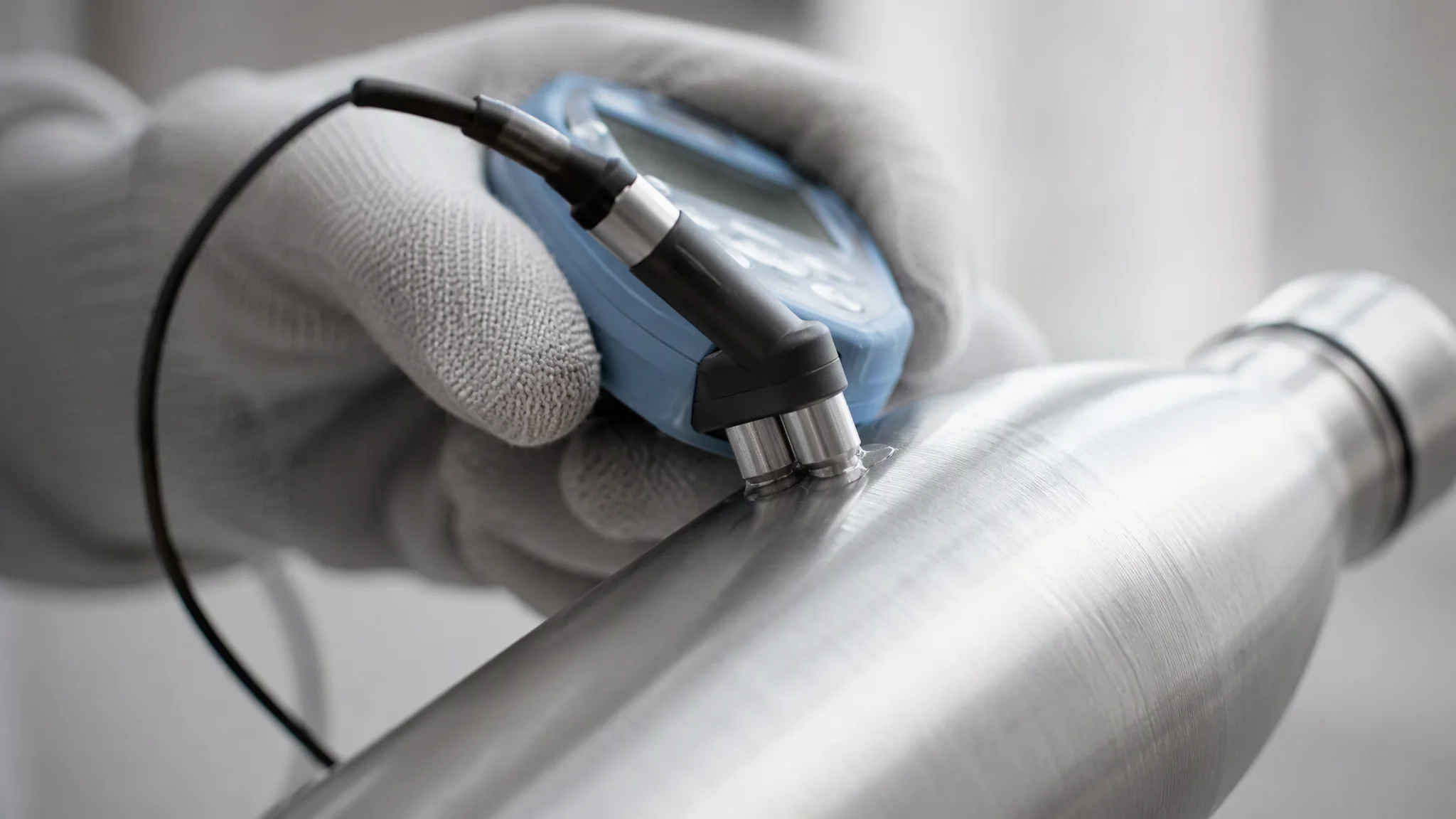
State the number, the tolerance direction, and the measurement method. “0.45 mm” is not a specification. “0.45 mm nominal, 0.42 mm minimum at any point on the body, verified by ultrasonic thickness gauge at four meridians and three heights per bottle” is. Body and base are separate lines; so is the neck. If you specify minimum-only you will pay for steel you may not need; if you specify nominal-only you will receive the bottom of the band.
For calibration on what the number physically means, our engineering note on how thin stainless steel bottle wall can go covers the forming limits behind this field.
3. What does “500 ml” actually mean?
Three conventions are in daily use: brim-full capacity (water to the absolute rim), nominal capacity (to a defined fill line below the rim), and usable capacity (leaving headspace for a lid and for liquid movement). The difference between brim-full and usable on a tapered 500 ml body is commonly in the 30–60 ml range, and it is enough to fail a retail claim. Specify the convention, the fill temperature, and the tolerance (a common one is ±3%). If your market requires an e-mark or a stated net content, the convention has to match the regulatory definition, not the factory’s habit.
4. Should you specify finished weight?
Yes, as a band, not a point. Weight is the fastest incoming-goods check you have and the cheapest proxy for steel consumption. “Net weight 320 g ± 8 g, lid included, gasket included” tells you more in ten seconds on a scale than a wall-thickness argument that takes a week. The trap is specifying weight without specifying what is included — a quote can hit the weight by putting the grams into the base instead of the body, which passes the scale and fails the drop test.
5. Which dimensions does the toolmaker actually need?
Overall height with and without lid, maximum diameter, base diameter, mouth internal diameter, thread spec (pitch, starts, engagement length), and the radii at the shoulder and base. A photo is not a drawing. A capacity figure is not a drawing. Send a dimensioned 2D drawing with tolerances and a GD&T datum scheme, plus a STEP file if the factory will cut a new mould. Missing this field is what turns a “quote” into a guess, and it is the reason two factories can quote the same photo at prices that differ by the cost of a mould.
6. How do you specify surface finish without ambiguity?
Separate the substrate finish from any coating. For bare stainless, specify the finish process (mirror polish, brushed, sandblast, electropolished) and, where relevant, a roughness target such as Ra in micrometres measured per a stated instrument and traverse length. For powder coating, specify the chemistry (polyester versus epoxy), the dry film thickness target and range in micrometres, the gloss level, and the adhesion test. “Matt black” describes a photograph, not a surface.
7. Which colour standard and which ΔE?
Name the standard as a physical master or a numbered reference — a Pantone chip is a starting point, not a master, because ink on paper and powder on steel do not match. Then state the colour difference limit, the formula used to compute it, and the measurement geometry. Write it as: “ΔE00 ≤ 2.0 versus approved master plaque, measured with a spectrophotometer at D65/10° observer, SCI mode, 8 mm aperture, calculated per ASTM D2244.” Without the formula and geometry named, two labs can disagree about the same bottle and both be right.
8. What has to be fixed about the logo before quoting?
Process (laser, silkscreen, pad print, water transfer, powder coat plus laser), number of colours, print area in millimetres with a marked-up artwork showing placement, registration tolerance, and artwork file format with fonts converted to outlines. A vector PDF is the default; a JPEG of a logo is a re-drawing project that the factory will either absorb silently or price as a surprise. Print area is where quotes diverge most: a 40 × 60 mm one-colour mark and a 90 × 120 mm four-colour wrap are not the same line item, and neither factory is wrong.

9. Which food-contact compliance applies to lid and gasket?
The bottle body is stainless and largely straightforward; the lid, gasket, and any coated interior are where the paperwork lives. For US market entry, rubber articles intended for repeated use in contact with food are addressed in 21 CFR 177.2600, which sets extractives limits for aqueous and fatty food contact. Ask for the gasket compound identification, the declaration of compliance, and the migration test report — and put the requirement in the RFQ, because the cost of a compliant silicone differs from the cost of an unspecified one, and a quote cannot include what was never asked for.
10. Which performance tests are in scope?
List them explicitly: leak/air-tightness, thermal retention (hot and cold, with the starting temperature, ambient, and elapsed time), drop, lid cycling, handle or loop load, dishwasher cycling, coating adhesion and impact, and any salt-spray requirement. Each test consumes sample bottles and calendar time, and a factory that includes none of them will always look cheaper than one that includes three. The RFQ should state pass/fail criteria, not just the test names, and should say who pays for third-party testing if the buyer wants an external report.
11. Which AQL and which defect classes?
Name the sampling standard (ISO 2859-1 or ANSI/ASQ Z1.4), the inspection level, the AQL for major and minor, and — critically — the defect classification itself. “AQL 2.5” without a class definition is a number with no object; whether a 0.3 mm paint sag is major or minor decides the outcome of the inspection, not the AQL value. This is also the field that determines whether inspection happens at all, in-house or third-party, and at what point in production. Our breakdown of AQL defect classes for drinkware is the reference we use when writing this clause.
12. How many packaging levels are you actually buying?
Enumerate the stack from the bottle outward: protective sleeve or polybag, divider or cavity tray, inner colour box with its material and print, master carton with its board grade and burst or ECT value, carton marking, and pallet pattern with stretch-wrap requirement. Each level has a cost and a cube. Two factories quoting “packed for export” can be a full level apart. Because packaging drives cube, it also drives freight — our note on container loading optimisation for drinkware shows how a carton change moves the landed number without touching the bottle.
13. Which Incoterm and which named place?
An Incoterm without a named place is incomplete and, in a dispute, unenforceable. Write “FOB Ningbo” or “DDP Hamburg, duty and VAT included”, not “FOB” or “CIF”. Then state who pays inland haulage, export clearance, terminal handling, ocean freight, insurance, import clearance, duty, and last-mile. Ask for the export carton dimensions and gross weight on the quote so freight can be recalculated independently — if a factory cannot give you carton cube, its FOB number is half a number.
14. How should tooling and MOQ be structured?
Separate tooling from unit price. A mould cost amortised into the unit price is invisible, non-transferable, and impossible to compare across bidders. Ask for the tooling cost as a standalone line, who owns the tool, whether it is transferable, its expected life in shots, and the maintenance responsibility. State MOQ per colour and per SKU, not just per order, because a 3,000-piece MOQ that resets per colour is a different commercial offer from 3,000 pieces mixed. For new shapes, our cost breakdown for custom mould development explains which tooling lines should appear.
15. How long is the quote good for?
State a validity period and, if steel is a material share of the cost, an index basis. A 30-day quote on a programme with a 120-day lead time is a placeholder, not a price. Ask what happens at expiry — full re-quote, or a formula tied to a published coil index with a stated trigger threshold. Two quotes at the same number with 30-day and 90-day validity are not the same offer, and the difference will surface at purchase order, which is the worst possible moment.
What do these specification gaps look like in measured data?
Three data sets from our own inspection records, 2026. Each is a production process measurement, not a specification commitment, and none of it is a market statistic — it is what the gap between a loose RFQ and a tight one looks like when someone puts an instrument on the product.
How much does wall thickness actually vary inside one lot?
Our inspection records, 2026: n = 120 bottles across 4 SKUs of nominally identical 500 ml double-wall bodies, measured with a calibrated ultrasonic thickness gauge (5 MHz dual-element probe, single-echo mode, glycerin couplant, 0.01 mm display resolution), four meridians × three heights per bottle, against a nominal 0.45 mm body wall in 304 stainless. Expanded measurement uncertainty on this set-up was ±0.02 mm at k = 2. Observed body wall: mean 0.443 mm, 5th–95th percentile 0.421–0.462 mm; base wall 0.52–0.58 mm; 3.4% of individual readings fell below 0.40 mm. Set against a 0.42 mm minimum, that lot is a mixed result — passable in the mean, not passable at the tail. A quote written as “0.45 mm” and a quote written as “0.42 mm minimum” were never the same input.
How far apart can two lots of the same powder colour be?
Our inspection records, 2026: n = 48 coated panels drawn from 6 production lots of the same matt black polyester topcoat, measured with a handheld spectrophotometer in SCI mode, 8 mm aperture, D65 illuminant / 10° observer, against an approved master plaque, with ΔE00 calculated per the practice described in ASTM D2244. Lot-to-lot ΔE00 ranged 0.4 to 1.9; within-lot 95th percentile was 1.1. Our internal acceptance limit for opaque powder topcoat is ΔE00 ≤ 2.0 against master; several of our customers write 1.5. Both are defensible — but a quote that assumes “colour matching included” and a quote that assumes “colour matching to ΔE00 ≤ 1.5 with a master plaque supplied by the buyer” carry different costs, because the second one implies tighter incoming control and more rejected panels.
What do leak and drop failures look like at n = 60?
Our inspection records, 2026: n = 60 finished bottles, two test groups of 30. Leak test per internal SOP: 0.3 bar (30 kPa) internal air pressure, held 60 s, immersed in a water bath, bubble-free required at lid, thread, and base welds — 2 failures, both at the lid thread interface, a 3.3% failure rate in a lot that had already passed a visual check. Drop test per internal SOP written against the drop-orientation and height logic of ASTM D4169, but not a certified D4169 report: 1.2 m onto concrete, six orientations, 59 of 60 passed with one dent at the base radius. The point for RFQ purposes is that both tests sit outside a bare “leak test” scope. A supplier quoting leak-only and a supplier quoting leak plus drop plus lid cycling are quoting different products at the same nominal specification.
Note on these figures: they are internal process data from our own inspection records, published to show measurement method and spread. They are not a specification guarantee, not a warranty term, and not third-party market research. Your lot will have its own distribution.
What should you attach to the RFQ besides the form?
The form carries the numbers; the attachments carry the intent. Five items, in order of how much they change the price.
A dimensioned 2D drawing. PDF, with tolerances, datums, and a revision block. This is the single attachment that removes the most guessing.
A STEP or IGES model if a new mould is possible. It lets the toolmaker quote confidently instead of quoting a risk premium.
A reference sample. A physical bottle says more about finish, lid feel, and weight than any document. Send two if you can — one to keep, one to cut. Label it as a reference for appearance only, or you will be held to it dimensionally.
Forecast and order pattern. Annual volume, first order, reorder cadence, and colour split. A factory prices risk, and uncertainty about volume is risk. Give a 12-month forecast with a clearly labelled confidence level rather than a single annual number that reads as a commitment you cannot make.
Artwork in a production-ready format. Vector, outlined, with the print area and placement marked up, in the colour space the process needs (Pantone references for silkscreen, a physical master for powder).
And the target price — should you disclose it? Usually not in the first round. A disclosed target price stops being a benchmark and becomes an anchor: bidders converge on it, and the quote you receive is a reaction to your number rather than to your specification. Disclose it only in a second round, to a shortlisted supplier, and only after you have the cost breakdown.
How do you normalize quotes that assume different things?
Before you compare, put every quote on one baseline. The mechanics are simple; the discipline is not.
Step 1 — strip the trade term. Convert every quote to a common term, usually FOB the same port, using the supplier’s own freight and clearance figures where given and your forwarder’s estimate where not. Note the assumption next to each converted number so the comparison stays auditable.
Step 2 — add the missing packaging. Where a quote excludes a level you require, add your own cost for that level. Do not silently accept a shallower pack as a cheaper offer.
Step 3 — price the inspection and tests. Add third-party inspection at your standard, and the cost of the tests the low quote omitted.
Step 4 — move tooling out of the unit price. If one bidder amortised a mould and another did not, restate both as unit price excluding tooling plus a separate tooling line.
Step 5 — restate at your volume. Recompute at the quantity you will actually order, not at the quantity that produced the lowest unit price.
| Line | Supplier A | Supplier B | Normalised to |
|---|---|---|---|
| Quoted unit price | as quoted | as quoted | FOB, same port |
| Wall thickness | nominal | minimum | minimum, same value |
| Decoration | 1 colour, 40×60 | 4 colour, 90×120 | your artwork, exactly |
| Packaging levels | 2 | 4 | 4, buyer-specified |
| Inspection | none | AQL 2.5 in-house | AQL 2.5, third-party |
| Tests | leak only | leak + drop | leak + drop + adhesion |
| Tooling | amortised | separate | separate line, buyer-owned |
| Validity | 30 days | 90 days | 90 days, index-linked |
After normalisation, the ranking usually changes. In our own reviews the most common outcome is that the apparent low bid moves to third place once packaging and inspection are added, and the spread across the field compresses by more than half. That compression is the value of the exercise: it means you are now negotiating a real difference rather than an accounting one.
What should a quote contain beyond the unit price?
A unit price is one cell in a table that should have forty. Ask for the breakdown in a fixed template so the rows line up across bidders:
Steel consumption (kilograms per piece, and the coil price basis); body and base forming; welding or seamless drawing; polishing or coating (with DFT and process); decoration (setup plus per-piece, by colour); lid assembly and gasket; leak test and any other in-line test; packaging by level with material and print; master carton and pallet; tooling as a separate line with ownership and life; sample cost and whether it is credited against the first order; MOQ per colour and per SKU; lead time from artwork approval and from deposit, stated separately; payment terms including deposit percentage and balance trigger; inspection arrangement and who bears third-party fees; validity and index basis; and the deviation sheet.
If a supplier cannot fill that template, that is information too — usually that the price was assembled by analogy rather than calculated. On payment structure specifically, our note on OEM payment terms and deposit risk explains why the deposit line belongs in the comparison rather than in the fine print.
Which RFQ mistakes cost the most?
Disclosing the target price in round one. Bidders converge on it. You lose the independent signal about what your specification actually costs, and you can no longer tell whether the target was generous or impossible.
Leaving logo area undefined. Print area and colour count are among the largest decoration variables. A quote built on a 40 × 60 mm one-colour assumption will be re-priced the moment your wrap artwork arrives, and the re-price arrives after you have already told your board who won.
Omitting the packaging level. This is the most common silent gap and it hits twice: once on unit cost, once on freight cube. A quote without carton dimensions cannot even be freighted accurately.
No validity period. Steel moves. A quote without a validity date is an option the supplier has granted itself, not you.
Accepting “AQL 2.5” with no defect definitions. You will discover the definition at inspection, when the argument is expensive and the vessel is booked.
Comparing quotes at different order quantities. Unit price is a function of quantity. A 10,000-piece price compared against a 3,000-piece price is not a comparison, it is a mistake with a spreadsheet attached.
How do you tell whether a supplier actually read your RFQ?
Ask for a deviation sheet. It is a one-page reply in which the supplier restates each of your 15 fields and marks it comply, comply with comment, or deviation, with the deviation written out in their own words. Make it a condition of quotation: no deviation sheet, no quote considered.
Three things happen when you do this. First, the suppliers who skimmed will produce a deviation sheet with fields missing or answered “standard”, and you can see immediately that the quote was assembled from a template. Second, the suppliers who read carefully will flag fields where your own specification is internally inconsistent — a common one is a wall thickness minimum that cannot be met by the forming process at the neck, or a colour tolerance tighter than the powder supplier can hold. That feedback is worth the exercise on its own. Third, the deviation sheets become the technical annex to the purchase order, which means the specification you thought you bought is the specification you can enforce.
Two clarifying questions separate the good replies from the assembled ones: “which field in our RFQ is the largest cost driver in your quote, and why?” and “what would you change in our specification to reduce cost without changing the product our customers see?” A supplier who cannot answer the first has not costed the job. A supplier who answers the second with specifics has.
What does a realistic RFQ-to-quote timeline look like?
For a bottle on an existing mould with existing decoration tooling, a competent factory can return a costed quote inside five to seven working days, and a deviation sheet with it. For a new mould, add two to three weeks: the toolmaker needs the STEP file reviewed and the drawing tolerances confirmed before a mould price means anything. For a new colour on powder coat, add the time to spray and approve a master plaque — a colour cannot be quoted accurately against a Pantone chip alone.
If a quote arrives in 24 hours with no questions, treat it as a budgetary indication, not a bid. The questions are the work. A factory that returns your 15-field RFQ overnight without a single query has either seen a nearly identical programme recently, or has not read it.
Frequently asked questions
How many fields should a drinkware RFQ contain?
Fifteen is a workable number for most programmes: grade, thickness definition, capacity basis, weight, dimensions, finish, colour, logo, compliance, tests, AQL, packaging, Incoterm, tooling/MOQ, and validity. More than twenty and suppliers stop reading carefully; fewer than ten and the gaps get filled with assumptions. The count matters less than whether every field has an answer you could enforce at inspection.
Is it better to send the RFQ to more factories or fewer?
Fewer, with a tighter document. Five well-briefed bidders produce comparable quotes and a real signal. Fifteen bidders produce a wide spread that is mostly noise, plus a lot of quoting effort that nobody pays for. If you need a market read, do it in a separate, clearly labelled budgetary round rather than mixing it into a competitive bid.
Should I include a target price in the RFQ?
Not in the first round. A disclosed target becomes an anchor and bidders converge on it, which destroys the independent information you were trying to buy. Share it in a second round with shortlisted suppliers, after you have cost breakdowns and can see which line the target is stressing.
How do I compare quotes that use different wall thickness conventions?
Restate every quote to a minimum-thickness basis at the same value, at the same measurement points, before comparing. Nominal with a downward tolerance and minimum-at-any-point are different products, and the steel consumption difference is real. If a supplier will not restate, ask for the tolerance band in writing rather than assuming it.
Do I need third-party inspection if the factory has its own QC?
For a first order, usually yes — not because factory QC is dishonest, but because it is measured against the factory’s interpretation of your specification. A third-party inspection against your AQL and your defect definitions closes that interpretation gap. Our factory audit checklist covers what to look at beyond the inspection report itself.
What is a deviation sheet and why should it be mandatory?
It is the supplier’s line-by-line reply to your specification, marking comply, comply with comment, or deviation. It is mandatory because it converts an implicit assumption into an explicit record, and because the suppliers who cannot produce one have told you something useful about how the quote was built.
How long should a drinkware quote stay valid?
Thirty days is common and reasonable for a short programme. For anything with a lead time beyond 60 days, ask for 90 days with an index basis, or a formula with a stated trigger threshold. A quote that expires before your purchase order is issued was never a price.
Can one RFQ cover both a stock bottle and a custom mould?
Yes, but split it into two clearly separated sections with two separate price schedules. A stock-mould quote and a new-mould quote have different cost structures and different risk profiles; mixing them in one table is how a tooling cost ends up invisible inside a unit price.
This article was written by the OEM Water Bottle technical sourcing team, which has spent more than a decade quoting and producing stainless steel drinkware for brand owners, importers, and promotional programmes across North America and Europe. We run our own incoming inspection, in-line leak testing, and colour control, and we quote against customer RFQs of this shape every week — including the ones with gaps in them. Our approach here is deliberately procedural: every quantitative figure in this article comes from our own 2026 inspection records, with the instrument, sample size, and standard named so a buyer can challenge or reproduce it. We have not used market-size or growth estimates anywhere in this document, because those numbers cannot be verified at the level of a single purchase order.