Last updated: November 1, 2026
If you import stainless steel tumblers and bottles into the United States and sell them under your own brand, the retail carton around that tumbler is now a regulated product in its own right. Not the bottle — the carton. The molded pulp cradle, the poly bag, the PET window, the hang tag, the shrink band, the corrugated shipper. Seven US states have now passed packaging extended producer responsibility (EPR) laws, and the obligation they create does not sit with the factory that prints your carton. It sits with you.
This is the part that most sourcing teams discover late, usually when a PRO invoice arrives or a retailer sends a compliance questionnaire with a deadline attached. This article answers the four questions a B2B buyer actually asks: does this law reach me, when do I have to register, what does it cost per unit, and how do I take that cost back out of the packaging specification before it compounds. Everything below is written for the specific case of a drinkware SKU — a 20 oz to 40 oz tumbler or bottle in a printed folding carton, packed in a corrugated shipper, sold direct-to-consumer or through a retail chain.
TL;DR — Do You Need to Register in 2026?
The short answer: probably yes, and the deadline is not the one your freight forwarder will warn you about.
- If you are the brand on the carton (you own the artwork, you own the Amazon listing, you take title to the goods) you are almost certainly the “producer” in the EPR sense — the party that first sells or imports the packaged product into the state. Your Chinese or Vietnamese factory is a supplier, not a producer.
- If you are the importer of record but not the brand, the obligation can split or land on you depending on the state’s definition and your contract. Assume it is yours until a lawyer reads the statute for your specific flow.
- Registration is already live in at least four states and reporting clocks are running in three more. Missing a data deadline is a cheaper problem than missing a registration deadline, but both are avoidable.
- Per-unit cost is small; per-SKU cost is not. A carton-level fee is typically measured in cents per unit, but it multiplies across every size, every colourway and every channel — and it recurs annually, indexed to a fee schedule you do not control.
- The controllable lever is packaging weight and material mix, both of which are decided on the factory floor, in the spec sheet, months before the fee is invoiced. That is where the money is.
One framing sentence is worth memorising, because it changes how you negotiate: EPR fees are assessed on packaging placed on the market, by weight and by material — not on packaging purchased. You cannot buy your way out of them with a bigger order, and you cannot ask a factory to “absorb the EPR cost” in a way that removes the legal obligation. The obligation stays with the entity named in the statute. What a factory can do is help you reduce the weight and improve the material mix that the fee is calculated on.
Who Counts as the “Producer” of a Tumbler Carton?
Every one of the seven state programs uses a version of the same definition: the producer is the person who sells, offers for sale, distributes or imports the covered packaging into the state, usually qualified by who owns the brand or who first introduces the packaged product. California’s statute places the duty on “producers of covered material sold, offered for sale, imported, or distributed in the state,” and requires each producer to either participate in an approved PRO plan or comply individually (California Public Resources Code, Division 30, Part 3, Chapter 3, Article 2). Maine’s program rule phrases it as the party that supplies packaging material “in or into” the state (Maine DEP, Stewardship Program for Packaging, 2026).
Four ownership patterns decide where the obligation lands for a drinkware SKU:
| Flow | Who is the producer | What the factory can carry |
|---|---|---|
| You own the brand, you are importer of record | You | Weight reduction, material substitution, packaging data |
| US distributor owns the brand, you manufacture for them | The distributor | Packaging data packs, design-for-recycling changes |
| You sell blank/white-label into a retailer’s private label | Usually the retailer as brand owner — confirm in writing | Nothing contractual unless you agree to it |
| Amazon FBA with your brand on the carton | You, for the retail carton and any poly bagging | SIOC-compliant primary pack, less material per unit |
Note the asymmetry in the last column. A factory can make packaging lighter, swap a PVC window for a paperboard cut-out, or move a pulp cradle to a folded paperboard fitment. A factory cannot register as a producer on your behalf, cannot file your supply data, and cannot indemnify you against a state penalty — the registration is tied to a legal entity selling into that jurisdiction, and that entity is yours.
This is also why “just add 2% to the FOB and cover the EPR thing” is a bad clause. It moves cash, not liability. The state will still look for the brand owner, and you will still be the one answering a data request in March.
Which Seven States Now Have Packaging EPR, and When Do the Actions Land?
The table below is built only from state agency pages and PRO publications that were live and readable as of November 1, 2026. Where a program is still in rulemaking, the table says so rather than implying a fee is already being charged.
| State / law | Where the program stands | Action that concerns a drinkware brand |
|---|---|---|
| California — SB 54 (2022) | Permanent regulations approved by the Office of Administrative Law and filed with the Secretary of State on May 1, 2026; CAA approved as the first PRO; CAA’s producer responsibility plan received by CalRecycle October 13, 2026, with a 75-day review window | Producer must be an approved participant of a PRO plan, or compliant individually, before selling covered material into the state; source-reduction and recycling-rate obligations step up in 2027, 2028, 2030 and 2032 |
| Oregon — Recycling Modernization Act | DEQ approved CAA’s program plan on February 21, 2025; program launched in July 2025 as the first producer-funded paper and packaging program in the country; 2027 producer fee schedule published | Fees are already being invoiced; annual supply reporting by material category |
| Colorado — HB22-1355 (2022) | Producer registration deadline October 1, 2024; supply data due July 31, 2025; CDPHE approved CAA’s final plan December 9, 2025; producers remit dues to CAA on or before January 1, 2026; implementation began early 2026 | Dues already payable; de minimis small-producer exemption is indexed annually to CPI |
| Maine — LD 1541 (2021), 38 M.R.S. § 2146 | Rule Chapter 428 adopted December 2024 and amended March 2026 to add Appendix A (Packaging Material Types List); program is at the “contract a stewardship organization” step, with the schedule being reassessed | Registration is triggered within 90 days of the registration mechanism becoming available; annual report due May 31, invoiced July 1, payment September 1 |
| Maryland — SB 901 (2025) | Signed May 13, 2025; program rules effective May 25, 2026; producers must register with CAA and file simplified reporting by May 31, 2026; producer responsibility plan due July 1, 2028 | Registration and reporting now; producer cost reimbursement begins July 1, 2028 |
| Minnesota — Packaging Waste and Cost Reduction Act, Minn. Stat. § 115A.144 | MPCA confirmed CAA’s registration February 18, 2025; producers required to be PRO members by July 1, 2025; first annual registration including producer and brand list due July 1, 2026; needs assessment due December 31, 2026 | Registration and brand-level disclosure now; producer funding obligation starts February 1, 2029 at no less than 50% of net costs, rising to 75% in 2030 and 90% in 2031 |
| Washington | Department of Ecology announced CAA as the state’s PRO on March 4, 2026 | Program build-out in progress; producer obligations follow the PRO plan, so this is the year to get packaging data clean rather than to file |
Sources for the table: CalRecycle SB 54 program page, CAA Oregon, CAA Colorado, Maine DEP, CAA Maryland, CAA Minnesota, CAA Washington.
Two patterns are worth reading out of that table. First, the states are not synchronized: Oregon is collecting, Colorado is collecting, California is in the gap between regulation-effective and plan-approved, and Maine, Maryland, Minnesota and Washington are at four different stages of build-out. A single “EPR is coming in 2027” line in a sourcing plan is wrong in both directions — too late for Oregon and Colorado, too early for Minnesota fees.
Second, the earliest obligation in every state is data, not money. Registration asks you to describe your packaging by material and weight; reporting asks you to keep doing it annually. A drinkware brand with 40 SKUs across four sizes and three finishes typically has 40 to 120 distinct packaging configurations once you count carton, insert, bag, tag and shipper as separate line items. Building that bill of materials once, correctly, is the difference between a two-hour filing and a two-month archaeology project.
Are You Exempt? The Threshold Table That Decides Half Your Workload
Before you budget a single dollar for fees, check whether the law reaches you at all. Every one of these programs carries a small-producer exemption, but the thresholds are built on two completely different bases — revenue and tonnage — and drinkware brands get caught by the tonnage test far more often than they expect.
| State | Exemption test (compiled October 2026) | What it means for a 100,000-unit program |
|---|---|---|
| California | Small-producer route at roughly $1 million in California gross sales | The lowest bar of the seven. Most branded drinkware programs cross it; a single regional test launch may not |
| Oregon | Producers below roughly $5 million in global annual revenue | You are measured on global revenue, not Oregon revenue — a European brand with small US volumes still counts |
| Colorado | Roughly $5 million global revenue, de minimis figure indexed annually to CPI | The number moves every year; the exemption you qualified for in 2025 is not a permanent status |
| Maine | Under $2 million in-state revenue (a higher temporary threshold applies in the early program years), or under one ton of covered packaging per year | The tonnage limb is the trap — see the arithmetic below |
| Minnesota | Under $2 million global revenue, or under one ton of packaging annually | Same tonnage trap, and no fees are being invoiced yet — but registration and brand disclosure already are |
| Maryland / Washington | Set in each state’s rules; both are earlier in build-out than Oregon or Colorado | Read the rule, not the summary blog you found — thresholds in new programs are still being finalized |
Thresholds above are compiled from state agency and PRO material available as of October 2026 and are summarised by a third-party state comparison published on 24 October 2026 (Packaura, “Packaging EPR Laws Compared,” October 2026). Treat them as a screening tool, not a legal opinion: exemption figures are indexed, amended and, in at least one state, still being rewritten.
Now the tonnage arithmetic, because it is the part almost nobody models. One short ton is 907 kilograms. If a 40 oz tumbler ships in a retail carton with a molded pulp cradle and a poly bag totalling 160 grams of packaging, then one ton is reached at roughly 5,670 units per year (907 kg ÷ 0.16 kg). A brand doing 100,000 units a year is at 16 tonnes of packaging — roughly sixteen times the “small producer” tonnage line in Maine and Minnesota. In other words: if you sell drinkware at any meaningful scale, the tonnage exemption is not a shelter, it is an illusion.
The same arithmetic explains why the packaging bill of materials matters more than the revenue line on your tax return. Tonnage is a physical fact you can measure, forecast and reduce. Revenue is a lagging indicator you cannot negotiate with.
How Is the Fee Actually Calculated on a Tumbler Carton?
Strip away the paperwork and the formula in every one of these programs is the same shape:
Annual fee ≈ Σ (kilograms of material placed on market × material rate) × eco-modulation factor + program administration
Four inputs decide the number: how much your packaging weighs, what it is made of, whether that material is recyclable in the state’s system, and how much of the program’s collection cost your material class is asked to carry. Only the first two are under your direct control from a factory spec sheet.
Two mechanics catch importers off guard. First, eco-modulation: a gram of polypropylene film and a gram of printed paperboard are not billed at the same rate, because one is recovered in the state’s system and the other contaminates it. Rates published by PROs and state programs for 2026 diverge by an order of magnitude between readily recyclable fibre and hard-to-recycle multilayer plastic. That divergence is the whole reason a packaging change can be worth more than a price negotiation.
Second, the minimum invoice. Material fees on 16 tonnes of light packaging are not large in absolute terms. The administrative layer around them — PRO membership minimums, per-state reporting effort, consultant hours, internal data assembly — often exceeds the material fee itself for a mid-sized brand. Budget the admin line first; it is the number that surprises finance.
Here is an illustrative model. Every input below is an assumption, deliberately round, so you can see the mechanics and then replace the inputs with your own rate card. None of these figures are a quotation of any state’s current schedule.
| Line | Current pack | Lightweighted pack |
|---|---|---|
| Retail carton (paperboard) | 120 g | 95 g, window removed |
| Molded pulp cradle | 30 g | 22 g folded paperboard fitment |
| Poly bag | 8 g | 0 g, paper belly band |
| Hang tag + string | 2 g | 0 g, printed on carton |
| Total per unit | 160 g | 117 g |
| Tonnage at 100,000 units | 16.0 t | 11.7 t |
| Fee at an assumed $0.05/lb blended rate | ≈ $1,760 | ≈ $1,290 |
| Annual saving | — | ≈ $470 plus freight and material savings |
Read that table honestly, because it contains the most useful conclusion in this article: the fee itself is not the reason to act. A saving in the hundreds of dollars does not justify a packaging redesign. The reasons to act are the ones stacked around it. A lighter carton cuts corrugated volume in the container, which cuts ocean freight and duty-assist exposure. A mono-material pack removes a recyclability penalty and answers the retailer questionnaire your buyer will send in Q1. And a measured packaging BOM is the same data set you will need for EU packaging rules, which are stricter than anything in the US today. The fee is a symptom; the specification is the disease.
Which Layers of a Drinkware Pack Get Counted — and Where Is the Leverage?
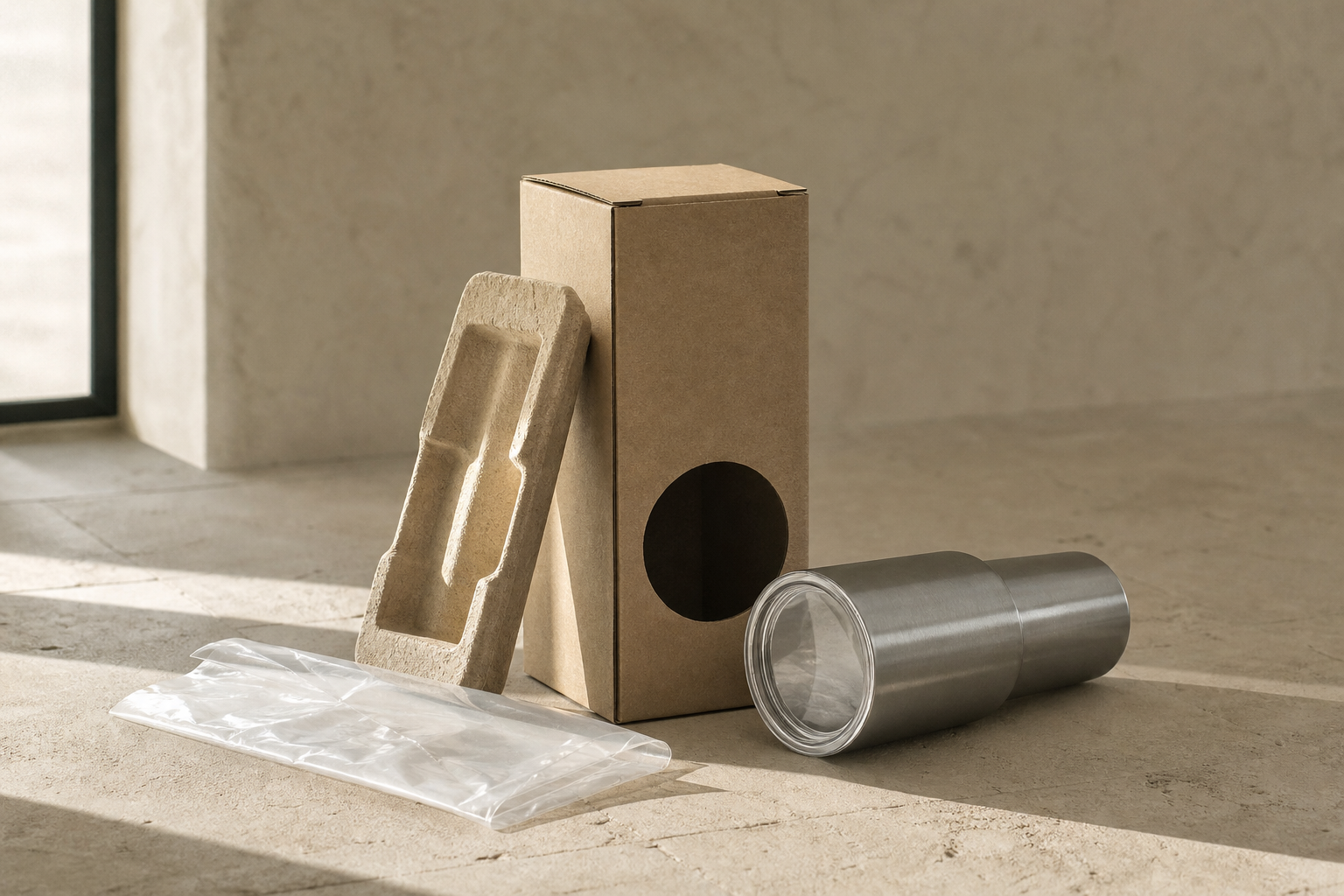
Most sourcing managers discover, halfway through their first registration, that “packaging” means every component that touches the product or carries the brand, not just the box. For a typical retail-ready tumbler SKU, the bill of packaging looks like this:
| Layer | Typical material | Reduction lever you can specify |
|---|---|---|
| Primary carton | Coated paperboard, often with a plastic window | Drop one caliper step; replace window with a die-cut aperture; strip lamination where print quality allows |
| Product cradle / insert | Molded pulp, EVA foam, or folded board | Folded board fitment instead of pulp; delete foam entirely if the bottle is stable in carton |
| Protective bag | PE or PP film | Paper band, or no bag where the carton already seals and the finish resists scuffing |
| Window film | PET or PVC | Eliminate — PVC in particular is the worst-rated material class in every program |
| Hang tag, string, sticker | Paper, cotton, vinyl | Print on the carton; move care instructions to a QR code on the base |
| Shrink band / tamper seal | PVC or PET shrink | Paper safety seal where the lid geometry allows |
| Shipper | Corrugated, void fill, tape, labels | Right-size the case; delete void fill by re-cutting the divider; move to a self-seal mailer for DTC |

Where do the grams actually sit? In our experience quoting drinkware programs, the primary carton is normally the single heaviest packaging component per unit, with the shipper a close second on a volumetric basis — which is why carton caliper and case-packing geometry, not bag thickness, are where a lightweighting project should start. This is a structural observation, not a billing prediction: measure your own pack before you act on it.

The measurement method matters more than the spreadsheet. Weigh ten units per SKU on a 1-gram-resolution scale, component by component, tare each container, and record the average and the spread. Ten units catches the caliper variation that a single sample hides. Repeat the exercise after any supplier change, any material substitution and any print-method change, because the EPR fee is assessed on what actually shipped, not on what the artwork file said. Keep those sheets for at least five years: they are your defence if a state or a PRO questions a reported figure, and they are the input for every packaging decision you make for the next half-decade.
How Does US Packaging EPR Differ From the EU Rules You Already Model?
The two regimes are often lumped together in compliance decks, which is a mistake. The US model is a funding system: producers pay for collection and processing, and in six of the seven states there is no binding design mandate on your carton. California is the exception, with statutory source-reduction and recycling-rate targets that step up through 2032. The EU model is a design and information system: recyclability requirements, harmonised labelling, minimum recycled content, and a digital product passport attached to the product itself. Different obligations, different deadlines, different enforcement.
What they share is the input: a per-SKU inventory of materials and weights. Build it once, to a standard your finance team can audit, and both compliance files get cheaper. If you have not yet mapped the EU side, our breakdown of GPSR and PPWR requirements for stainless steel drinkware is the companion piece to this one — the packaging data you assemble for a US PRO registration drops straight into a PPWR conformity file.
Which Contract Clauses Move the EPR Risk Off Your Balance Sheet?
You cannot contract your way out of a statutory obligation, but you can contract your way out of the two things that actually cost money: bad data and unannounced packaging changes. Five clauses do most of the work, and all five belong in the same section of the supply agreement as your quality terms.
1. A packaging data sheet per SKU, as a deliverable. Not a picture, not a PDF of the artwork. A line-item table: component name, material and grade, supplier, unit weight in grams with tolerance, print method, and whether the component is recycled or virgin content. Make it a condition of pre-production sign-off, so no run ships without it. Every downstream obligation — registration, annual reporting, the retailer questionnaire, the EU file — consumes this sheet.
2. Change notification, in writing, with lead time. Material substitutions happen quietly: a carton caliper drops a step because the mill was short, a pulp cradle becomes foam, a PE bag becomes thinner. Any of those changes alters your reported tonnage and can breach a packaging commitment you made to a retailer. A 30-day written notification clause with a right of rejection costs nothing to negotiate and closes the most common audit gap we see.
3. Explicit allocation of the statutory obligation. State in the contract that registration, reporting and payment of packaging EPR fees are the buyer’s responsibility, and that the supplier’s obligation is limited to the accuracy of the data it provides. The reverse clause — a supplier promising to “handle EPR compliance” — is worthless: it has no legal personality in the state, cannot register, and cannot absorb a penalty assessed on your entity. Vague language here creates a false sense of coverage, which is worse than no clause at all.
4. A lightweighting review, annually. One page, once a year: the three heaviest components per SKU, the material alternatives tested, and the cost and weight impact of each. This converts packaging EPR from an annual surprise into a slow, predictable improvement curve, and it produces exactly the documentation that sustainability questionnaires ask for.
5. Records and audit rights. Five-year retention of packaging weights and material declarations, plus the right to re-weigh at your own cost. When a PRO’s invoice is challenged — or when you are challenged — the party holding the scale data wins the argument.
Two of these clauses interact with retail compliance in ways worth flagging. If your channel includes big-box or marketplace programmes with their own packaging requirements, the same specification work serves both files; our guide to retail-ready packaging and drop-test compliance covers the physical test side that EPR does not touch.
How Do You Rebuild the Landed-Cost Model Without Overreacting?
The temptation is to add one blended “EPR” percentage to every SKU and move on. That produces a number finance cannot defend and a sourcing team that cannot act on it. Build four lines instead:
- Material fee, per SKU per state. Weight in kilograms × your best current rate assumption × the number of units you expect to place on that state’s market. Keep the rate in one cell so it can be updated when the schedule changes.
- Program administration, annual. Membership minimums, reporting hours at a loaded labour rate, and any external help. This line is fixed, so it dilutes with volume and punishes long-tail SKUs — which is itself a useful portfolio signal.
- Packaging change cost, one-off. New cutting dies, print plates, and qualification runs. Amortise over the remaining life of the SKU, not over one order.
- Exposure reserve. A modest contingency for rate increases and for the state that adds a fee earlier than your model assumed. Rates are set annually by bodies you do not sit on.
Then stress-test it once. Double the material rate assumption and confirm the result is still immaterial to your gross margin. For most drinkware programmes it will be — a few cents per unit at worst. That conclusion is worth having in writing, because it stops the topic from absorbing management attention it does not deserve, and it redirects that attention to the two things that do move money: packaging weight and channel mix. Run the review in the same quarter every year, ideally ahead of the season when PROs publish the next schedule.
What Are the Most Common Mistakes Buyers Make?
- Assuming the factory is the producer. It is not, in any of the seven states. The registration is tied to the entity selling into the jurisdiction.
- Treating seven states as one deadline. Oregon has been invoicing since 2025, Colorado since early 2026, California’s rules took effect in May 2026, Minnesota’s fees are years out, and Maine’s administrator search has been the slowest of the group. One calendar entry will be wrong in six places.
- Ignoring the tonnage limb of the exemption. A brand doing 100,000 units sits at roughly sixteen tonnes of packaging. The “under one ton” language reads like a shelter and is not.
- Forgetting marketplace packaging. Poly bags, mailer boxes and inserts used for e-commerce fulfilment are packaging too, and they are frequently specified by a fulfilment provider rather than by your factory — so nobody puts them in the BOM.
- Confusing registration with compliance. Registration is a one-time act; reporting is annual forever, and the data quality bar rises each cycle.
- Waiting for a letter. Oregon publishes a noncompliance registry. Being named on it is a commercial problem with retailers long before it is a legal one.
Frequently Asked Questions
Does US packaging EPR apply to a brand that only sells on Amazon?
In most cases yes. These laws are triggered by selling or distributing covered packaging into a state, not by the channel you sell through. If your brand is on the carton and you are the importer or seller of record, you are the producer — and the poly bagging and mailer your fulfilment provider adds is packaging placed on the market too. Confirm the exemption threshold for each state before you conclude you are out of scope.
Can my Chinese supplier register as the producer on my behalf?
No. Registration attaches to a legal entity selling into the jurisdiction, and the statutes place the duty on the producer — normally the brand owner or importer. A factory can supply the packaging data, reduce weight and change materials, but it cannot register, file or absorb a penalty assessed on your entity. Any contract clause implying otherwise should be rewritten.
Is the fee based on the packaging I buy or the packaging I sell?
On packaging placed on the market — effectively what you sell or distribute into the state in a reporting year, measured by material and weight. Stock sitting in a warehouse is not the trigger; units sold or distributed are. This is why over-ordering does not reduce the obligation and why accurate sales-by-state data matters more than purchase records.
What happens if I miss a registration or reporting deadline?
Consequences vary by state and range from administrative fees and corrected filings to civil penalties, and at least one state maintains a public noncompliance registry. The practical risk usually arrives earlier through retail: a buyer’s compliance team sees a gap on a supplier questionnaire and escalates long before an agency does. Treat the state deadlines as hard dates and the retailer questionnaire as the real enforcement.
Does the stainless steel bottle itself count as packaging?
No. These programmes cover packaging and paper products — cartons, inserts, bags, film, tags, shippers. The bottle is the product. Product-level regimes (chemical restrictions, material declarations, digital product passports) are separate files with separate evidence, which is why the material and coating documentation you already hold for EU purposes stays relevant here.
If I ship in bulk to a US warehouse that packs for me, who is the producer?
It depends on who places the packaged product on the market, and it is exactly the kind of split that should be written down rather than assumed. If the third party owns the packaging specification and sells the finished pack under its own brand, the obligation may sit with them; if you own the brand and they merely fulfil, it probably sits with you. Put the answer in the fulfilment agreement, with the packaging data obligation attached to it.
Do I need a separate registration in every state?
Yes, in substance. A single PRO administers several of these programmes, so one relationship can cover multiple filings, but each state keeps its own deadlines, data formats, fee schedule and exemptions. Budget one registration per state and one annual reporting cycle per state, and keep a single source of truth for the underlying packaging weights so the filings cannot drift apart.
How long should I keep packaging weight records?
Five years is a sensible working standard: it covers audit cycles, amended filings and the warranty horizon on most retail programmes. Keep the raw scale sheets, not just the summary, because the component-level spread is what proves a reported average was measured rather than estimated.

About the author
Written by the OEM Water Bottle Sourcing Team, a stainless steel drinkware manufacturer serving brand owners and importers in North America and Europe. Our engineering and packaging teams support customers through specification, sampling, production and the packaging documentation that US state programmes and EU rules now require. This article is operational guidance, not legal advice; programme dates, thresholds and fee schedules change, and the governing state agency or PRO publication always prevails over any summary, including this one.