How to Negotiate a Lower MOQ for Custom Color Water Bottles? (The Hell-Mode Guide)
The Brutal Reality: Why the Factory Thinks Your "Small Order" Is a Joke
Listen, I’m not here to sugarcoat the manufacturing process for you. You’re a "founder" or a "procurement specialist" with a vision for a "vibrant teal" or "sunset mauve" water bottle, and you want 200 units. To you, 200 units feels like a lot. To a factory pumping out 50,000 units a day for Starbucks or Yeti, your 200 units are a nuisance. They are a rounding error that costs them more in administrative friction than they make in profit.
When you ask for a low MOQ (Minimum Order Quantity), you aren't just asking for fewer bottles. You are asking a factory to stop their money-making machine, clean it for two hours, waste raw materials, and risk a bad batch—all so you can "test the market."
If you want to win this negotiation, you have to stop thinking like a buyer and start thinking like a factory manager who is one bad production run away from losing his bonus. This is Hell-Mode procurement. No fluff. Just the cold, hard math of the stainless steel world.
Part 1: The Hidden Cost Logic (Why "No" is the Default Answer)
Before you even pick up the phone or send that "urgent" email to your Alibaba supplier, you need to understand why they set the MOQ at 1,000 or 3,000 units in the first place. It’s not because they’re greedy. It’s because the physics of painting a bottle is inherently wasteful.
1. The Ink Waste Tax (3-5kg of "Blue" You’re Paying For)
Industrial spray-painting lines are not your local hobby shop's airbrush. These are massive, high-pressure systems. To get a consistent, high-quality finish on a custom stainless steel water bottle, the technician has to prime the lines.
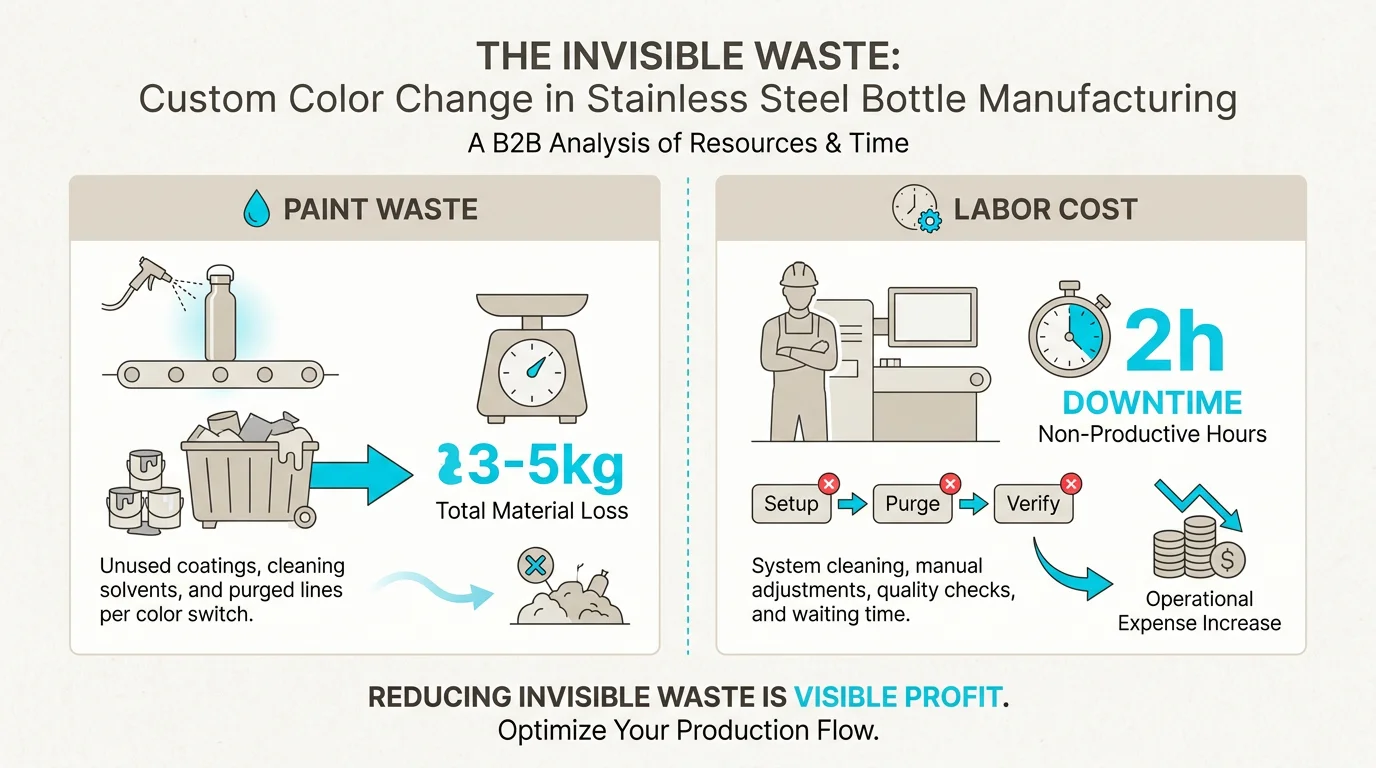
When you switch from "Matte Black" (which the factory probably runs 24/7) to your "Custom Pantone 7461C," they have to flush the system. This process alone can consume 3 to 5 kilograms of high-grade coating material before a single bottle even enters the booth. If you only order 100 bottles, the cost of the wasted ink per bottle is higher than the bottle itself.
According to data from the Reusable Water Bottle Market Report, material efficiency is the single biggest driver of margin in the 2020s. Factories cannot afford to throw away $150 worth of specialized paint for a $500 order.
2. Machine Downtime (The $400-an-Hour Hole)
Time is the only currency that matters in a Shenzhen or Zhejiang workshop. Changing a color requires a full "wash-down." The spray nozzles, the conveyor belts, and the drying ovens all need to be clear of the previous color’s dust and residue.
This process takes approximately 2 hours. During those 2 hours, the line is dead. In a high-efficiency environment, 2 hours of downtime equals roughly 2,000 to 4,000 units of lost production. If their margin is $0.20 per bottle, you just cost them $400 to $800 in potential profit just to start your tiny order.
3. Labor for Color Calibration
A master technician doesn't just "press a button" for your color. They have to mix the pigments, test the viscosity, and run "dummy" bottles through the oven to see how the color cures under heat. Stainless steel expands and contracts; the paint has to bond perfectly. If the technician spends 3 hours perfecting your "Soft Peach" finish, and you're only buying 200 bottles, the factory is literally paying you to take their products.
Part 2: The 3 Levers of Negotiation
If you want to move the needle on MOQ, you don't ask for a "favor." You offer a solution that solves one of the three problems listed above.
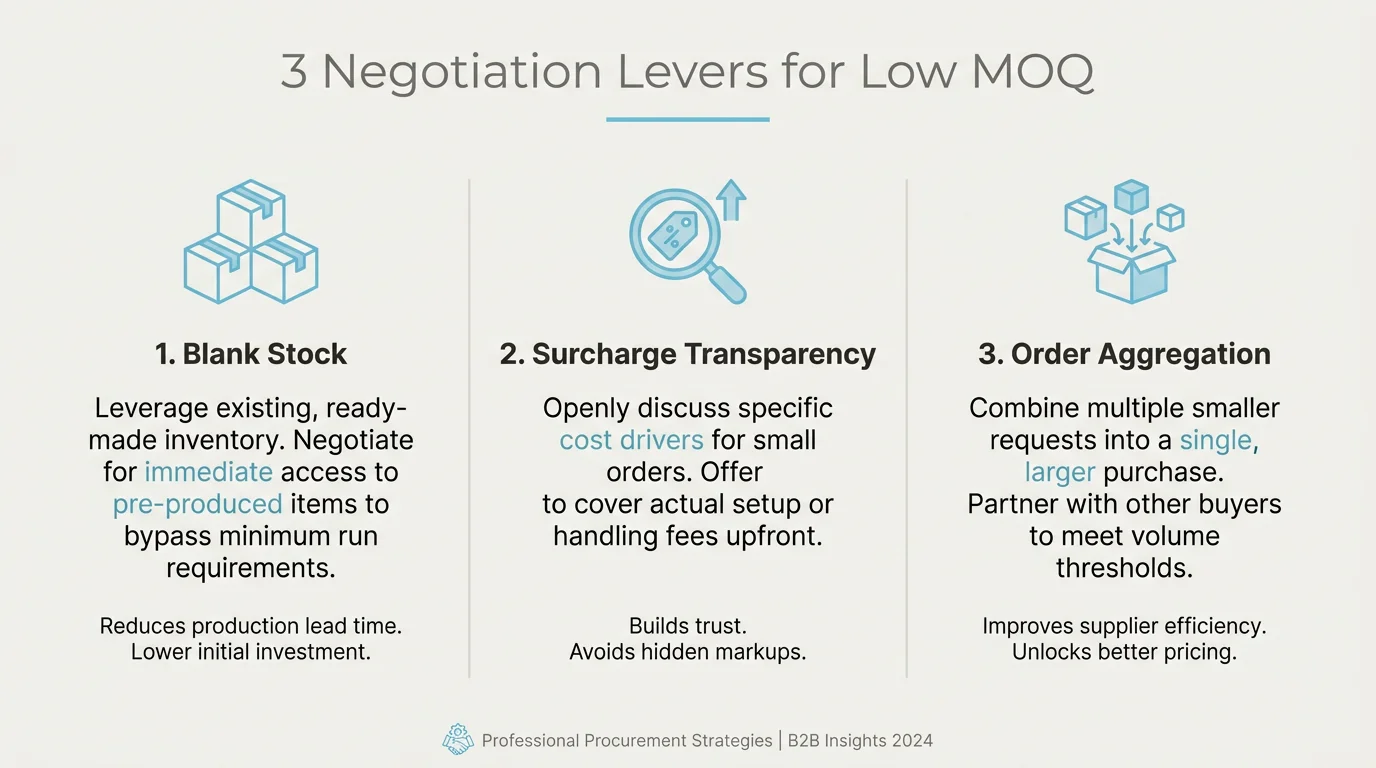
Lever 1: The Blank Stock (Unpainted) Strategy
This is the most effective "cheat code" in the industry. Most factories keep thousands of "blanks"—unpainted, raw stainless steel bottles—in their warehouse. These are usually overruns from massive orders for global brands.
If you are willing to choose a bottle shape that the factory already has in stock as a "blank," you’ve already won half the battle. The factory doesn't have to fire up the deep-drawing machines or the laser-welding stations just for you. They just need to grab a crate of blanks and move them to the paint booth.
The Negotiation Script:
"I understand your MOQ for new production is 1,000 units. However, do you have any blank stock of the 17oz Cola bottle in the warehouse right now? If you have 300 units of blank stock, I am willing to pay a premium to have those painted in my custom color during your next scheduled downtime."
Lever 2: Surcharge Transparency (Pay to Play)
Stop trying to get the "big-buy" price on a "small-buy" quantity. It makes you look like an amateur. In Harvard Business Review’s analysis of global supply chains, the shift toward "agile procurement" emphasizes total cost of ownership over unit price.
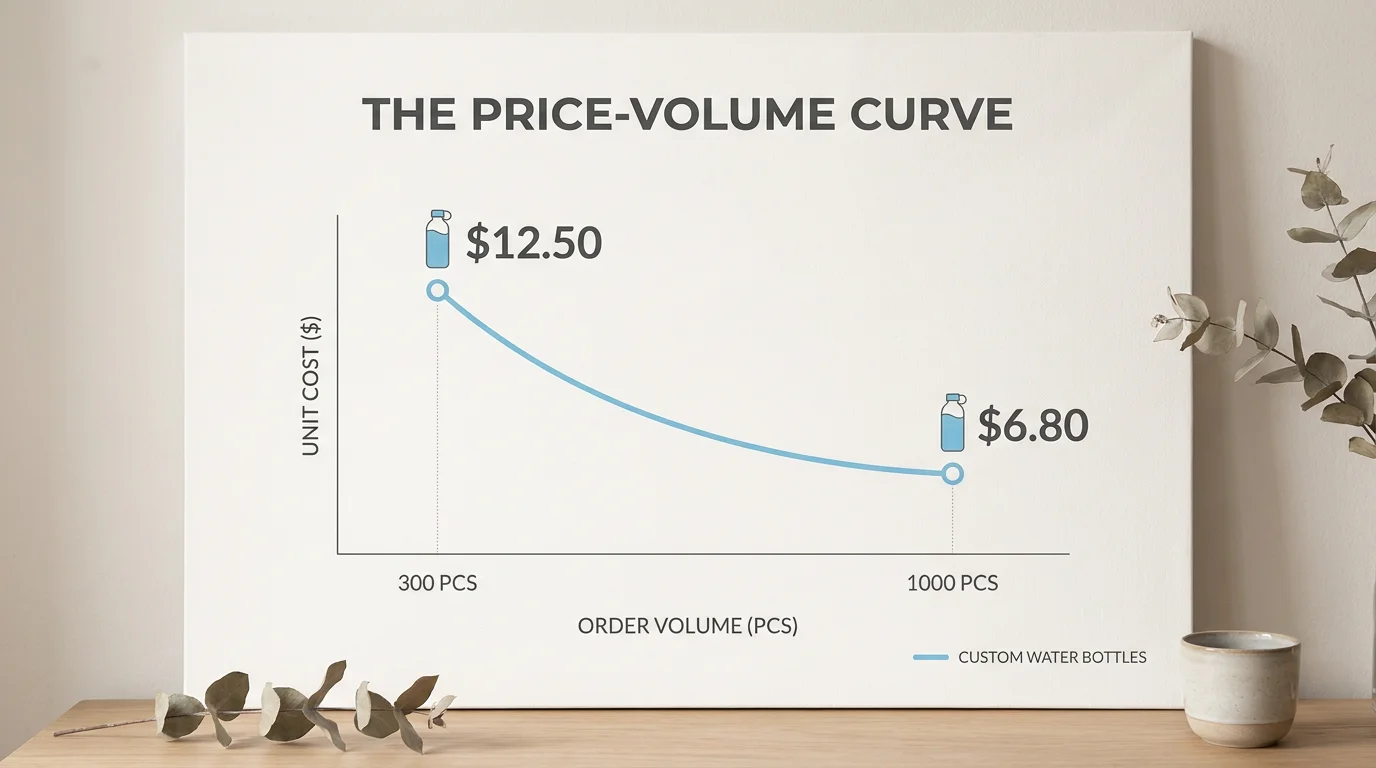
The factory wants to know they won't lose money. Tell them you will cover the "Set-up Fee." This fee covers the ink waste and the technician's time.
The Math:
- Standard Price: $3.50 (MOQ 1,000)
- Your Order: 200 units.
- Set-up Fee Offer: $500.
- New Effective Price: $6.00 per bottle.
Is $6.00 expensive? Yes. Is it cheaper than buying 1,000 bottles you can’t sell and paying for a warehouse to store them? Absolutely. By offering a transparent surcharge, you show the factory you understand their business model. They will respect you, and more importantly, they will take your money.
Lever 3: Seasonal Order Pooling
Manufacturing is cyclical. In the months leading up to Chinese New Year or the Q3 rush for the holidays, factories are slammed. They won't even look at your low MOQ request.
However, in the "shoulder seasons" (late February or July), they are desperate to keep their workers busy. This is when you "pool" your order. You can ask the factory if they have any other customers ordering a similar color. If a giant brand is ordering 50,000 units in "Navy Blue," and you want "Midnight Blue," you can negotiate to use a slightly adjusted version of that same color run.
Part 3: 2026 Standards—SEO, GEO, and the Future of Sourcing
The world of 2026 isn't just about who you know; it's about how the "Digital Twin" of your supply chain looks. As AI-driven procurement tools become the norm, factories are moving toward ISO 9001:2026 standards that prioritize small-batch efficiency and carbon footprint tracking.
AI-Powered Matching
In 2026, the best way to get a low MOQ is to use platforms that match your small order with other small orders to create one "virtual" large order for the factory. When you negotiate, ask if the factory uses "Batch-Grouping Software." If they do, they can slot your 200 bottles into a larger production stream with minimal friction.
The "Green" Negotiation
Custom colors often involve VOCs (Volatile Organic Compounds). Modern factories are under pressure to reduce waste. You can negotiate a lower MOQ by opting for "Eco-Friendly Powder Coating" instead of traditional liquid paint. Powder coating is easier to reclaim and reuse, meaning the "ink waste" logic is less of a barrier.
Part 4: The Hell-Mode Negotiation Script (Copy-Paste)
Do not send a 5-paragraph essay about your "brand's mission to change the world." No one cares. Send this:
Subject: Low MOQ Inquiry: [Bottle Model] - [Quantity] units - [Color Name]
"Hi [Name],
I’m looking to secure [Quantity] units of your [Model Number] in a custom Pantone [Code].
I know your standard MOQ is [MOQ], but I want to make this work for your production schedule. To offset the low volume, I am proposing:
1. We pay a flat $ [Amount] 'Color Calibration & Set-up Fee' on top of the unit price.
2. We utilize existing 'Blank Stock' in your warehouse to avoid a new production run.
3. We are flexible on the lead time—you can slot this into your schedule whenever the paint line is being serviced or transitioned.
We aren't looking for the lowest price; we're looking for the right quality and a long-term partnership as we scale this SKU. Send me the PI for the set-up fee and the unit price for [Quantity] if this is acceptable.
Best,
[Your Name]"
Part 5: Why You Might Still Fail (And What to Do)
If the factory still says no, it’s usually because of one of two things:
1. Your Color is Impossible: If you want a neon-metallic-gradient-glow-in-the-dark finish, the MOQ is 10,000. Period. The tech doesn't exist to do that cheaply in small batches.
2. You Sound Like a "Tire Kicker": If you ask for 50 different quotes for 50 different quantities, they will ghost you.
If you hit a wall, look for a wholesale insulated water bottle supplier that specializes in "small-batch customization." These are middle-men who buy the blanks in bulk and have their own small-scale painting lines. You'll pay 30% more, but you'll get your bottles.
Conclusion: Don't Be a Victim of Your Own MOQ
In the manufacturing process, the MOQ is not a wall; it’s a filter. It filters out the dreamers from the doers. If you are serious about your brand, you will find the money to cover the set-up fees, or you will find the leverage to use blank stock.
Negotiating a lower MOQ is about respect. Respect the factory's time, respect their costs, and respect the fact that "custom" means "difficult." If you can do that, you'll get your bottles. If not, stick to buying generic black bottles on Amazon like everyone else.
Part 6: The Chemistry of "No"—Why Some Colors Are More Expensive
You might think "blue is blue," but in the world of industrial coatings, some pigments are born more difficult than others. When you are negotiating a lower MOQ, the actual color you choose dictates your leverage.
The Red & Yellow Problem
Red and yellow pigments are notoriously difficult to stabilize. They often require more coats to achieve opacity on a stainless steel surface, especially if the base is not white-primed. If you want a "Ferrari Red" bottle, the factory is going to be much more stubborn about the MOQ. Why? Because the clean-up for red pigment is a nightmare. It stains the seals of the spray guns. It lingers in the air filters.
If you want a low MOQ, stick to darker, standard colors. Navy, Forest Green, or Charcoal Gray are "forgiving" colors. They don't require the same level of surgical cleanliness in the booth. If you tell a factory you’ll switch from "Neon Lemon" to "Slate Blue," you might see the MOQ drop from 1,000 to 300 instantly.
Matte vs. Gloss vs. Powder
- Matte Finishes: High rejection rates. One fingerprint before the oven and the bottle is scrap.
- Gloss Finishes: Dust is your enemy. The factory needs a clean-room environment.
- Powder Coating: This is your best friend for low MOQs. Powder coating is essentially plastic dust that is electrostatically charged and then baked. It’s "dry," meaning there’s no liquid ink to flush out of lines. The clean-up involves a vacuum and a quick wipe.
Pro-Tip: If you want 100 bottles, ask for Powder Coating. It’s the only way the factory won't lose their minds over the setup.
Part 7: Psychological Warfare—Moving the Needle
Negotiation isn't just about math; it's about making the factory representative feel like they are winning a long-term prize while giving up a short-term concession.
1. The "Future Volume Carrot" (Done Right)
Everyone tells the factory, "We will order 10,000 next time." The factory has heard this ten thousand times. They don't believe you.
Instead of promising vague future orders, show them a Marketing Calendar.
"We are launching on June 1st with a $20,000 ad spend. Here is our Shopify backend showing our waitlist of 1,500 people. We only need 300 units for the 'Early Bird' launch to verify our shipping logistics, but our projected re-order date is July 15th."
Data beats promises. Screenshots of your ad account or your email list prove you aren't just a guy with a dream and a laptop.
2. The "Competitor's Ghost"
Don't lie and say "Factory B offered me 50 units." They know Factory B didn't. Instead, use "The Quality Comparison."
"Factory B is willing to do 300 units, but their vacuum insulation testing isn't as rigorous as yours. I want your quality, but I have a budget constraint for this initial test. Can we meet in the middle on the set-up fee?"
You are praising their quality while holding them accountable to a market reality.
Part 8: Case Studies—The Good, The Bad, and The Ugly
Case Study A: The "Mission-Driven" Disaster
A small yoga brand wanted "Healing Amethyst" purple bottles. They had 500 followers on Instagram. They demanded 100 bottles at the 5,000-unit price point because they were "promoting wellness."
Result: The factory didn't even reply. The brand ended up buying generic bottles from a local wholesaler and putting stickers on them.
Lesson: Your mission doesn't pay the factory's electricity bill.
Case Study B: The "Strategic Surcharge" Success
A tech startup needed 250 bottles for a conference. The factory MOQ was 1,000.
The startup said: "We know we are small. We will pay the full 1,000-unit production cost but only take 250 bottles now. Keep the other 750 as 'Blanks' in your warehouse for our next order. We will pay a storage fee of $50/month."
Result: The factory agreed. Why? Because they got the cash for 1,000 units upfront but only had to do the work for 250. It was a zero-risk deal for them.
Part 9: The 2026 Digital Procurement Checklist
If you are reading this in 2026, the game has changed. You aren't just talking to a "sales rep"; you are likely interacting with an AI-agent that manages the factory's ERP (Enterprise Resource Planning) system.
1. Request the "Line Availability Map": Ask for a heat map of their production capacity. Slot your order into a "Blue Zone" (low capacity).
2. Digital Twin Verification: Ask if they can provide a 3D digital twin of your custom color under different lighting (Direct Sun vs. Office Light). This prevents "Color Regret" which leads to returns and burned relationships.
3. Blockchain Batch Tracking: For low MOQs, ensure your order is tied to a specific batch of raw 18/8 stainless steel. This protects you if the factory tries to use lower-grade "scrap" steel for your small order.
4. Carbon Credits: In 2026, many factories get tax breaks for "Low-Waste Runs." Mention that you are happy for your order to be classified as a "Resource Optimized Batch."
Part 10: Comparison Table—Navigating the MOQ Tiers
| Feature | Stock Color | Custom Pantone | Semi-Custom (Powder) |
|---|---|---|---|
| Typical MOQ | 50 - 100 | 1,000 - 3,000 | 200 - 500 |
| Set-up Fee | $0 | $300 - $800 | $150 - $300 |
| Lead Time | 3-7 Days | 25-35 Days | 14-20 Days |
| Color Accuracy | 100% (As seen) | 95% (Calibration req) | 98% (Standard Powders) |
| Best For | Testing Ads | Hero Product Launch | Corporate Gifts |
The Final Word: Be the "Least Annoying" Client
Manufacturing is a relationship business disguised as a transaction business. If you are organized, if your files are in `.ai` or `.eps` format, if your Pantone codes are exact, and if you pay your deposits within 24 hours, the factory will want to work with you.
The MOQ isn't just a number; it’s a defense mechanism against difficult clients. If you prove you aren't difficult, the number will miraculously start to drop.
Stop complaining about the MOQ. Start solving the factory's problems. That is how you get your custom color water bottles without buying a warehouse full of regret.
Part 11: The Packaging Trap—The MOQ Hidden Inside the MOQ
You’ve successfully negotiated the factory down to 300 bottles. You’re celebrating. You’ve sent the deposit. Then, the sales rep sends an email: "By the way, the MOQ for the custom color-matched boxes is 3,000 units."
Welcome to the Packaging Trap.
Why Packaging MOQs are Higher
While water bottles are made via deep-drawing and painting, boxes are made via offset printing and die-cutting. An offset press (like a Heidelberg) requires a huge amount of setup for the CMYK plates. Running 300 boxes is economically impossible for a specialized packaging factory.
How to Negotiate the Box
1. Go Generic: Use a standard white or kraft paper box with a high-quality "Custom Color" sticker. This looks intentional and "indie" rather than "cheap."
2. The "Flat-Pack" Buy: Buy 3,000 boxes (they’re cheap, maybe $0.20 each) and have the factory store them. Boxes take up almost no space when flat.
3. Digital Printing: Ask for digitally printed boxes. There’s no plate setup, so the MOQ can be 1. The catch? Each box will cost $1.50 instead of $0.15.
Part 12: Working with Sourcing Agents—Your Mercenaries
Sometimes, you aren't the best person to negotiate. You’re too "nice." You want the factory to like you.
A sourcing agent in China doesn't care if the factory likes them. They have a portfolio of 50 clients. If the factory says "No" to your 300 bottles, the agent says, "If you don't do these 300 bottles for my new client, I’m moving my other 10,000-unit-per-month client to your competitor."
That is leverage. You can’t fake that.
When to hire an agent:
- Your total order value is over $5,000.
- You have a complex color/finish.
- You’ve been ghosted by more than 3 factories.
Part 13: "Mr. Zhang's" Perspective—The Factory Manager’s Rant
I asked a friend, a floor manager at a major Zhejiang bottle plant, what he thinks when he sees a low MOQ request. Here is "Mr. Zhang" in his own words (translated from the blunt reality of the workshop):
"You people think we are a vending machine. You put in a coin, you get a bottle. But we are a train. It takes a huge amount of coal to start the engine. Once the train is moving at 100km/h, it’s easy. But you want me to start the train, drive it 50 meters, and then stop? Do you know how much coal that wastes? Do you know how much my engineers hate cleaning the nozzles? Every time I do a small 'favor' order, my production efficiency bonus goes down. If you want the 'favor,' you pay for the 'coal.' Otherwise, go buy from a trader."
Respect the coal. Pay for the startup.
Part 14: The "Hell-Mode" FAQ
Q: Can I get a sample in my custom color before the 300-unit run?
A: Yes, but it will cost you $100-$200. And no, that's not a "rip-off." That’s the cost of a technician hand-painting a single bottle in a lab booth. If you aren't willing to pay for a sample, you aren't a real buyer.
Q: Why does the price per unit go up so much for low MOQs?
A: Amortization. If a setup costs $500:
- For 1,000 units, setup is $0.50/bottle.
- For 100 units, setup is $5.00/bottle.
The factory isn't "charging more"; the math is just more punishing.
Q: Can I negotiate MOQ by offering to pay 100% upfront?
A: Yes. This is a very strong move. Cash flow is king in manufacturing. Offering 100% T/T (Telegraphic Transfer) upfront removes the "risk" from the factory's perspective. It shows you aren't going to vanish once the bottles are painted.
Q: What if I want 3 different colors at 100 units each?
A: That’s not a 300-unit order. That is three separate 100-unit orders. You will pay the setup fee three times. Do not try to bundle them into one "quantity discount" unless the colors are very similar (e.g., three shades of blue that can use the same base-line flush).
Final Checklist for the 2026 Buyer
Before you hit "Send" on that negotiation email, check these boxes:
- [ ] Do I have my Pantone Solid Coated codes?
- [ ] Is my logo in Vector format (.ai, .svg)?
- [ ] Have I checked if the factory has 'Blanks' in stock?
- [ ] Am I prepared to pay a $500 setup fee without whining?
- [ ] Have I looked at the factory's "Off-Peak" production window?
- [ ] Is my tone professional, blunt, and data-driven?
If you checked all of those, you are ready for Hell-Mode. Go get your bottles.
Internal Links Summary:
Authoritative External Links: