Last updated: September 13, 2026 | Based on 2026 sample-approval frameworks (spec lock, cosmetic/assembly, reliability validation), injection-molding trial-stage documentation (T0-T3), and OEM sampling lead-time data from Guangdong and Zhejiang facilities
Most drinkware programs that fail do not fail during production — they fail at sample approval, because the buyer approved the wrong thing. Sampling is not one event; it is three distinct stages that reduce three different uncertainties: prototype samples resolve design uncertainty, pre-production samples resolve manufacturing uncertainty, and the golden sample resolves production-lot uncertainty as the signed physical reference standard for every future QC decision. Mold trials add a parallel track — T0 through T3 test shots that validate the tool itself before mass production. Typical timelines: prototype tools deliver first samples in 2-6 weeks, pre-production tools run 8-20+ weeks, and a golden-sample approval cycle itself takes roughly 7-14 days from submission to signature. The approval failure modes are consistent and avoidable: multiple stakeholders sending conflicting comments to the factory, approving a color without recording the lighting condition or master reference, approving a functional prototype while assuming the surface finish is final, and never labeling or storing the approved unit. This guide gives the stage definitions, the trial-track model, the lead-time table, the five-step approval checklist, and the four failure modes that turn a golden sample into a future dispute.

Sampling to Production: What Prototype, Pre-Production, and Golden Samples Really Mean
1. Why Does Sample Approval Determine Program Success?
A drinkware program’s quality ceiling is set long before the first container ships. It is set the moment the buyer signs off on a physical sample — because that unit becomes the reference against which every subsequent production lot is judged, whether or not anyone wrote that down. Programs do not usually fail because a factory cannot manufacture a bottle. They fail because the factory manufactured exactly what was approved, and the buyer assumed they had approved something else.
Sampling language compounds the problem. “Engineering sample,” “pre-production sample,” “golden sample,” “first article,” and “counter-sample” mean different things across factories and industries, and there is no universal vocabulary that forces alignment. A buyer who says “send me a sample” without naming the stage is inviting the factory to send whatever is cheapest to produce — usually a stock unit, not a representation of their order. The discipline that prevents this is treating sampling as a staged gate process with named deliverables, defined approval authority, and a physically controlled reference unit.
For the tooling economics that sit upstream of sampling, see our custom mold development cost guide. Sampling is where those tooling investments get verified — or exposed.
2. What Are the Sample Stages and What Does Each Reduce?
Three distinct sample stages, each reducing a different kind of uncertainty:
| Stage | Uncertainty reduced | What you are approving |
|---|---|---|
| Prototype sample | Design uncertainty | Does the shape, capacity, and lid concept work? Often 3D-printed or hand-built; not production-representative on finish or material |
| Pre-production sample (PPS) | Manufacturing uncertainty | Can the production tooling, process, and material actually deliver the design at spec? Made with production tooling |
| Golden sample | Production-lot uncertainty | The signed, labeled, physically controlled reference standard for all future lot comparisons |
| Counter-sample | Supplier capability | A unit a new supplier produces from your original spec, to demonstrate replication capability on their own equipment |
Source: 2026 sample-stage documentation — pre-production sampling process guides (Importivity), Golden Sample definitions and approval frameworks (Sofeast, China Future Sound), and prototype/counter-sample distinctions in manufacturing QA practice.
The critical insight is that these stages are not a bureaucratic sequence — each one closes a different information gap. Approving a prototype as if it were a golden sample means the finish, material, and assembly tolerances were never validated. Skipping the pre-production stage and going from prototype to mass order means the tooling was never proven. The stage you skip is the stage whose failure surfaces in your warehouse.

3. What Are T0-T3 Mold Trials?
When custom tooling is involved, sampling runs on a parallel track called mold trials — documented as T0, T1, T2, and T3 test shots. This vocabulary comes from injection molding practice and applies directly to the plastic components of drinkware (lids, handles, gaskets, straws) and to the tooling qualification logic for any custom assembly:
- T0 — first test shot: the initial trial run, used to identify major mold or material issues. Expect problems: short shots, flash, dimensional drift. T0 is a diagnostic event, not an approval gate.
- T1 — refinement: the mold is corrected for the defects found at T0. Dimensional and cosmetic quality begins to converge on the drawing.
- T2 — dimensional validation: the refinement round where the part is measured against the drawing and the assembly is tested. Buyer review happens here in most programs.
- T3 — final trial round: the last validation before full-scale production begins. A T3-approved part and its mold are production-qualified.
The buyer’s role in the trial track is to know which round they are approving. “The sample looks good” after a T0 shot is not an approval — it is a data point. And on the steel side, the same logic applies to deep-drawing trials: the wall thickness and neck-thread tolerances that pass at the prototype stage must be re-verified on production dies, which is why pre-production samples exist as a separate gate.
4. How Long Does Each Sampling Stage Take?
Lead times drive program planning, and the variance between stages is large enough to break a launch calendar:
| Activity | Typical lead time | Notes |
|---|---|---|
| Prototype tooling first samples | 2-6 weeks | Design validation before production tooling investment; shorter mold life, lower cost |
| Production tooling samples (T0-T3 cycle) | 8-20+ weeks | Includes mold build, trial rounds, and corrections; the longest single lead-time item in most programs |
| Golden sample approval cycle | 7-14 days | From sample submission to buyer signature; buyer-side review is the usual bottleneck |
| Revision round (per iteration) | 1-3 weeks | Each rejection round costs this much calendar time; consolidating feedback is the control lever |
Source: 2026 lead-time ranges — prototype vs production tooling lead times (Evok Poly lead-time data), golden sample approval duration (Darlon pre-production sampling guide, 7-14 days), and mold trial stage documentation (Fictiv, EPower Corp T0-T3 frameworks).
Planning implication: a custom drinkware program with new tooling occupies 10-26+ weeks before the first production unit exists, and each rejected sample round adds 1-3 weeks. That is the cost of an unclear brief. A program that consolidates feedback into one revision per round instead of three saves 2-6 weeks — which is often the difference between hitting a seasonal launch window and missing it.

5. What Should Your Golden Sample Approval Checklist Contain?
A golden sample is only as useful as the checks performed before signature. The five-step structure that prevents approval drift:
- Spec lock: dimensions, capacity, wall thickness, steel grade (304 vs 316L — see our material grade verification guide), lid type, gasket material and hardness, print/engraving specification. Nothing in this list may remain “to be confirmed” at signature.
- Cosmetic and assembly validation: powder coat color against the master reference under recorded lighting, surface defect acceptance criteria (define orange-peel and pinhole limits numerically), assembly fit and gap tolerances, handle attachment integrity if applicable.
- Functional validation: leak test under inverted and pressure-cycled conditions (the failure modes are covered in our lid engineering analysis), insulation performance test at the specified duration, lid open/close cycle count, and drop test at the specified height.
- Reliability validation: thermal cycling (hot/cold cycles to the specified count), dishwasher cycle simulation, and gasket compression set after cycling. These are the tests that separate a sample that works on day one from one that works after 6 months.
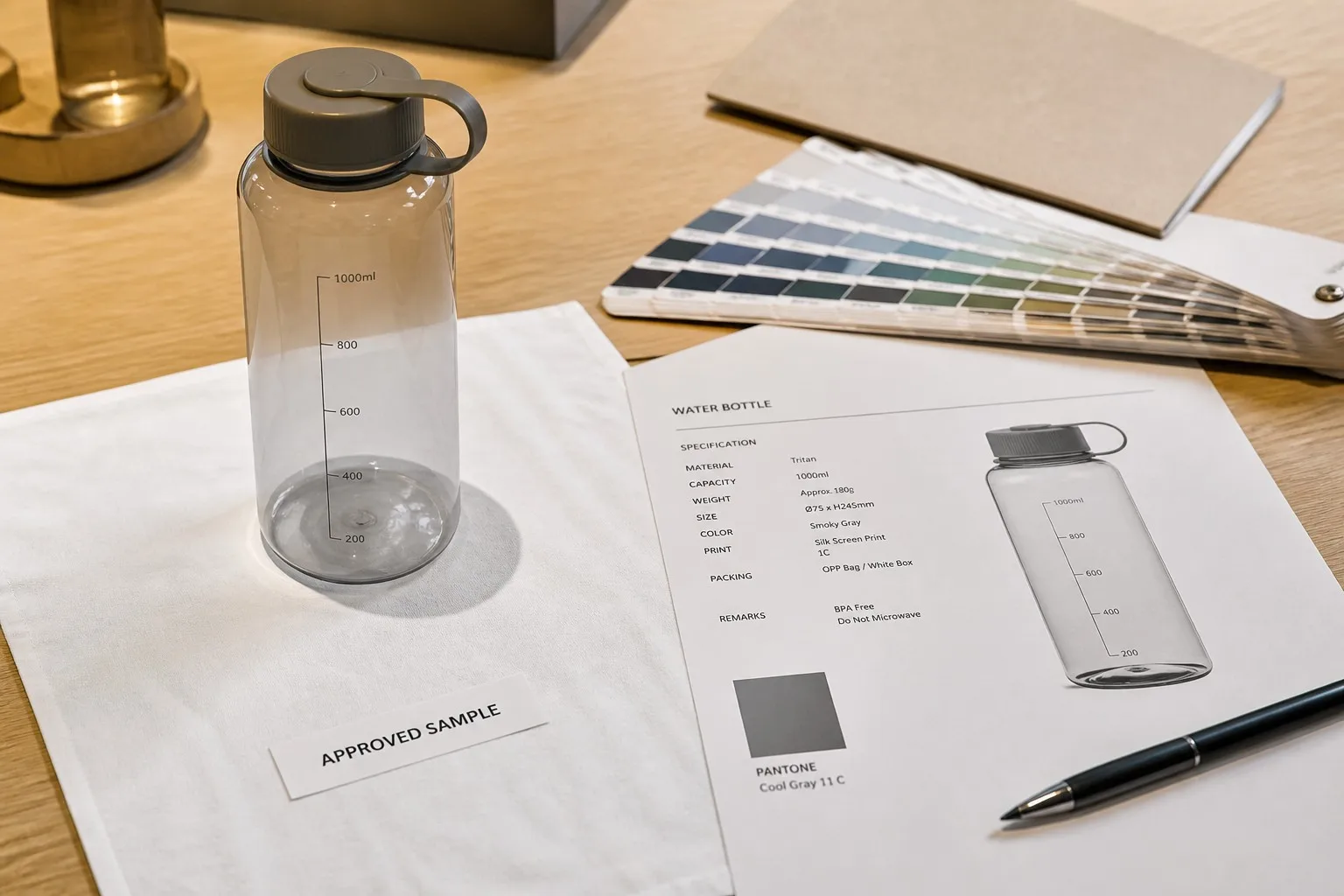
- Documentation and signature: the approved unit labeled with the PO number, approval date, and both buyer and factory signatures; test reports attached; one copy stored by the buyer in a controlled environment and one retained by the factory.
Steps 1-4 are technical, and each one fails silently if skipped — a spec that stays “to be confirmed” becomes a production argument, and an unvalidated reliability check becomes a warranty claim eight months later. Step 5 is what makes the approval legally and operationally durable — an unlabeled approved sample in a factory cabinet is not a reference standard, it is a rumor.
6. What Buyer Mistakes Cause Sample Approvals to Fail?
The failure modes repeat across programs, and all four are buyer-side:
- Conflicting comments from multiple stakeholders. Several teams send comments directly to the factory without a consolidated owner. The factory implements a contradictory mixture, and the resulting sample satisfies nobody. Fix: one approval owner, one consolidated comment set per round.
- Approving color without recording the reference. Signing off a powder coat color without documenting the master reference chip and the lighting condition (D65 vs office fluorescent) means the next production lot will be judged under different light and “will not match.” Fix: record the master standard and the viewing condition in the approval document.
- Approving a functional prototype as if the surface were final. Prototype units are often hand-finished; the production surface will differ. Fix: explicitly mark prototype approvals as “functional only” and require a fresh surface approval at the pre-production stage.
- Approving by photograph. Screen color and lighting distortion make photo approval unreliable for any cosmetic decision. Fix: physical samples to the approver for color and finish; photos only for documenting dimensional or assembly issues.
Each of these mistakes converts into a production dispute weeks later, when the factory points to the approved sample and the buyer points to their expectation. The golden sample’s entire purpose is to make that conversation unnecessary.
How should a buyer consolidate sample feedback?
The mechanics matter as much as the principle. Designate one approval owner who collects every department’s comments into a single numbered list, maps each comment to a specific drawing dimension or specification line, and marks each as blocking or non-blocking. Send only the consolidated list to the factory — never individual department emails. Blocking comments determine whether the sample passes; non-blocking comments are logged for the next revision round so they do not silently expand scope. When the revised sample arrives, the owner verifies each blocking item against the original comment number, which turns approval from a subjective impression into a traceable checklist. Factories respond to this discipline with faster, more accurate revisions, because the brief stops changing mid-round.
7. What Should Your Sample RFP Specify?
Turn the sampling process into RFP clauses so the factory’s obligations are explicit:
- Stage naming: “Quotations must specify sample stage — prototype, pre-production, or golden — with the deliverable definition for each stage and the tooling used to produce it.”
- Revision rounds: “Include the number of included revision rounds and the cost and lead time per additional round.”
- Trial documentation: “For custom tooling, provide T0-T3 trial reports with dimensional measurements against the drawing for each round.”
- Validation scope: “Golden sample submissions must include leak, insulation, cycle, and drop test reports at the specified parameters.”
- Golden sample control: “One golden sample labeled with PO number, approval date, and dual signatures shall be retained by the factory; a second shall be shipped to the buyer. Both are the reference standard for production QC.”
For sample-stage planning in your own program, review our OEM manufacturing capabilities and wholesale pricing structure, or contact our sourcing team with your target launch window and we will map the sampling calendar backwards from it.
8. Frequently Asked Questions
What is the difference between a prototype sample and a golden sample?
A prototype sample validates design — it answers whether the shape, capacity, and lid concept work, and is often 3D-printed or hand-built without production-representative finish. A golden sample is the final approved, signed, labeled physical reference standard used to judge every future production lot. Approving a prototype as if it were a golden sample means finish, material, and assembly tolerances were never validated.
How long does golden sample approval take?
Roughly 7-14 days from sample submission to buyer signature, with buyer-side review usually being the bottleneck. Each additional revision round adds 1-3 weeks of calendar time, which is why consolidating feedback into one comment set per round is the main schedule control lever.
What are T0, T1, T2, and T3 in mold trials?
They are successive test-shot rounds for custom tooling: T0 is the first test shot used to identify major mold or material issues; T1 refines the mold for defects found at T0; T2 validates dimensions against the drawing and tests assembly; T3 is the final round before full-scale production. A T3-approved part and its mold are production-qualified. “The sample looks good” after T0 is a data point, not an approval.
What is a pre-production sample and why is it separate?
A pre-production sample (PPS) is made with production tooling and resolves manufacturing uncertainty — whether the tooling, process, and material can actually deliver the design at spec. It is separate from the prototype stage because prototype units are not production-representative; skipping the PPS gate means the production tooling was never proven before the mass order.
What should a golden sample approval checklist include?
Five steps: spec lock (dimensions, capacity, wall thickness, steel grade, lid type, gasket material and hardness, decoration spec); cosmetic and assembly validation (color against master reference under recorded lighting, numeric defect criteria, fit tolerances); functional validation (leak, insulation, cycle, drop tests); reliability validation (thermal cycling, dishwasher simulation, gasket compression set); and documentation with dual signatures plus controlled storage.
What is a counter-sample?
A counter-sample is a physical unit produced by a new supplier based on the buyer’s original prototype or existing product specifications. It demonstrates whether the new factory can accurately replicate or improve the required design using their own equipment — commonly used when qualifying a second source.
Why do sample approvals fail?
Four buyer-side failure modes: multiple stakeholders sending conflicting comments directly to the factory without a consolidated owner; approving a color without recording the master reference and lighting condition; approving a functional prototype while assuming the surface finish is final; and approving by photograph, where screen color and lighting distortion make cosmetic judgment unreliable.
Get a Quote for Your Custom Project
Tell us your requirements — we will respond within 12 hours.
Commercial terms
| Minimum order quantity | 100 pcs per SKU |
| Sampling lead time | 3 days |
| Production lead time | 7 days at MOQ 100 |
Applies to existing tooling and standard colours. New mould development or custom colour matching carries its own lead time — confirm the schedule with our team before committing to a delivery date.