Last updated: 20 October 2026 | Written from production-line and supplier-audit experience. Quantitative limits are cited to the standard, regulation or published source named in each table. Where a figure is a market quote band rather than a regulated limit, the basis is stated explicitly. Nothing here is legal advice; confirm current text with your own lab and counsel.
Quick answer: On stainless steel drinkware, the decoration method decides who owns the claim. Powder coating gives you colour and coverage at the lowest unit cost, but it is a polymer film bonded to metal — it can chip, and dishwasher detergent is designed to attack exactly that kind of film. Laser engraving removes or anneals the surface itself, so there is nothing to peel, but it cannot deliver colour and it changes the corrosion profile of the marked area. Screen and pad printing sit in between and fail in a specific, predictable way: ink adhesion loss at the edges of the print. UV digital print gives you short runs and full colour, and has the weakest dishwasher story of the four unless a primer system and a post-cure are specified. The procurement answer is not “pick the most durable process”. It is “match the process to the claim you intend to make, then write a test that proves the claim before you pay for the tooling.”
A buyer in Ohio orders 12,000 powder-coated 20 oz tumblers with a corporate logo. The coating looks perfect on the golden sample. Six weeks after the programme launches, the client’s own customers start posting photos of bottles with a white ring of bare steel where the logo used to be, and the buyer discovers that “dishwasher safe” was never defined anywhere in the purchase order, the spec sheet, or the factory’s process documentation. The supplier says the bottles were tested. The test turns out to be a thumb rub and a visual check under a desk lamp.
This is the most common decoration failure in the category, and it is a specification failure, not a manufacturing one. The factory made what was ordered. What was ordered was a colour, a gloss level and a logo position — not an adhesion performance class, not a cycle count, not a post-wash acceptance criterion. This article treats decoration as an engineering decision with five variables: dishwasher durability, adhesion, food-contact compliance, unit cost, and claim risk. It covers the four processes that account for nearly all decorated stainless drinkware sold into North America and the EU, and it ends with purchase-order language you can copy.
A durability claim is only meaningful on a defined body and coating combination, not as a general statement about the decoration method. In our current line, Custom Personalized Coffee Mugs and Personalised Water Bottles are the closest matches.
Why Does Decoration Fail in the Dishwasher at All?
Because a domestic dishwasher is a hostile chemical and thermal environment, and most decoration films were never designed for it. Three mechanisms act at once.
Alkaline attack. Dishwasher detergent is strongly alkaline — the working solution in a domestic cycle typically sits well above pH 10, and commercial machine detergents run higher still. Powder coatings, screen inks and UV inks are cross-linked organic polymers. Alkali hydrolyses ester and urethane linkages at the film surface, and the damage is progressive: the film does not fail on cycle 3, it fails on cycle 60 after the surface has been chemically thinned.
Thermal cycling. A wash phase near 60–70 °C followed by a cold rinse and a heated dry cycle imposes repeated differential expansion between a polymer film and a stainless substrate. The coefficient of thermal expansion of a typical coating is several times that of 304 stainless. Every cycle loads the interface. Adhesion that survives one cycle may not survive 125.
Mechanical abrasion. Water jets, cutlery contact, rack vibration and — the underestimated one — other bottles knocking together in the basket. Edge chips start at the rim of a printed band or the boundary of a powder-coated panel, because that is where the film has an exposed cross-section for water and detergent to wick under.
Now add the fourth factor that buyers rarely write down: the substrate was not prepared for a coating in the first place. Stainless steel passivates. Its chromium oxide layer is the reason it does not rust, and it is also the reason adhesives and coatings struggle to bond to it. Any decoration process that does not either remove that layer mechanically/chemically or chemically bond through it is relying on weak dispersion forces and will fail at the interface rather than in the film.
What Are the Four Processes Buyers Actually Choose Between?
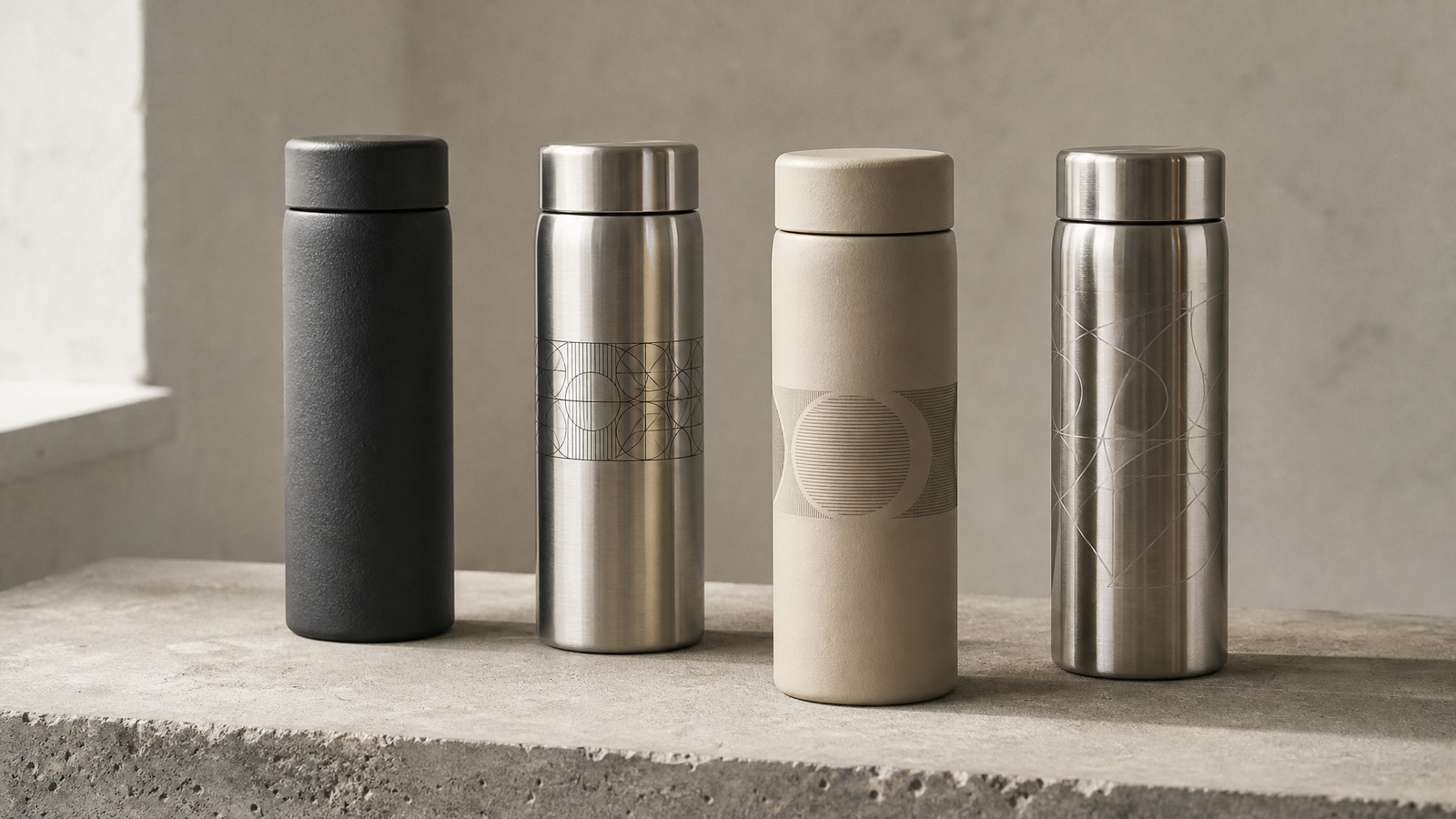
The commercial menu is narrower than the trade-show menu. For stainless drinkware exported at volume, four processes cover the overwhelming majority of decorated programmes.
Powder coating is an electrostatic process: a dry polymer powder is sprayed onto a grounded part and cured in an oven, typically in the 180–200 °C range, forming a film usually somewhere between 60 and 120 µm depending on the specification. It gives full-body colour, matte-to-gloss control, soft-touch variants, and excellent coverage of weld seams and polishing marks. It is the cheapest way to make a bottle look like a designed object rather than a metal tube.
Laser engraving is not really engraving in most drinkware factories. Three distinct things get sold under that name: annealing (a fiber laser heats the surface and grows a thin dark oxide, no material removal, sub-10 µm effect), deep engraving (material is vaporised, leaving a measurable recess, typically 20–100 µm deep), and ablation of a coating (a laser removes powder coat or paint to expose bare steel — a two-colour effect that is a coating process with a coating process’s failure modes). Annealing is fast and cheap; it is also the least durable variant, because the mark is an oxide layer a few micrometres thick.
Screen printing and pad printing apply a pigmented ink through a mesh (screen) or a silicone pad (pad). Pad printing wraps onto curved surfaces better; screen printing gives heavier ink deposit and better opacity. Both require a cure — UV-cured or two-part catalysed — and both depend entirely on pre-treatment of the stainless surface for adhesion. They are the standard choice for one- and two-colour logos and for small print areas on an otherwise bare bottle.
UV digital printing is inkjet with instant UV cure, which allows full-colour, variable-data and photographic artwork with no plate or screen cost. On stainless it is a two-component system in practice: a primer or adhesion promoter, then the ink, then a clear coat if the print is to survive handling. Without the primer, UV ink on bare stainless is a decorative sticker with ambitions.
| Process | What it physically is | Typical film / mark | Colour range |
|---|---|---|---|
| Powder coating | Electrostatic polymer powder, oven cured | ~60–120 µm film on the outside | Full RAL range, matte/gloss/texture |
| Laser — anneal | Surface oxide grown by fiber laser heat | Sub-10 µm oxide, no removal | Grey to black only |
| Laser — deep | Material vaporised | ~20–100 µm recess | Bare metal tone, tactile |
| Screen / pad print | Pigmented ink through mesh or pad, cured | ~10–40 µm ink deposit | 1–4 spot colours, metallics possible |
| UV digital | Inkjet + UV cure, primer-dependent | ~15–50 µm with primer and clear | Full CMYK + white, photographic |
Film and mark thickness ranges are process ranges stated by coating and laser suppliers; treat them as specification targets to confirm with your own supplier’s process capability sheet, not as universal constants.
Which Process Actually Survives the Dishwasher?
Ranked against a defined protocol rather than an opinion, the order is stable: bare-metal laser marks survive indefinitely because there is no film to remove; powder coating and prints survive only as long as their adhesion and cure are correct; and the failure difference between a good and a bad coating is far larger than the difference between process families.
The problem is that “dishwasher safe” has no single legal definition. The closest thing to a reference method in Europe is EN 12875-1, which specifies a mechanical dishwashing resistance test for domestic articles made from ceramic, glass, glass-ceramic, vitreous enamel, metal and plastic. Crucially, the standard defines the method, not a pass level: it does not state how many cycles a given product must withstand. Testing houses running EN 12875-1 conventionally quote a minimum of 125 cycles, then multiples of 250 if a longer claim is needed. That is the number to put in your purchase order, because it converts a marketing phrase into a measurable commitment.
| Process | Dominant failure mode | Realistic claim ceiling | Where it fails first |
|---|---|---|---|
| Powder coating (correctly specified) | Edge chipping, then progressive under-film corrosion | Dishwasher safe, top rack, 125+ cycles | Rim, base ring, logo edge |
| Powder coating (underspecified) | Blistering and sheet peel in 20–60 cycles | Hand wash only | Large flat panels |
| Laser anneal | Contrast fade, no removal | Permanent mark, colour may lighten | Uniform across the mark |
| Laser deep engrave | None functionally; localised corrosion risk | Permanent mark | Heat-affected zone in salt spray |
| Screen / pad print | Ink adhesion loss at print edges | Dishwasher safe if catalysed + primed | Thin lines, halftones, small type |
| UV digital | Primer failure then full print lift | Hand wash recommended unless cleared | Dense ink areas, dark colours |
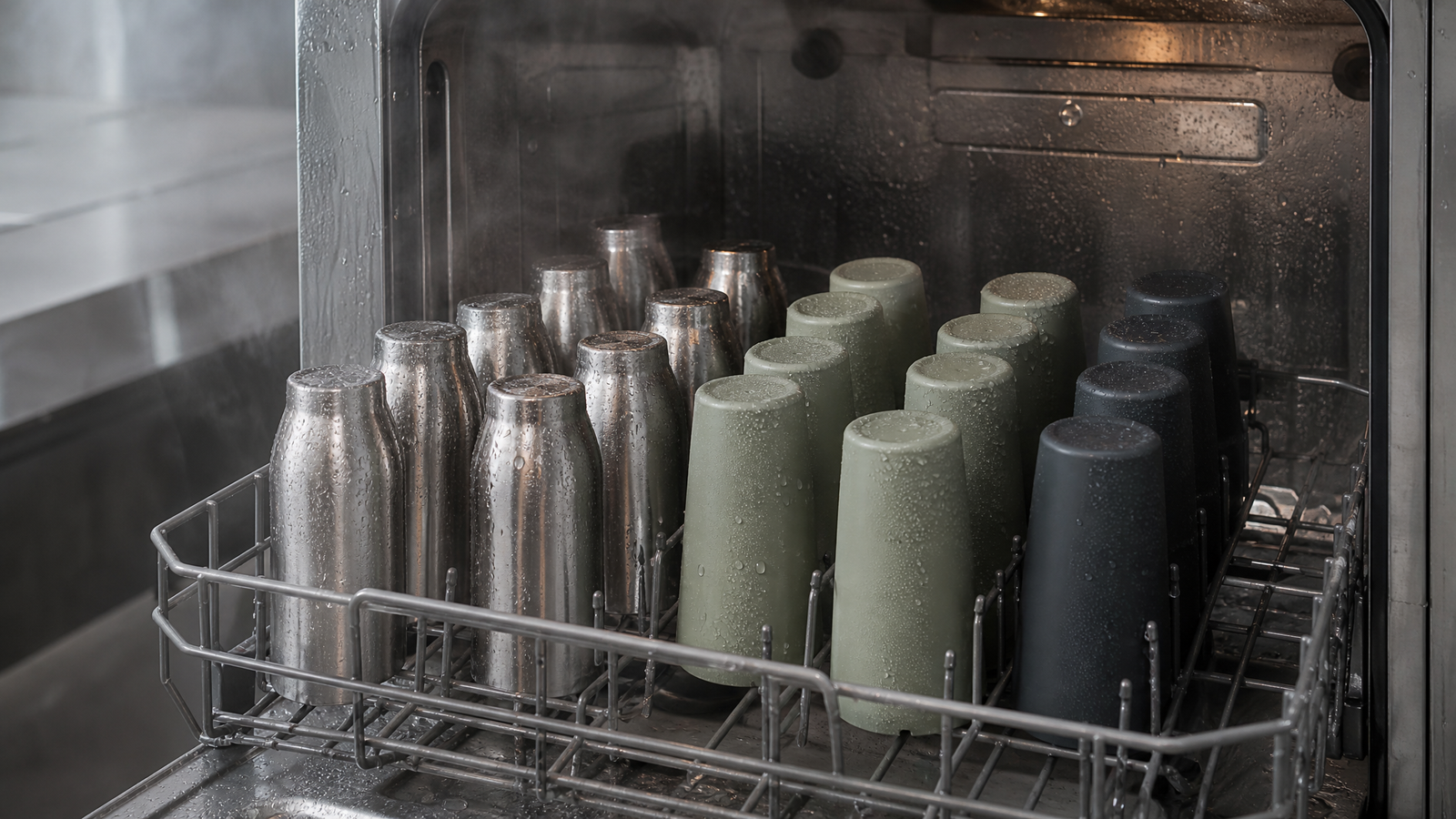
Two practical notes that decide more claims than the process choice does. First, top-rack versus bottom-rack is not a marketing hedge — bottom-rack exposure combines higher jet pressure, higher temperature and direct detergent contact, and it is where coating failures concentrate. If your packaging says top rack, your test should be run top rack, and your test report should say so. Second, detergent matters. A factory test run with a mild liquid detergent proves nothing about a consumer cycle using a high-alkalinity tablet with bleach. Specify the detergent type and dose in the protocol, or buy a test that does.
What Does ASTM D3359 Actually Prove About Adhesion?
It proves whether a coating met a minimum bond threshold on the day it was tested. It does not prove dishwasher durability, and confusing the two is the single most expensive misunderstanding in decorated drinkware sourcing.
ASTM D3359 is the standard tape test for rating adhesion. The current edition, ASTM D3359-23, defines two methods: Method A for coating systems thicker than 125 µm (5 mils), and Method B for films thinner than 125 µm — which is the method that applies to almost every powder coat, print and UV film on a bottle. The result is a grade from 0B to 5B based on the area of coating removed from a cross-hatched lattice.
| ASTM D3359 grade | Area removed | Interpretation for drinkware |
|---|---|---|
| 5B | 0% — no coating detached | The only acceptable incoming grade for a dishwasher-safe claim |
| 4B | Less than 5% detached at intersections | Marginal; acceptable only for hand-wash products |
| 3B | 5–15% detached along edges and intersections | Reject for any decorated product going to retail |
| 2B | 15–35% detached along edges and on some squares | Process is out of control — check pre-treatment first |
| 1B | 35–65% flaked | Wrong chemistry for the substrate |
| 0B | More than 65% flaked | No adhesion at all; the film was never bonded |
Grading scale per ASTM D3359-23 (Standard Test Methods for Rating Adhesion by Tape Test); the standard itself notes the method is insensitive to all but large differences in adhesion and that results depend on operator technique — a point worth remembering when a supplier sends you a single 5B photo.
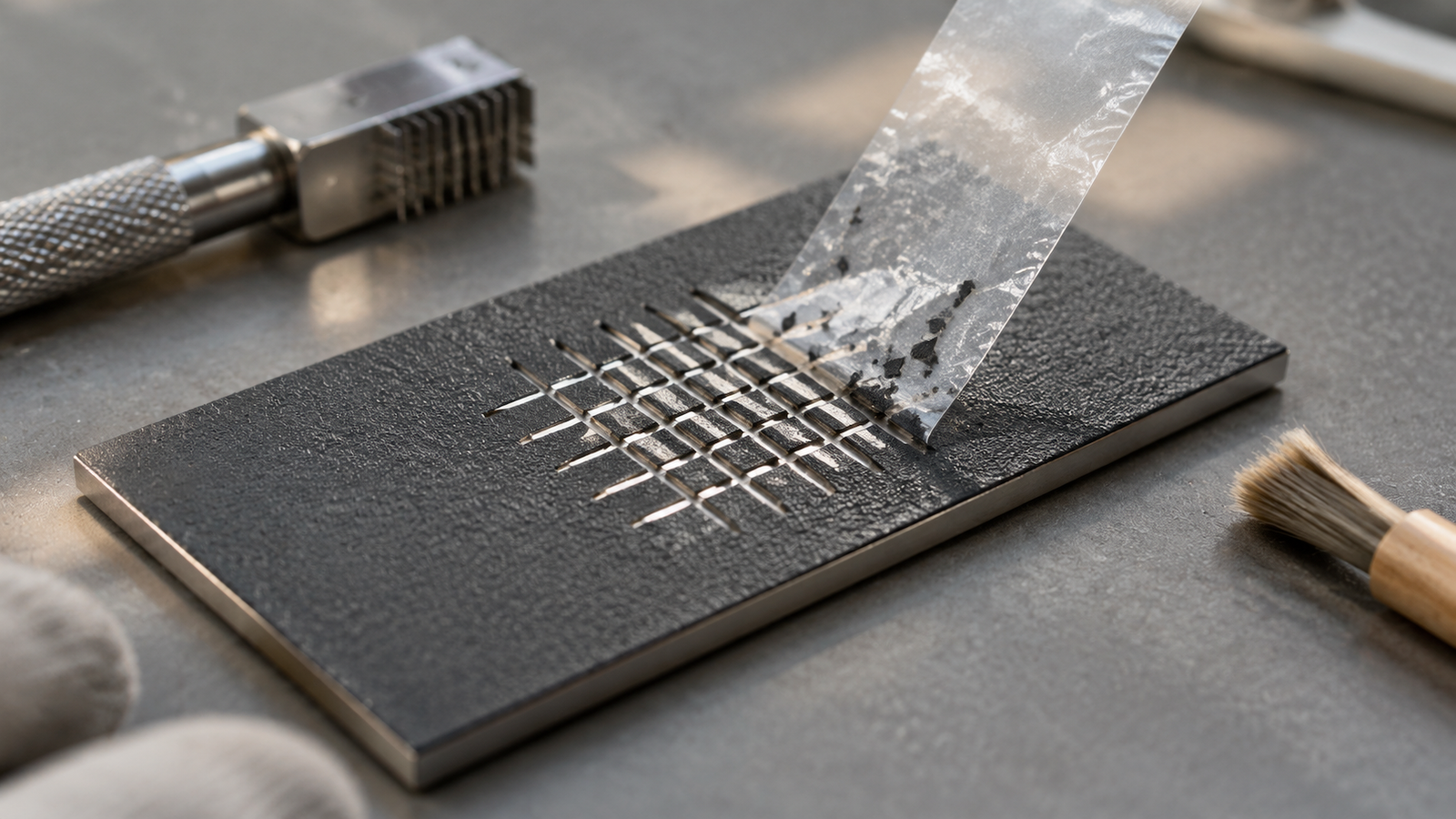
The standard is explicit that it evaluates “lower levels of adhesion” and cannot distinguish between good and excellent. That is not a flaw for procurement; it is a useful sorting tool. A 0B or 1B result tells you the pre-treatment step is missing. It cannot tell you whether a 5B coating will still be 5B after a year of consumer washing. For that you need a sequence: cross-hatch, then dishwasher cycles, then cross-hatch again, and a pass criterion on the retained grade. Buyers who ask for “ASTM D3359 5B” and stop there have bought a snapshot of day one.
The practical protocol we recommend, and the one worth writing into a PO: initial cross-hatch on three units from the lot; 125 cycles per EN 12875-1 conditions; re-cross-hatch on the same units in an adjacent area; acceptance = no grade lower than 4B after cycling, with no blistering and no under-film creep visible at the cut edges. Our wider set of pre-shipment checks is laid out in the pre-shipment QC protocol guide, and the adhesion test is only one line in that checklist.
Why Does Powder Coating Peel — and How Do You Specify It Correctly?
Powder coating peels for one of four reasons, and only one of them is the powder’s fault.
1. Pre-treatment skipped or degraded. Stainless needs a defined sequence — alkaline degrease, rinse, and either a mechanical key (light grit or brush) plus a chemical adhesion promoter, or a conversion coating. A plant that runs parts straight from polishing to the spray booth is relying on whatever oil film is left. The tell is a 0B–1B cross-hatch on an incoming lot that “always used to pass”.
2. Under-cure. Powder is a thermoset. Under-cured film looks fine, feels slightly softer, and has dramatically worse chemical resistance. Cure is a function of metal temperature and dwell time, not oven air temperature — a thick-walled vacuum bottle takes longer to reach cure temperature than the thin panels the oven was set up for. Ask for the cure schedule in °C and minutes at substrate, and ask for a solvent rub or MEK double-rub result as process control.
3. Film too thick at edges. Over-spraying to hide a polishing mark builds film at rims and corners, where cure is incomplete and internal stress is highest. That is exactly where dishwasher failures begin.
4. The coating is on the wrong side of the thermal budget. A standard decorative polyester powder is not a dishwasher-grade system. If the product carries a dishwasher claim, the powder grade must be selected for alkali resistance, and the supplier must be able to name it.
On cost, powder coating is the cheapest way to add full-body colour. Job-shop pricing in North America for general industrial powder coating is commonly quoted in the band of roughly $2–6 per square foot, with minimum job charges in the $50–150 range — meaningful for a small parts finisher, but a poor guide for a factory running its own line at volume, where the economics are driven by powder consumption instead. On consumption, a widely used industry rule of thumb for spray application without reclaim is 60% transfer efficiency, giving roughly 5.0 m² of coverage per kilogram of powder. Reclaim systems raise effective efficiency and cut cost per part; the labour and oven energy are what actually set the price at volume.
Translated into a drinkware bill of materials, powder coating typically adds a low single-digit dollar amount per unit at 5,000+ pieces on a simple one-colour body, and the number moves with colour count (two-tone and masked designs add labour steps), gloss level, and whether the interior is masked. The material cost is not the risk. The risk is a coating system selected on colour rather than chemistry.
Is Laser Engraving Really Permanent?
Permanence is the strongest argument for laser, and it is broadly true — but “permanent” and “unchanged” are different words, and the variant of laser marking you buy determines which one you get.
Annealing is the default for stainless logos. A fiber laser delivers controlled heat, and a thin oxide film forms at the surface, producing a dark grey-to-black mark with no material removal. It is fast — seconds per unit — needs no consumables, and cannot peel. What it can do is fade: the mark is an oxide layer a few micrometres thick, and repeated alkaline washing plus abrasion gradually reduces contrast. On a matte or brushed body, an annealed logo also has low contrast to begin with, which is why so many annealed logos read as grey rather than black.
Deep engraving removes metal, leaving a recess you can feel with a fingernail. It is the most abrasion-proof option available and the right choice for serial numbers, capacity markings on the base, and any mark that must remain legible after years of use. It costs more per unit because it is slower, and it creates a heat-affected zone: the chromium oxide layer is disturbed at the mark, which is precisely why some engravers report rust blooming inside deep-engraved marks on 304 after salt-spray or dishwasher exposure. That is a passivation issue, not a decoration failure — specify a post-engrave passivation or a nitric/citric treatment if the mark sits in a wet area.
Laser ablation of powder coat is the two-tone look — a coated body with the logo burned back to bare steel. Buyers love it and often do not realise they have bought a coating product. Once the coating is opened at the logo boundary, water and detergent have an entry point at every letter. If the coating underneath is not fully cured, ablation marks become the initiation sites for under-film corrosion, and you get a rust halo around the logo within months.
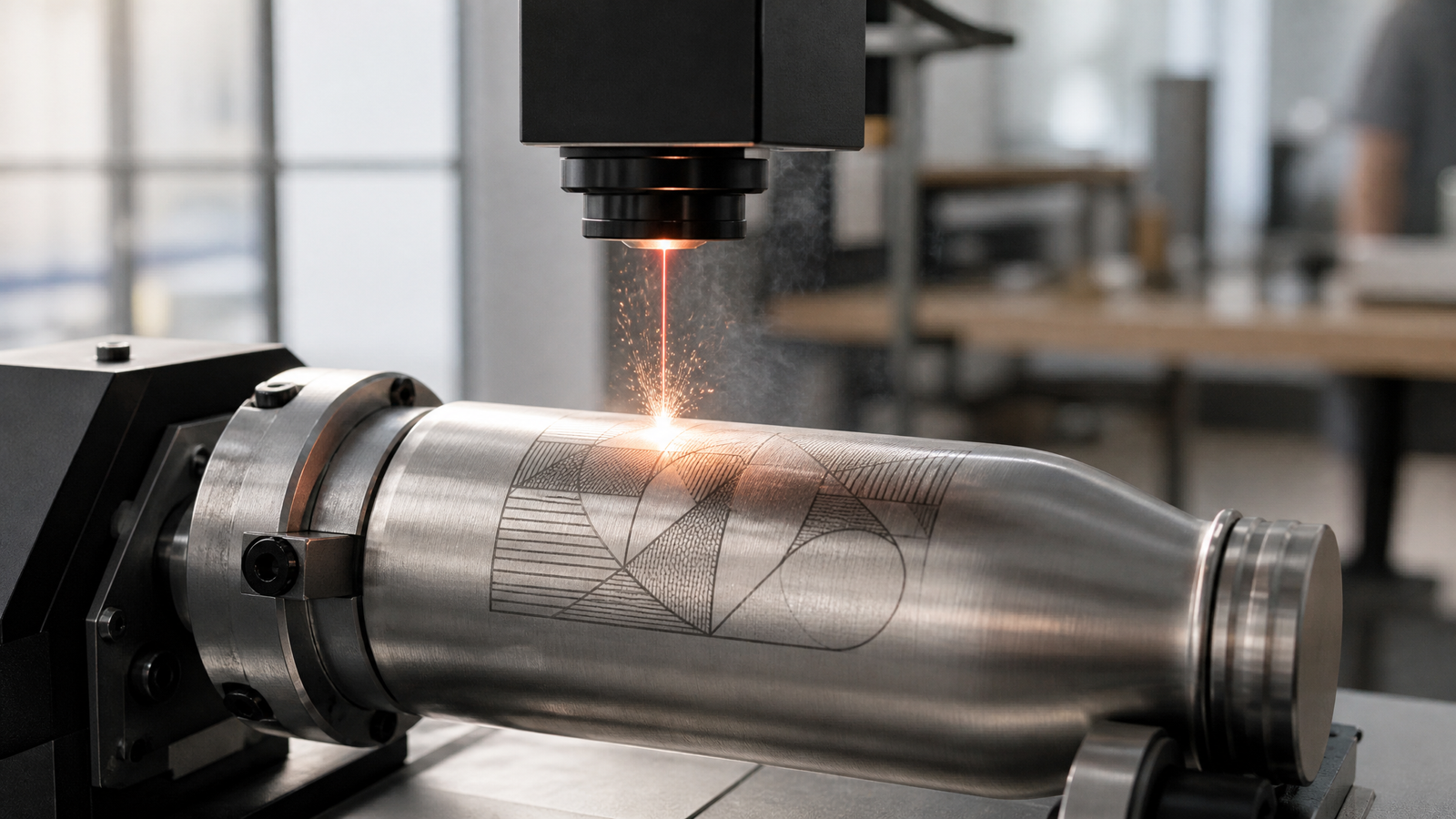
What laser cannot do is colour. There are laser-colour processes for stainless (a controlled oxide stack that produces blue, gold or black), but the colour range is narrow, the process window is tight, and colour consistency across a 10,000-piece run is a genuine capability question for any factory that offers it. Treat laser colour as a special-effect finish with a higher reject rate, not as a substitute for print.
When Does UV Print Make Sense on Stainless?
UV print makes sense when the artwork is the product: full-colour gradients, photographic imagery, personalisation, short runs, or a design that changes every season. It makes very little sense as a durability play.
The economics are the reason it exists. Screen and pad printing carry setup costs — screens or plates, colour matching, and a press setup per colour. UV digital has effectively no per-design tooling, so it wins below the volume where a screen’s amortised setup is recovered, and it wins outright when you need 40 SKUs of 100 pieces rather than 4 SKUs of 1,000. Above that crossover, screen printing is cheaper per unit and generally more resistant.
The durability caveat is primer. UV inkjet ink on bare stainless is a poor bond; the commercial systems that survive washing use a primer or adhesion promoter, and frequently a clear coat over the print to protect it from abrasion. That turns a one-pass digital process into a three-pass process, and the primer becomes the weakest link: when a UV print fails in the dishwasher, it usually fails as a whole-image lift rather than as edge wear, because the primer-to-steel interface gave way.
If you are selling UV-printed drinkware into the US market with any printed claim about the decoration, note that the compliance story travels with the ink, not the bottle. Surface coatings and printed films on consumer products are inside the scope of lead-in-paint rules, which is the next section — and the same logic that drives our Prop 65 testing and warning guide applies to decorated surfaces as much as to the steel itself.
What Do Food-Contact Rules Demand From a Coating?
More than most decorated-drinkware buyers assume, because the outside of a bottle is not automatically outside the rules. A coating on the exterior of a drinking vessel is a surface coating on an article intended for food contact; a coating on the inside is a food-contact material in the strict sense. Both carry obligations, and they are different obligations in the US and the EU.
US — lead in surface coatings. 16 CFR Part 1303 bans paint and similar surface-coating materials containing lead in excess of 0.009 percent (90 ppm) by weight of the total nonvolatile content or the dried film, a limit reduced from 0.06 percent effective 14 August 2009 under section 101(f) of the CPSIA. The Consumer Product Safety Commission states the same 90 ppm figure on its Lead in Paint business guidance page. Note two things: the rule applies to “paint or any surface coating” on products used by consumers, and it applies to what is on the product, not to what the pigment supplier intended. A coloured powder coat or a red screen ink is inside that scope. Ask for a total-lead test on the finished film, not a pigment certificate.
US — food-contact coatings. Where a coating contacts food, 21 CFR 175.300 governs resinous and polymeric coatings used as the food-contact surface of articles for producing, manufacturing, packing, processing, preparing, treating, packaging, transporting or holding food. The regulation is a composition list plus an end test: the finished coating must not yield chloroform-soluble extractives above 0.5 mg per square inch of food-contact surface (approximately 50 ppm) under the extraction conditions set out in 21 CFR 176.170 — conditions selected by food type and temperature. For a drinkware interior coating, that means your supplier’s declaration has to name the extraction condition used, not just say “FDA approved”.
EU — framework and GMP. Regulation (EC) No 1935/2004 is the framework: Article 3 requires that materials and articles do not transfer constituents to food in quantities that could endanger human health, bring about an unacceptable change in composition, or deteriorate organoleptic characteristics. Regulation (EC) No 2023/2006 adds good manufacturing practice, including the requirement for a documented quality assurance system and, for printing inks and coatings, specific rules on the use of substances and on printing operations. There is no EU-wide harmonised measure for powder coatings on metal drinkware, so compliance is demonstrated through the framework plus national measures plus migration testing — which is exactly why the paperwork varies by factory.
Germany — LFGB. Section 30 of the German Food and Feed Code prohibits the manufacture or placing on the market of food-contact materials that could endanger health, and Section 31 covers the transfer of constituents and organoleptic change. In practice, LFGB §30/31 testing combines overall and specific migration with a sensory panel for odour and taste. That sensory element is where coated drinkware fails more often than buyers expect: a coating that passes migration can still taint hot water, and a taint complaint is unanswerable in retail.
| Requirement | Numeric limit / criterion | Applies to | Document to demand |
|---|---|---|---|
| 16 CFR 1303 | ≤ 90 ppm lead in the dried coating film | Exterior and interior coatings on consumer products | Total-lead test report on finished film |
| 21 CFR 175.300 | ≤ 0.5 mg/in² chloroform-soluble extractives | Coatings contacting food (liner, rim, inside) | Extraction test report with conditions per 176.170 |
| EC 1935/2004 Art. 3 | No unsafe transfer; no unacceptable composition change | All food-contact articles placed on the EU market | Declaration of Compliance, migration test data |
| EC 2023/2006 | Documented GMP and quality assurance system | Manufacturing of FCMs, including printing | GMP certificate / audit report |
| LFGB §30/31 | Migration limits plus sensory pass | Products sold in Germany | LFGB test report incl. odour/taste panel |
One structural point that gets missed: the interior coating is a different supplier decision from the exterior decoration. Most decorated bottles are bare stainless inside, which removes an entire compliance layer and is why bare-interior powder-coated bottles are so common. If you are buying a coloured interior, you have created a food-contact coating obligation on top of a decoration choice, and the test package roughly doubles. The interaction between coating choice and chemical restrictions is also where the PFAS question lands — if a coating or its additives are fluoropolymer-based, your declaration file needs to match what we set out in the PFAS-free declaration guide.
How Do You Compare Cost Per Unit Without Being Fooled?
Compare “landed cost of a compliant decorated unit”, not “decoration price”. Four cost lines get left out of most comparisons and they are the ones that decide margin.
- Setup and tooling amortisation. Screens, plates, print programmes and laser fixtures are one-time costs spread over the run. A $900 screen setup across 600 units is $1.50 per unit; across 12,000 units it is $0.075. This single line reverses many process decisions.
- Reject rate at the decoration step. Two-tone powder coating and multi-colour registration print both carry higher in-line reject rates than single-pass laser. A 4% reject rate on a $1.20 decoration step is $0.048 per good unit — often bigger than the difference between two processes’ quoted prices.
- Second-pass operations. Masking for two-tone coating, primer plus clear for UV print, post-engrave passivation, and re-packing between passes are all labour. Each one adds handling damage risk as well as cost.
- Claim cost. This is the line nobody puts in the spreadsheet. A decoration with a 2% return rate on a $24 retail item costs more in refunds, shipping and review damage than the entire decoration budget for that SKU.
| Cost element | Powder coat | Laser | Screen / pad | UV digital |
|---|---|---|---|---|
| One-time setup | Low | Very low (programme + fixture) | Per colour, moderate | Near zero |
| Unit cost at 500 pcs | Low | Low–mid | High (setup dominates) | Mid |
| Unit cost at 10,000 pcs | Lowest | Low | Lowest for 1–2 colours | Mid–high |
| Colour flexibility | Powder stock colours only | None (mono) | 1–4 spot colours | Unlimited |
| Dishwasher ceiling | High if specified | Highest | High if catalysed | Lowest |
Directional comparison only. Absolute numbers vary by country of manufacture, substrate finish, colour count and order size; get three quotes on identical specification sheets before committing. For exterior industrial powder work, published job-shop bands in North America run about $2–6 per square foot with $50–150 minimums, and industry guidance puts un-reclaimed spray transfer efficiency at about 60%, or roughly 5.0 m² per kilogram of powder — useful for sanity-checking a supplier’s claimed powder consumption, not for pricing a programme.
What Should the Purchase Order Actually Say?
This is where decoration programmes are won or lost. A PO that says “logo: laser engraved, dishwasher safe” is not a specification. Here is language that is.
- Process and system identification. Name the process and the chemistry: “Exterior: polyester powder coating, alkali-resistant grade, supplier to confirm product code and cure schedule”; “Logo: fiber laser annealing, 0.3 mm line width, mark depth N/A”; “Logo: two-part catalysed screen ink, colour matched to Pantone X, primer specified.”
- Film thickness and measurement method. State the target range and the gauge used, and where on the part it is measured (body wall, not the base fillet).
- Adhesion class before and after cycling. “ASTM D3359 Method B, initial ≥ 4B on 3 units; after 125 cycles per EN 12875-1, ≥ 4B with no blistering and no under-film creep.”
- Cycle protocol in full. Detergent type and dose, water hardness, rack position, load configuration, dry cycle. Without these, two labs will produce two different results on the same bottle.
- Chemical compliance package. Total lead on finished film to 16 CFR 1303; FDA 21 CFR 175.300 extraction data if the coating contacts food; EU Declaration of Compliance to 1935/2004 plus GMP to 2023/2006; LFGB §30/31 if Germany is in scope.
- Colour and gloss tolerances. A spectrophotometer reading with ΔE limit and a gloss unit range, measured on a defined geometry. “Matches the sample” is not a tolerance.
- Repair and touch-up rule. Whether the factory may touch up a chip, with what, and whether touched-up units are countable as first quality. Uncontrolled touch-up is how a 2% defect rate becomes a 6% claim rate.
- Golden sample custody. Signed, dated, retained by both parties, and re-signed if any input changes.
If your programme is a first private-label launch, the decoration spec is one of six documents you need to lock before tooling — the sequence is covered in the private label launch timeline, and decoration belongs in the same workstream as the mould, not after it.
How Do You Audit a Decoration Line in Two Hours?
You do not need a week. You need to see four things, and three of them are not the product.
Watch the pre-treatment stage. If the plant cannot show you the degrease and rinse stages, or if parts move from polishing to the booth with no intermediate step, nothing downstream matters. Look at the rinse water: clean, running, and monitored. Ask for the bath concentration log.
Read the cure record. A powder line should have oven temperature records and a substrate-temperature verification (a data logger travelling through the oven on a representative part). A print line should have UV dose or oven dwell records per shift. If the answer is “the operator checks it”, ask what the operator checks against.
Look at the reject bin. The reject bin tells you more than the QC report. What is in it, how it is sorted, and whether the defects are edge chips, colour drift or print misregistration tells you which process variable is unstable. A plant with an empty reject bin during a decorated run is either exceptional or hiding the bin.
Run one destructive test in front of you. Cross-hatch a coated unit and pull the tape. A 5B takes ninety seconds to demonstrate and settles the argument. Then ask for the retained 125-cycle report and check the dates, the sample size and whether the tested units were production-drawn or hand-built.
Which Process Fits Which Business Model?
Match the process to the claim and the channel, and most of the decision makes itself.
- Promotional and corporate gifting, 500–5,000 units, one colour logo, hand-wash reality. Laser annealing or screen print. Cheapest route to a clean mark; do not promise the dishwasher.
- Retail private label with a full-body colour story, 5,000+ units. Powder coating with a named alkali-resistant grade, 125-cycle data, and an exterior-only coating so the interior stays bare and the compliance package stays simple.
- Premium or gift channel where the mark is the brand. Deep laser engraving or pad print on bare steel. No film, no peel claim, and a tactile mark that reads as quality.
- Personalisation, seasonal drops, many SKUs at low volume. UV digital with primer and clear coat — and a hand-wash recommendation unless you have paid for cycle testing on the exact print stack.
- Two-tone designs and laser-ablated logos. Accept that you have bought a coating product, and put the same adhesion and cycle protocol behind the logo boundary that you put behind the body.
What Are the Hidden Claim Risks?
Decoration drives claims in three ways, and only the first is obvious.
The durability claim. “Dishwasher safe” without a defined protocol is an unsubstantiated performance claim. In the US it is exposure under FTC substantiation expectations; in the EU it interacts with unfair commercial practices rules. The fix is documentary, not rhetorical: a named method, a cycle count, a sample size and a retained report.
The chemical claim. A coloured coating is a formulated product with pigments, additives and possibly stabilisers. Lead is capped by 16 CFR 1303; other substances may be caught by state-level rules such as California’s Proposition 65, which is why decorated surfaces deserve their own test plan rather than being folded into a steel-only submission. Our Prop 65 guide for drinkware importers covers how to structure that testing so the coating is not the gap.
The recall and liability claim. A coating that lifts in sheets creates two problems at once: an appearance defect that generates returns, and a foreign-material concern if flakes end up in a drink. The second is the one that escalates. If your coating is on the inside, or on a rim the mouth touches, a peeling event is a safety event — and that changes which insurance and indemnity terms you need from the supplier.
The cheapest mitigation is boring: keep coatings off food-contact surfaces where the design allows, specify the process by chemistry rather than by colour, and test after cycling rather than before. Everything else is a variation on those three.
Frequently Asked Questions
Is powder coating on stainless steel drinkware dishwasher safe?
Only if the coating grade, pre-treatment and cure are specified for it. A standard decorative polyester powder on poorly prepared stainless can begin blistering within 20–60 wash cycles, while an alkali-resistant grade on correctly pre-treated and fully cured steel can hold a 125-cycle claim. “Powder coated” tells you nothing about dishwasher performance; the grade and the process record do.
Does laser engraving void the corrosion resistance of stainless steel?
It can locally disturb the passive chromium oxide layer, especially with deep engraving. Annealed marks are a thin surface oxide and rarely cause problems; deep-engraved marks in wet areas are more exposed. Ask for post-engrave passivation (citric or nitric) and verify with salt-spray or a wash-cycle test on marked units, not on blanks.
Which decoration method is cheapest for 1,000 units?
For a single-colour logo at 1,000 units, laser annealing usually wins because there is no consumable and no screen or plate to amortise. For full-body colour at 1,000 units, powder coating is cheapest per unit but the setup sits heavily on each piece. Screen printing only becomes competitive once setup is spread over several thousand units.
How many dishwasher cycles should I require before shipment?
125 cycles is the conventional minimum under EN 12875-1 practice, extendable in multiples of 250. The standard defines the method, not a pass level — you must set the acceptance criterion yourself, and it should include an adhesion grade after cycling, not just a visual check.
Can a supplier really claim “FDA approved” for a coating?
Not in those words. FDA does not “approve” coatings; it regulates them. For a food-contact coating the relevant evidence is compliance with 21 CFR 175.300, including chloroform-soluble extractives at or below 0.5 mg/in² under the extraction conditions of 21 CFR 176.170. Ask for the test report, not the phrase.
What lead limit applies to a coloured coating on a water bottle?
16 CFR Part 1303 caps lead in paint and similar surface coatings at 0.009 percent — 90 ppm — by weight of the dried film or total nonvolatile content. Test the finished film from a production unit. A pigment supplier’s declaration does not cover cross-contamination in the spray booth or the primer underneath.
Why does a printed logo disappear but the bottle body stays perfect?
Because the two surfaces have different interfaces. The body may be bare steel with no film at all, while the logo is an ink layer with its own adhesion and cure behaviour. Print failures concentrate at thin lines, halftones and print edges, where the ink deposit is thinnest and water wicks under the boundary first.
Do I need separate compliance tests for the exterior decoration?
Usually yes. Exterior coatings sit inside lead-in-paint rules in the US and inside the general safety obligation of EU 1935/2004. They are not automatically covered by a steel-composition test or a food-contact migration test on the liner. Budget a coating-specific line item in the test plan from the first order.
About This Workshop
This article was written from the production side of stainless steel drinkware manufacturing, not from a marketing desk. The lines we run and audit cover vacuum flask bodies, tumblers and sports bottles in 304 and 316 stainless, with in-house decoration across powder coating, fiber laser marking, screen and pad printing, and UV digital print.
What we can show a buyer on a factory visit: the pre-treatment line (degrease, rinse, adhesion promoter), oven temperature and substrate-temperature cure records, a laser cell with fixture and programme files, a print line with UV dose logs, and a QC bench with a cross-hatch cutter, torque gauge, coating thickness gauge and a retention test station.
How we test decoration: ASTM D3359 Method B cross-hatch on incoming lots and after wash cycling; EN 12875-1 style wash runs at 125 cycles and multiples of 250 on request; salt-spray exposure on marked and unmarked units side by side; and retained golden samples signed by both parties.
What we do not claim: we do not publish a certified capacity figure we cannot document per line, and we do not describe a test as third-party verified unless a named laboratory issued the report. Where this article quotes a limit, the standard or regulation is named so you can check it yourself. Sample-room and bench capacity is quoted per project after the specification is fixed.
Sources consulted for the numeric limits in this article: ASTM D3359-23, Standard Test Methods for Rating Adhesion by Tape Test; 16 CFR Part 1303 (eCFR); CPSC, Lead in Paint; 21 CFR 175.300 (eCFR); Regulation (EC) No 1935/2004 (EUR-Lex); Regulation (EC) No 2023/2006 (EUR-Lex); EN 12875-1 mechanical dishwashing resistance method; published powder-coating cost and transfer-efficiency guidance (industry job-shop bands and coating-consumption estimates).