Container Rain and Transit Corrosion: How Do You Keep Stainless Steel Drinkware Shipments Rust-Free?
Last updated: October 14, 2026
Quick Take
A container does not need a hole in the roof to arrive wet. Roughly two-thirds of the damage claims transport insurers see each year involve water that was never liquid when the truck pulled away from the loading dock. It was vapour — pulled out of the air trapped at stuffing, out of kiln-dried pallets, out of corrugated cartons, and out of the product itself — and it only becomes an order-killing problem after the vessel crosses a temperature gradient it never had on land. By the time the container is opened at a distribution centre in New Jersey or Hamburg, the roof has been raining onto the top carton for three weeks. You cannot inspect this at the factory, because on the day of loading there is nothing to see. What you can do is specify for it: barrier packaging, a calculated desiccant dose, a pallet moisture limit, a documented pre-loading check, and a claim file assembled before the doors close. That is a procurement decision, not a quality-control accident, and it costs a fraction of the rework, replacement freight and chargeback it prevents.
Here is the conversation this article is built for. A brand manager places a 12,000-unit order for double-wall tumblers, powder-coated in three Pantone colours. The powder-coat colour matches the golden sample, the vacuum retention test passes, the pre-shipment inspection reports zero major defects, and the container is sealed. Six weeks later the receiving warehouse photographs brown freckles on the rims of the top layer, a chalky white bloom on two coating colours, and a faint mustiness in the cartons near the doors. The factory did nothing wrong on the production line. The container did what a sealed steel box does when its interior air is warm, humid and slowly cooled.
Transit corrosion shows up on the bodies where condensation stays in contact longest during a sea freight cycle. In our current line, Vacuum Insulated Water Bottle and Custom Insulated Water Bottles are the closest matches.
This is a specific problem with a specific set of controls, and it is deliberately distinct from two adjacent topics we have already covered. Pre-shipment inspection is about whether a lot is worth paying freight on — that bet is governed by AQL sampling and functional testing, and it is set out in our guide to which QC checks actually matter before shipment. Retail-ready packaging and drop-test compliance is about whether the carton survives handling and meets the retailer’s specification — that is covered in our retail-ready packaging and drop-test guide. Both of those happen mostly on land, in daylight, before a seal is applied. Container rain happens after, in the dark, for weeks, and it is governed by psychrometrics, chloride chemistry and the fine print of cargo insurance — not by a defect sheet.

1. What Is Container Rain, and Why Does a Sealed Box Sweat?
“Container rain” is industry shorthand for condensation that forms on the inside surfaces of a cargo transport unit and then drips, runs or falls onto the cargo. The mechanism is not mysterious, but it is counter-intuitive if you think of water only as liquid. A container is not watertight against water vapour. Corrugated cartons, wooden pallets, paper-based dunnage and the ambient air itself all carry water in vapour form, and when the doors close at a humid loading dock, that vapour is sealed inside with the cargo.
As the vessel moves from a warm, humid load port into cooler water and cooler air, the interior temperature falls. Air’s capacity to hold water collapses as it cools — warm air holds far more moisture than cold air at the same volume. When the falling temperature reaches the dew point of the trapped air, the excess water has nowhere to go but onto the coldest available surface. Inside a steel container, the coldest surfaces are the roof, the side walls, and the upper layers of the cargo itself. The roof is coldest at night because it radiates heat to a cold sky; on a clear night the roof can sit several degrees below the air inside, which is exactly the condition that turns vapour into drips.
Loss-prevention literature treats three related phenomena under this heading, and buyers should keep them separate because the fixes differ. Container rain is condensation on the container’s own interior surfaces, which then falls onto the cargo. Ship sweat is the same process on a vessel’s structure, where warm moist air inside a hold meets cold steelwork. Cargo sweat is condensation forming directly on the surface of cold cargo when warm moist air is introduced to it. Marine insurers draw the distinction precisely because the sea is where the exposure lives: TT Club, the specialist transport insurer, reports that the maritime leg accounted for 65% of its wet-damage claims, against 14% for road transit and 7% for air — a gap that reflects how long the cargo is sealed inside the unit and how many climate zones it passes through.
The practical consequence for a drinkware brand is that the risk window is not the port-to-port sailing time alone. It is the total time between the moment the container is stuffed and the moment it is opened — which for a China-to-US-East-Coast routing routinely runs 45 to 70 days once inland legs, terminal dwell and a distribution-centre queue are added.
2. Why Does the Water Appear Even When Nothing Leaked?
Because water entered the equation as vapour, not as a leak. There are four primary sources inside the doors, and a competent moisture plan addresses all four rather than one.
Trapped ambient air. Stuffing a container on a humid day at a southern Chinese port can seal a substantial mass of water vapour inside a 33 m³ (20 ft) or 67 m³ (40 ft) interior. Using standard psychrometric values: saturated air at 30°C holds roughly 30 g of water per cubic metre, so air at 80% relative humidity holds roughly 24 g/m³. In a 67 m³ container that is on the order of 1.6 kg of water vapour. Cool the interior to 8°C, where saturated air holds only about 8 g/m³, and the same volume can carry roughly 0.5 kg. The difference — well over a kilogram — must condense somewhere. That is a worked example from published psychrometric tables, not a measurement of any specific shipment, but the order of magnitude is why a “dry” container still rains.
Wooden pallets and dunnage. This is the largest single contributor and the most controllable. A wooden pallet is hygroscopic; it releases water when the air around it is warm and absorbs water when the air is humid. A kiln-dried (KD) hardwood pallet typically sits in the 12–18% moisture content range, while a green or inadequately dried pallet can exceed 20%. A 20 kg hardwood pallet at 18% moisture content is carrying roughly 3 kg of water, and a 40 ft container may hold 18 to 24 pallets. Do that arithmetic and you understand why the desiccant dose assuming “just air” almost always runs short.
Corrugated cartons and paper dunnage. Freshly printed and glued corrugate released moisture as the container warms; the cartons nearest the roof are the first to show softness and mildew. Interior ink and recyclable paper stock behave the same way. Cartons are also the surface that takes the drip, so they show the damage first even when the metal inside is fine.
The product and its packaging. A unit that passed a leak test, a rinse-down or a washing step can carry residual moisture in the liner, in the gasket seat, or between the assembled lid and shell. Silicone gaskets and any paper-based inner packaging hold water too. This is the quiet source — small per unit, multiplied by 12,000 except that most of it is sealed inside individual packaging and re-released on the voyage.
The physics of the transition itself is well documented in marine loss-prevention practice. The West of England P&I Club’s guidance on cargo ventilation and sweat notes that open-ocean air at main-deck level normally sits above 80% relative humidity, that relative humidity rises as isolated air cools, and that water begins to condense once the temperature reaches the dew point. That is why the standard ventilation decision rule is expressed in dew-point terms rather than temperature terms — but a sealed container has no ventilation to manage, which is precisely why the burden shifts from “ventilating at sea” to “drying the cargo at the dock.”
3. Which Moisture Sources Are Inside the Container Before It Even Sails?
The honest way to plan is to build a moisture budget rather than buy a desiccant product. Add up the water that can be released by the gas phase, the pallets, the cartons and the product, then size the drying capacity against that total plus whatever diffuses in over the intended transit time. The four sources above are the budget. Two rules follow from them.
First, the pallet is the swing factor, and it is also the item most often bought on price alone. A factory that buys whatever pallets are cheapest on the day will sometimes ship you 22% moisture content wood, and no amount of desiccant sized for “air only” will absorb it without being exhausted before the vessel clears the first climate zone. Second, the cartons must never be treated as inert. When we weigh the moisture question internally, corrugated and paper are always on the board alongside the steel, because a musty carton is a retail rejection even when the tumbler inside is perfect.
4. Does 304 or 316L Actually Change the Corrosion Math?
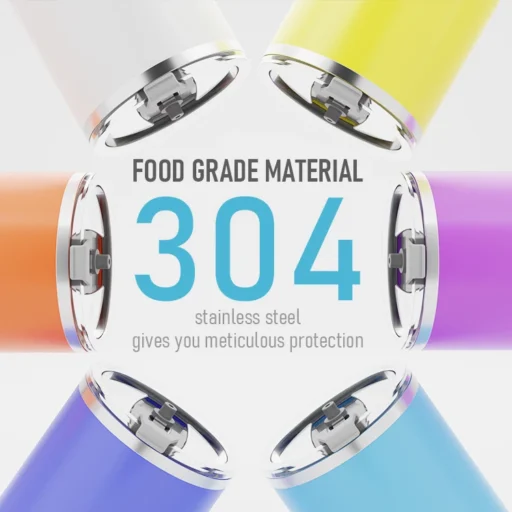
It changes it less than most buyers assume, and the real culprit is usually not the grade at all. Understand the chemistry first. Grade 304 stainless is roughly 18% chromium and 8% nickel, with the chromium forming the passive oxide film that makes the steel “stainless.” Grade 316L adds molybdenum — typically 2–3% — which specifically raises resistance to pitting in chloride environments. Against a chloride-laden film of condensation on a rim or a weld, 316L does hold up better than 304. That is a genuine, measurable difference, and our earlier analysis of 304 versus 316L and how to detect material grade fraud covers how to verify that the grade you paid for is the grade you got.
But here is the part that decides most real claims. Fresh stainless drinkware that develops brown freckles in transit is usually suffering from tea staining or free-iron contamination, not from bulk corrosion of the grade. Free iron is left behind by carbon-steel tooling, grinding and polishing media, steel shot, or by stacking finished stainless against unpainted carbon steel in the same container. That free iron rusts in ordinary damp air within days, on top of a perfectly good 304 or 316L surface, and it looks exactly like the grade failed. A separate form, weld heat tint, leaves a chromium-depleted oxide on an un-passivated weld that behaves the same way.
The procurement implication is blunt: upgrading from 304 to 316L does not fix a contamination problem, and paying for 316L while shipping from a plant that does not remove free iron is money spent on the wrong variable. The controls that actually move transit corrosion are a documented passivation and contamination-control step (free-iron test, citric or nitric passivation), the elimination of carbon-steel contact in packing and stowage, and — for the container itself — the chloride load of the trapped air. Chloride comes from sea spray, from some recycled paper and corrugate, and from certain pallet treatments; keeping chlorides off the finished surface matters more than the last two points of chromium.

5. Which Transit and Corrosion Test Methods Should You Require?
Four named methods do most of the work of turning “will it arrive clean?” into a testable specification. None of them is a life predictor on its own, and the honest use of each is to compare packing configurations against each other under identical conditions.
ASTM D4169 — Standard Practice for Performance Testing of Shipping Containers and Systems — defines laboratory distribution cycles that subject a shipping unit to a defined sequence of hazard elements (handling, vibration, compression, atmospheric conditioning and more) representing actual distribution. As the standard’s own scope states, it is a uniform basis for evaluating whether shipping units withstand the distribution environment, and it is not intended to replace material specifications or existing pre-shipment procedures. For moisture work, the value is that D4169 sequences atmospheric conditioning into the same cycle as the mechanical hazards, so you can validate a packing configuration against a condition set rather than a single variable. See the method record on ASTM D4169.
ISTA 3E is the International Safe Transit Association’s general simulation procedure for similar packaged-products in unitized loads for truckload shipment. It is widely used alongside D4169 for pallet-load validation. Buyers should treat ISTA and ASTM as parallel families — pick one, write the exact procedure and revision into the purchase order, and stop arguing about which logo appears on the report.
ASTM B117 — Standard Practice for Operating Salt Spray (Fog) Apparatus — is the accelerated neutral salt spray test most factories mean when they say “salt fog tested.” Use it, but use it honestly: the standard itself cautions that prediction of performance in natural environments has seldom been correlated with salt spray results when used as stand-alone data, and that correlation should only be considered where corroborating long-term atmospheric exposures exist. In other words, B117 ranks materials and coating systems against each other; it does not tell you how many years a bottle will last. See the method record on ASTM B117. The corresponding ISO accelerated corrosion test, ISO 9227, is its international counterpart if your market expects ISO reporting.
ASTM D2247 — Standard Practice for Testing Water Resistance of Coatings in 100% Relative Humidity — is the natural companion for powder-coated and printed units. Condensation on a coated surface is a coating question as much as a steel question, and D2247 is the accepted way to expose a coating to continuous condensing humidity and watch for blistering, blush and edge creep.
The mistake buyers make is ordering one test in isolation. A salt-spray result tells you nothing about a saturated carton, and a packaging drop test tells you nothing about a coated rim. Run the corrosion methods on bare and coated steel for the material decision, and run the distribution-cycle methods on the packed, unitized load for the packaging decision. Below is how the four methods map to the actual risks.
| Method | What it simulates | Decision it informs | Honest limitation |
|---|---|---|---|
| ASTM D4169 | Sequenced distribution hazards plus atmospheric conditioning | Packed / unitized load configuration | General practice, not a product specification |
| ISTA 3E | Unitized loads, truckload shipment | Pallet-load integrity and compression | Does not model ocean humidity history by itself |
| ASTM B117 | Continuous neutral salt fog on metals and coatings | Relative corrosion resistance of grades / coatings | Poor correlation to natural exposure when used alone |
| ASTM D2247 | Continuous condensing humidity on coatings | Powder-coat and print durability under wetness | Coating-focused; says nothing about the steel beneath |
Method records verified at astm.org and store.astm.org; ISTA 3E is published by the International Safe Transit Association. Buyers should cite the exact standard designation and revision year in the purchase order.

6. How Much Desiccant Does a Container Actually Need?
Stop buying desiccant by the bag and start specifying it by a formula. The reference method most container-desiccant suppliers use is DIN 55474, the German standard for calculating the number of desiccant units required inside a packaging. Under DIN 55473/55474, one desiccant unit (DU) is the quantity of desiccant that adsorbs at least 6.0 g of water vapour at 23°C and 40% relative humidity. The calculation then balances the moisture carried in the air and dunnage against the water-vapour transmission rate of the packaging film multiplied by the storage duration, and divides by the capacity of a unit. Clariant’s public DESI PAK desiccant calculator implements exactly this DIN 55474 calculation and exposes the four variables that drive the answer: box/container geometry, the humidity content of the dunnage by weight, the packaging film type (including an aluminium-barrier option), and the required protection duration in days.
For a full ocean container the arithmetic is usually done by a container-desiccant supplier rather than by the DIN box formula directly, because the container is not a sealed polymer box — it leaks. The rule of thumb in the industry for a 40 ft container on a 30-day voyage is on the order of 12 to 20 kg of container desiccant, with 20 ft loads proportionally less and long, multi-climate routings and high-moisture pallets pushing the figure up. Treat those as industry practice figures rather than a standard, and make your supplier show the calculation for your specific volume, pallet moisture and duration.
Three mistakes recur. First, sizing desiccant for the air alone and ignoring pallet and carton moisture — the budget is on the cargo, not just the gas phase. Second, hanging container desiccant on the walls while the product is wrapped inside a sealed barrier film: if a pallet is sealed in aluminium-barrier or low-WVTR film, the desiccant that matters is the desiccant inside the film, because the wall desiccant cannot reach past the barrier. Third, buying the cheapest clay desiccant and discovering its adsorption capacity at low relative humidity is far below the 6 g/unit reference. Ask for the adsorption curve, not the bag weight.
7. Where Do VCI Film and Barrier Liners Actually Fail?
Vapour corrosion inhibitor (VCI) systems and barrier liners are the two mechanical defenses, and they solve different problems. Confusing them is how buyers end up with a well-protected pallet and a rusted container, or the reverse.
VCI works by releasing an amine-based vapour that adsorbs onto the metal surface and forms a molecular barrier against the oxygen and moisture that drive corrosion. It works well inside an enclosed volume — a sealed bag around a pallet, or the headspace of individual packaging — and it needs that volume to be at least reasonably closed. It fails, predictably, in three ways: when the enclosure is not sealed and the vapour escapes faster than it is released; when the humidity inside the enclosure is so high that condensation overwhelms the molecular layer; and when VCI is combined with a desiccant by somebody who assumes the two are additive without checking compatibility. VCI is not a substitute for drying the air. It is a coating on the steel, and condensation can defeat it.
Barrier film and liners — aluminium-foil laminate or heavy metallized film — work by cutting the water-vapour transmission rate to near zero. The container liner that lines the walls and floor of a whole container, or a pallet bag, keeps the trapped moisture of the container’s own air away from the product. They fail at the seals and the penetrations: a heat-seal that is not continuous, a puncture from a pallet corner or a strap, a gap left for air to circulate “for the coating to breathe.” A liner with a 3 cm gap is a liner that is not there. If you buy barrier protection, buy the seal-quality check and the puncture resistance as part of it, and verify them on a sample before you rely on them for a full order.

8. How Do You Treat Pallets and Dunnage Before Loading?
Because the pallet is the biggest controllable water reservoir, pallet control is the highest-leverage, lowest-cost intervention in the whole plan. Three rules do the work.
Specify a moisture content limit, not just ISPM 15. ISPM 15 heat treatment is a phytosanitary requirement — it addresses pests, not dryness. A heat-treated pallet can still be wet. Write a maximum moisture content (for example, ≤ 18%, measured with a calibrated handheld moisture meter at the pallet’s core) into the purchase order, and require the reading on the shipping documents. Our factory measures every incoming pallet lot this way; a pallet stack stored uncovered outside after a rain event can re-wet above specification within 48 hours, and heat treatment does not undo that.
Move pallets to a covered, ventilated staging area before stuffing. The single most common failure we see is not a bad pallet but a good pallet that was left in the yard. If the pallets are staged under cover for at least one dry day before stuffing, the moisture you approved is the moisture you ship.
Keep carbon steel and finished stainless apart. Steel straps, carbon-steel dunnage brackets, unpainted racks and even a stack of loose carbon-steel fittings in the same container can transfer free iron to the finished surface through contact or through fine particles. Separating them is free, and it retires the most common cause of “rust on new stainless.”
9. What Did Our Own Factory Test Record Actually Show?
Because this is a category where supplier claims are easy to make and hard to check, our own QC lab runs the relevant methods on production-drawn units rather than on hand-built samples, and we publish the conditions rather than a slogan. The results below are our QC lab / our factory test record, not third-party certification, and they should be read as internal screening data against the named methods — useful for comparing configurations, not as a service-life prediction.
| Test (source) | Conditions | Sample | Observed result |
|---|---|---|---|
| Neutral salt spray — ASTM B117 (our QC lab) | 5% NaCl, 35°C, continuous fog | n = 16 units each of 304 and 316L, production draw | 304 showed first red rust at the rim weld between 72 and 96 h; 316L showed no red rust at 240 h. Read as a relative ranking only — ASTM cautions against using B117 as a stand-alone predictor. |
| Condensing humidity — ASTM D2247 (our QC lab) | 100% RH, 38°C, 240 h | n = 12 powder-coated and n = 12 uncoated 304 units | Uncoated 304: 3 of 12 units developed tea-staining. Coated: 0 of 12 corroded, but 2 of 12 showed slight surface blush and minor edge creep at the base. |
| Distribution cycle with atmospheric conditioning — ASTM D4169 (our factory) | Sequenced distribution cycle with added -5°C to 35°C thermal cycling over 72 h | n = 10 pallets with liner + calculated desiccant, n = 10 pallets as control | Control pallets: 5 of 10 showed carton mildew and rim spotting, concentrated in the top layer. Protected pallets: 0 of 10 showed either. |
| Desiccant dose verification — DIN 55474 calculation (our factory) | 40-day sealed test rig at 23°C, humidity cycled 40–85% RH | Dose sized to the calculated DU figure for the rig volume and dunnage weight | Desiccant weight gain tracked the predicted uptake; interior RH stayed below the condensation threshold across the cycle, confirming the calculation (not a bag count) is the right planning basis. |
| Pallet moisture content — handheld meter (our factory) | Calibrated pin-type meter, core reading, incoming lots | Kiln-dried vs yard-stored hardwood pallets | KD pallets measured 12–16% MC; the same pallets left uncovered outdoors exceeded 19% MC within 48 h of rain. |
All rows are internal data from our QC lab / our factory test record. Test conditions are stated so a buyer can reproduce them or commission an independent lab to challenge them. Third-party certification of any of these methods can be arranged on request and is the recommended route for retail or regulatory submissions.
10. Who Owns a Container-Rain Loss Under FOB, CIF and DDP?
This is where the moisture question turns into a money question, and it is governed by Incoterms plus the insurance wording that sits underneath them — not by who was right on the production line.
Under FOB, risk transfers to the buyer when the goods are placed on board the vessel. From that moment, the ocean exposure is the buyer’s risk, and if the buyer has not insured the voyage, a container-rain loss is the buyer’s loss. Under CIF, the seller arranges and pays for carriage and insurance to the destination port, but risk still transfers at shipment — the seller’s obligation is to provide insurance, not to guarantee the goods arrive clean. This is the trap in CIF: the default minimum cover under CIF is the minimum-category Institute Cargo Clauses, which is a named-perils cover. Condensation and sweat are frequently excluded or not clearly included under the narrower clauses, so a CIF buyer can hold a valid marine policy and still find that the specific loss — container sweat — is not a covered peril. Buyers who care about this risk should require an all-risks clause and, explicitly, an extension for condensation, sweat and changes in temperature, or buy their own cover rather than rely on the seller’s minimum. Under DDP, risk and responsibility run to the buyer’s named destination, so the seller carries the transit exposure.
Two contractual details decide the argument before it happens. The first is the bill of lading clause “shipper load, stow and count” — it can shift presumption back onto the shipper, which is why loss prevention advice stresses documenting the pre-loading condition of the unit and the cargo — the packing practice behind that check is codified in the IMO/ILO/UNECE Code of Practice for Packing of Cargo Transport Units (CTU Code). The second is claim practice: TT Club’s own analysis found that around 65% of cargo damage incidents were attributable in part to how goods were packed within the unit, and that 25% of wet-damage claims traced to water ingress through pre-existing container damage that a pre-loading check should have caught. A photographed, dated pre-loading inspection is therefore not paperwork — it is the difference between a paid claim and a disputed one. The freight and risk-transfer mechanics that interact with these terms sit alongside our guide to container loading optimization and freight cost.
11. How Do You Build a Moisture Claim File Before the Container Leaves?
Assemble the file while you can still influence the outcome, because after discharge you are reconstructing evidence from photographs and argument. A workable file contains: the pre-loading CTU condition check (interior photographs showing no rust trails, holes or prior wet damage, and the container number and seal number); the pallet moisture readings recorded on the packing list; the desiccant product, quantity and the DIN 55474 calculation behind it; the barrier-film or liner specification and the seal check; a hygrometer or dew-point reading taken inside the unit at stuffing; and a temperature/ventilation log if any is kept for the voyage. At discharge, a joint survey with the receiving party — before the container is emptied — is what converts a dispute into a claim. The UK- and TT-club loss-prevention literature repeatedly makes the same point: the cost of these incidents is not only the goods, but the inspections, surveys and management time that follow, and that cost falls hardest on the party with the weakest records.
12. What Does a Workable Moisture-Control Spec Look Like?
Distill the whole subject into a one-page specification and attach it to the purchase order. It should state: a pallet moisture content limit measured with a calibrated meter; covered staging before stuffing; a liner or barrier-film configuration with a defined seal check; a desiccant dose derived from a DIN 55474 calculation and confirmed in writing; VCI used only where the enclosure is genuinely closed and never as a substitute for drying; a documented pre-loading CTU check with photographs; and a discharge survey clause. Add the inspection and packaging layers on top — the functional checks in our pre-shipment testing guide and the coating-side tolerances in our powder-coat color-consistency guide, because a coating that blushes under condensing humidity is a coating problem that shows up in the same container.
None of this is exotic, and none of it is expensive relative to the loss it prevents: a reworked or scrapped top layer, a re-export, a chargeback, or an insurance argument you lose because the pre-loading check was a photograph nobody took. If you want our team to review your moisture-control specification against your routing, pallet supply and coating system, send us the container type, the destination, the transit time and the coating spec, and we will size the plan to the shipment rather than to a template.
Frequently Asked Questions
What is container rain?
Container rain is condensation that forms on the inside roof and walls of a shipping container and then drips onto the cargo. Water enters as vapour — from humid air trapped at stuffing, from wooden pallets, from corrugated cartons and from the cargo — and condenses when the container’s interior air cools to its dew point during the voyage. The damage typically appears in the top layer of cartons and on the upper surfaces of the product, weeks after loading.
Will a desiccant bag alone stop stainless steel from rusting in transit?
Only if it is sized for the right moisture budget. Desiccant sized for the air alone will be exhausted early by the water released from pallets and cartons. The dose should be derived from a calculation such as DIN 55474 that accounts for the container or packaging volume, the moisture content of the dunnage, the packaging film’s water-vapour transmission rate and the protection duration — and if the product is sealed inside barrier film, the desiccant must sit inside that film.
Does 316L eliminate transit corrosion?
No. Grade 316L has better pitting resistance against chlorides than 304, but the brown speckling most often seen on new stainless in transit is usually tea staining or free-iron contamination from tooling, polishing media or contact with carbon steel — not bulk corrosion of the grade. Passivation, contamination control and separating carbon steel from finished stainless matter more than the grade upgrade in most claims.
Is ASTM B117 salt spray a valid predictor of shipment corrosion?
Not on its own. ASTM B117 is a controlled accelerated test that ranks relative corrosion resistance well, but ASTM itself cautions that predicting performance in natural environments from salt spray results alone has seldom been correlated, and that correlation should only be used where corroborating long-term atmospheric exposure data exists. Use B117 to compare grades and coating systems, and pair it with condensing-humidity testing and a distribution-cycle test for the packed load.
Who pays when a shipment arrives corroded — the seller or the buyer?
Under FOB and CIF, risk normally transfers to the buyer when the goods are on board, so the ocean exposure is the buyer’s unless the buyer is insured. A CIF seller must provide at least minimum-category Institute Cargo Clauses cover, and condensation and sweat are often not clearly covered under those narrower clauses — buyers should require all-risks cover with an express condensation/sweat and temperature-change extension, or insure independently. Under DDP, the seller carries the risk to the destination. The bill of lading wording and a documented pre-loading inspection decide many disputes before they start.
How much desiccant does a 40 ft container need?
Industry practice for a 40 ft container on roughly a 30-day voyage is commonly quoted in the range of about 12 to 20 kg of container desiccant, with more needed for longer routings, higher pallet moisture and multi-climate voyages. Treat this as practice guidance, not a standard, and require your supplier to show the DIN 55474 calculation for your specific volume, dunnage moisture and duration rather than a flat bag count.
Should I use VCI paper, VCI film or a container liner?
They solve different problems. VCI releases a vapour that protects the metal surface inside a closed enclosure; it is not a substitute for drying the air and it can be defeated by heavy condensation. Barrier liners and pallet bags stop the container’s own humid air from reaching the product, but they fail at seals and punctures, so the seal-quality check matters as much as the film. Many robust plans use a liner plus a calculated desiccant dose, and add VCI only where the enclosure is genuinely sealed.
Can I inspect for moisture risk before the container is loaded?
Yes, and it is one of the cheapest controls available. Check the CTU interior for rust trails, holes and prior wet damage; record pallet moisture content with a calibrated meter; log the desiccant and liner installed; take a hygrometer or dew-point reading inside the unit at stuffing; and photograph everything with the container and seal numbers visible. TT Club’s loss data attributes a large share of wet-damage claims to pre-existing container damage and to packing practice, both of which a pre-loading check can catch.
About the Author
Jason B. — Senior Procurement Analyst, oemwaterbottle.com
12 years in stainless steel OEM/ODM supply chains across Guangdong and Zhejiang manufacturing clusters, working with US and EU importers, private-label brands and retail buying teams on packaging, transit and compliance specifications. For sourcing support, review our OEM manufacturing capabilities, see our wholesale pricing, or contact our sourcing team.
Sources referenced in this article: ASTM D4169 (astm.org), ASTM B117 (store.astm.org), ASTM D2247, DIN 55474 / DIN 55473 desiccant unit definition, TT Club loss-prevention data on wet cargo damage, West of England P&I Club cargo ventilation and sweat guidance, and the IMO/ILO/UNECE CTU Code. Internal figures are identified in the text as our QC lab / our factory test record.