Description
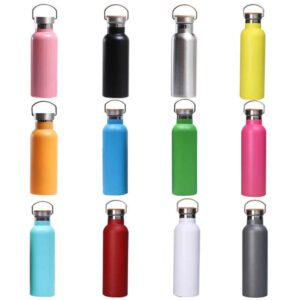
Custom Insulated Water Bottles
Compliance is the part of a drinkware program that cannot be fixed after the container ships. A bottle that fails a migration test at the destination port is not a quality issue, it is a stranded inventory issue. This page covers the food-contact framework by market, what a migration report actually contains, what factory audits look for, and which documents to request before placing an order.
The food-contact framework differs by market
United States: food-contact articles fall under FDA regulation, and for coatings and repeated-use articles the relevant reference is 21 CFR 175.300 together with the food-additive and prior-sanctioned-substance provisions. Compliance is demonstrated through material declarations and, where required, extraction testing.
European Union: Framework Regulation (EC) 1935/2004 sets the general safety requirement, and Germany’s LFGB is the reference most retail buyers in the EU actually ask for. LFGB testing covers overall migration and, for plastics and coatings, specific migration of relevant substances.
China: GB 4806 series governs food-contact stainless steel and coatings. Orders produced in China but sold elsewhere still need to satisfy the destination market, so the test plan should follow the destination, not the origin.
The practical consequence: the same bottle may need different documentation for a US retailer and a German retailer. Confirm the destination market before the test plan is written, not after.
What a migration report should contain
A report that states only “passed” is not useful for a buyer. A usable report names the test standard and the simulant used, the exposure conditions (time and temperature), the detection limit, and the measured value against the limit. It should identify the sample by article number and, ideally, by production batch.
Watch for reports run on a sample that is not the production article — a different coating, a different steel grade, or a prototype. A report is only evidence for the article it names.
Factory audit expectations
Social compliance audits such as amfori BSCI or Sedex SMETA are separate from product testing and answer a different question: whether the site can be used by a brand without reputational exposure. They examine working hours, wage records, safety systems, chemical storage and subcontracting.
Quality-system certification such as ISO 9001 indicates that documented process control exists. It does not certify the product. Buyers who treat ISO 9001 as a product certificate usually discover the gap at inspection.
Batch traceability
Traceability is what makes a defect investigation possible. At minimum, a batch code should link the finished bottle to the steel lot, the coating lot, the production date and the inspection record. Without it, a single failed test forces a recall of everything in the shipment.
Ask how the code is applied and where it is recorded. A code printed on the carton but not on the bottle cannot be traced once the bottle enters a warehouse.
Pre-shipment inspection
Inspection is normally sampled to an AQL level rather than run on every unit, so the sampling plan and the defect classification matter as much as the inspection itself. Critical defects — leaks, sharp edges, food-contact contamination — should be treated separately from cosmetic defects, because the acceptable quality level for each is different.
The most common structural mistake is inspecting before the vacuum is pulled and the printed decoration has cured. Both change the failure profile, so inspection has to happen after the finished article exists.
Documentation pack to request
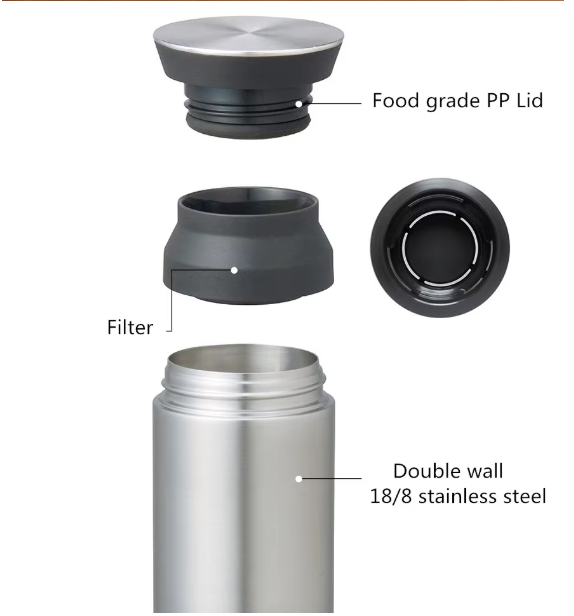
- Material declaration for inner shell, outer shell and all coatings
- Migration test report naming the standard, simulant, conditions and measured values
- Social audit report with the current validity period
- Quality-system certificate, scoped to the producing site
- Batch traceability method, with a sample code decoded
- Inspection plan, including AQL levels and defect classification
Request the pack before the order, not with the shipping documents. A document that arrives after production has started can only tell you what went wrong.
Thermal retention — double-wall vacuum series
| Initial fill (boiling water to brim, lid on) | 100°C |
| After 6 hours | 75°C |
| After 24 hours | 60°C |
Typical values for our double-wall vacuum series. Actual retention varies with fill level, ambient temperature, pre-heating and lid fit. Lot testing available on request before you commit to a specification.
Ordering & lead time
| Minimum order quantity | 100 pcs per SKU |
| Sampling lead time | 3 days |
| Production lead time | 7 days |
| Monthly capacity | 100,000 pcs |
Lead times apply to existing tooling and standard colours. New mould development or custom colour matching carries its own schedule — confirm before committing to a delivery date.
Need this bottle in your own spec?
Send capacity, material and finish requirements. We will confirm mould availability and come back with the next steps.
get a quote for this bottle