Last updated: October 27, 2026
Most conversations about lead in stainless steel drinkware go wrong in the first sentence. A buyer asks a factory “is your bottle lead-free?” The factory says yes. The buyer feels reassured. Six months later a retailer’s compliance team runs a handheld XRF unit across a base cap, sees a number that looks alarming, and the whole shipment gets frozen while three parties argue about what was actually measured.
The argument happens because “lead-free” is not a testable property of a bottle. It is a claim about a set of parts, each made from a different material by a different supplier, joined by different processes. A vacuum-insulated bottle is not one material. It is a stainless shell, a stainless liner, a weld or braze at the seam, a solder or weld plug sealing the vacuum port, a powder coat or print layer, a silicone gasket, a polypropylene or Tritan lid, sometimes a brass thread insert, a decorative ring, a bamboo coaster, a gift box. Lead and other heavy metals have historically entered that assembly through a handful of those components — and, importantly, through processes that are one supplier change away from reappearing.
This article is a working plan for procurement and QA teams at brands, retailers and importers who buy drinkware from contract manufacturers and need a defensible answer on heavy metals — not a reassurance, not a scare story. It maps where lead realistically hides, explains why a sealed interior joint and a lickable rim are treated differently by regulators, lines up the US and EU limits that actually apply to each part, and gives you the sampling and documentation structure to write into a purchase order.

Why Is Heavy Metals in Drinkware a Component Problem, Not a Steel Problem?
Because food-grade stainless strip is one of the cleanest inputs in the entire bill of materials, and it is almost never where a failure originates. Grade 304 or 316L sheet arriving from a mill with a mill test certificate and a controlled scrap percentage is a mature, well-specified product. Lead is not an intentional alloying element in 304 or 316L, and reputable mills keep residual lead far below any regulatory threshold because it comes in with scrap, not with intent.
What does fail — in enforcement actions, in retailer test reports, and in the recall record — is the small stuff around the steel. The solder that seals a vacuum port. The pigment in a coating. The stabiliser in a recycled polymer. The free-machining brass insert that machines beautifully precisely because lead is part of its formulation. Those are the components where a specification gap turns into a compliance event, and they are the components that a “we use 304 steel” answer does not address at all.
This is why we structure every heavy-metals program by component and process, not by product. The unit of control is not “the bottle.” It is “the base cap, the port seal, the exterior coating, the gasket, the lid polymer, and any metal trim.” Each of those has an owner, a material declaration, a test method and an acceptance limit. When one of them changes — a new solder supplier, a new powder coat colour, a switch from virgin to recycled PP — only that line of the program needs re-verification. A product-level “%”claim collapses entirely when any single input changes.
Where Does Lead Actually Hide in a Vacuum-Insulated Bottle?
In our experience auditing drinkware bills of materials, risk concentrates in five places, in roughly this order.
1. The vacuum port seal. After the air is evacuated from the space between the two walls, the port must be closed. Factories do this by resistance welding, laser welding, or by feeding a small amount of solder or braze into the port and capping it. Where solder is used, the alloy is the single highest-risk item in the product: certain tin-lead and leaded bronze filler alloys are cheap, flow well, and were standard practice in the industry for years. Lead-free alternatives exist and are widely used, but they cost more and require tighter process control, so they are exactly the kind of item that quietly reverts during a cost-down.
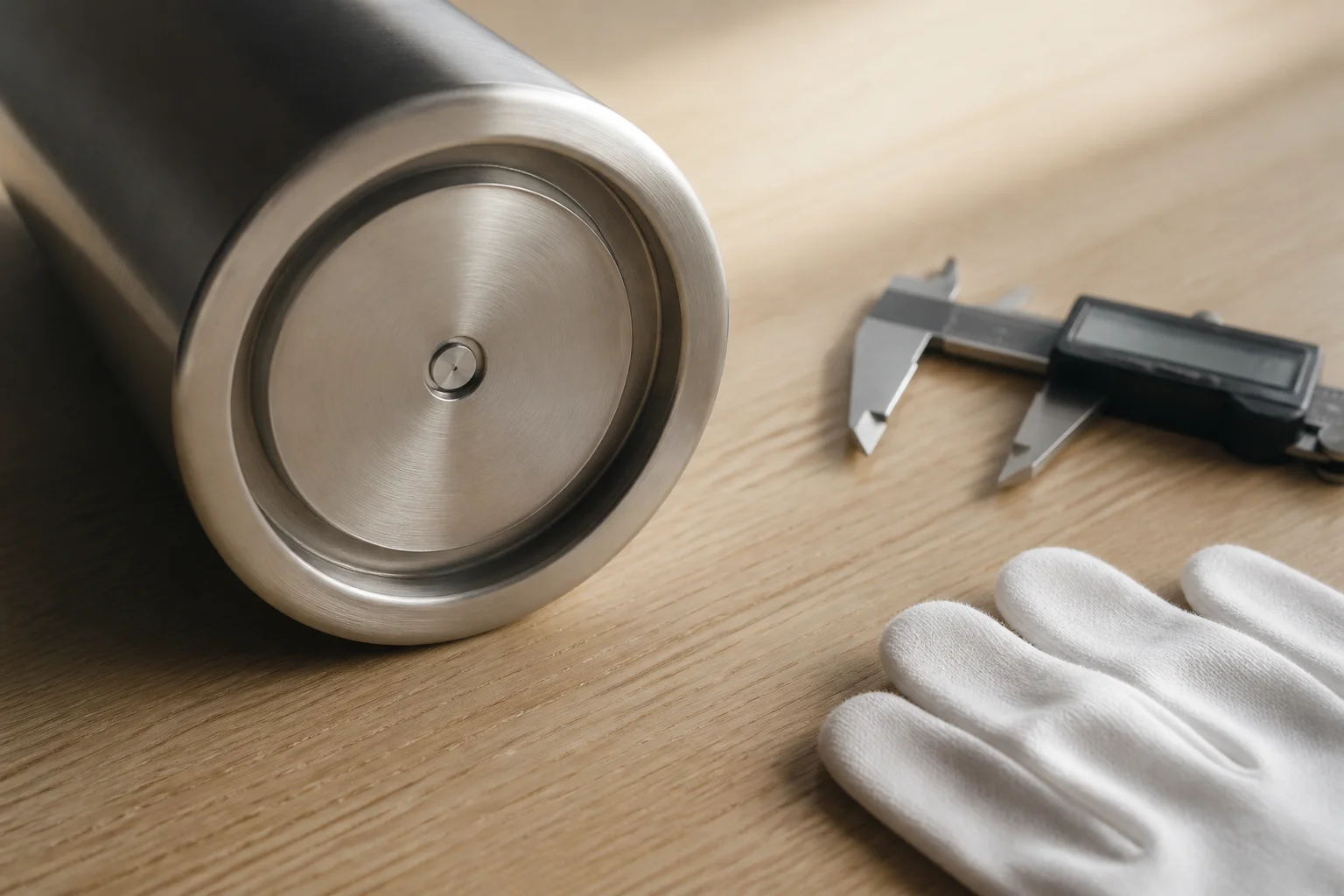
2. Base caps and cover discs. The port is usually hidden under a stamped disc that is press-fit or spot-welded on, sometimes with adhesive. That disc, its plating and its adhesive are all separate inputs. Enforcement history in children’s drinkware has focused precisely here: when a base disc detaches, a lead-containing solder dot that was previously inaccessible becomes accessible to a child. That is the mechanism behind the children’s cup recalls of the past several years, and it is a design-for-accessibility issue as much as a materials issue.
3. Coatings, inks and marking. Powder coat, liquid paint, sublimation film, UV-cured ink, pad-printed logos, laser-annealed marks. Pigments based on lead chromate are the classic hazard; they are inexpensive, opaque and heat-stable, and they appear in yellows, oranges and reds more than in other hues. Sublimation and UV inks can also carry heavy-metal pigments. Laser marking is the lowest-risk option of the group because it removes or oxidises the existing surface rather than adding material, but it still leaves an oxide layer that should be characterised if the mark sits on a rim.
4. Polymer and elastomer parts. Silicone gaskets, PP or Tritan lids, TPE grips, AS or PC collars. Lead appears here less as an intentional additive and more as contamination in recycled feedstock, in colour masterbatch, or in stabiliser packages from low-tier compounders. Recycled polypropylene is the specific watch item: an unverified recyclate stream can carry pigments and stabilisers from unknown prior use.
5. Brass and copper trim. Thread inserts, decorative rings, handle ferrules, badge plates. Free-machining brass is often alloyed with lead deliberately — typically in the 1–3% range for high-machinability grades — which puts it far above any 0.05% threshold. This is the component most likely to be missed, because it is small, considered “decorative,” and frequently sourced by the accessory supplier rather than the bottle factory.

What Is the Difference Between a Sealed Vacuum Port and an Accessible Surface?
This is the distinction that decides most arguments, and it is a legal distinction before it is a chemistry one.
US consumer product law does not regulate lead in “products.” It regulates lead in paint and surface coatings (16 CFR Part 1303, which bans lead-containing paint above 0.009% — 90 ppm — by weight of the dried film on consumer products and children’s articles), and it regulates total lead content in accessible substrates of children’s products (15 U.S.C. §1278a, which set the limit at 100 parts per million total lead by weight for any part of a children’s product). The operative word in the second rule is accessible. CPSC’s accessibility framework at 16 CFR Part 1500 addresses which parts of a product a child can reach during normal use and foreseeable abuse. A solder plug sealed inside an evacuated chamber behind a welded disc is, in normal use, not accessible. The same plug becomes accessible the moment the disc detaches.
That is not a technicality that lets anyone off the hook — it is the reason design integrity matters so much. A leaded solder joint that cannot be reached is a different legal object from a leaded solder joint under a cap that a three-year-old can pry off. For adult drinkware sold in the US, the direct federal exposure is narrower: the coating rule applies to all consumer products, and CPSC can act on an accessible lead hazard as a substantial product hazard under the FHSA/CPSA framework. For children’s drinkware, the 100 ppm accessible-substrate rule is squarely in play, and it is enforced.
The EU reaches the same physical situation from a different direction. REACH Annex XVII entry 63, as amended by Commission Regulation (EU) 2015/628, restricts lead in articles or accessible parts supplied to the general public that may, under normal or reasonably foreseeable conditions of use, be placed in the mouth by children. The threshold is 0.05% by weight (500 ppm) expressed as lead metal. The regulation defines the mouthing test geometrically: a part is treated as mouthable if it is smaller than 5 cm in one dimension, or has a detachable or protruding part of that size. There is an alternative compliance route — demonstrate that lead release does not exceed 0.05 µg/cm² per hour — and for coated articles the coating must hold that release rate for at least two years of normal use. Brass alloys get a separate derogation up to 0.5% lead, which is precisely why the brass insert deserves its own line in your BOM rather than being folded into “metal parts.”
So the practical rule for buyers: classification follows accessibility, and accessibility follows design and durability. Ask three questions of every lead-bearing component. Is it reachable in normal use? Can it become reachable through foreseeable abuse, drop, dishwasher cycling, or adhesive failure? And is the article one that a child could mouth? If the answers are no, no, no, you have a documented position. If any answer is uncertain, you have a test to run, not an argument to win in an email.
Which Regulatory Limits Apply, and to Which Parts?
The table below is the alignment matrix we use in technical files. Treat the limits as legal floors, not as targets — a factory working to the exact legal limit has no margin for measurement uncertainty or material variation.
| Rule | Limit | Applies to | Source |
|---|---|---|---|
| 16 CFR Part 1303 (lead-containing paint ban) | 0.009% (90 ppm) lead by weight of dried paint film | Paint and similar surface coatings on consumer products and children’s articles | eCFR, 16 CFR §1303.1 |
| CPSIA total lead content, 15 U.S.C. §1278a | 100 ppm total lead by weight, any accessible part | Children’s products — includes kids’ bottles, cups and lunch kits | 15 U.S.C. §1278a(a)(2)(C) |
| REACH Annex XVII, entry 63, paragraph 7 | 0.05% (500 ppm) lead by weight of any accessible part; alternative route 0.05 µg/cm²/h release | Articles supplied to the general public where an accessible part under 5 cm may be mouthed by children | Commission Regulation (EU) 2015/628 |
| REACH Annex XVII, entry 63, paragraph 8(g) | 0.5% lead permitted in brass alloys | Derogation for brass alloy articles and parts — the reason brass inserts need their own declaration | Commission Regulation (EU) 2015/628 |
| California Proposition 65, lead | NSRL 15 µg/day (oral, cancer); MADL 0.5 µg/day (reproductive) | Exposure-based — a warning is required above the safe-harbour level unless exposure is shown to be below it | OEHHA safe harbour list |
| FDA food-contact framework, 21 CFR Part 175 | No single numeric lead limit for metalware; resinous coatings must meet prescribed extraction tests | Interior coatings and liners, and the general “unsafe additive” standard for food-contact articles | eCFR, 21 CFR §175.300 |
Two things about this table are worth stating plainly, because they are where misinformation usually enters.
First, the US and EU numbers are not competing answers to the same question. The 90 ppm figure governs coatings; the 100 ppm figure governs accessible substrate in children’s products; the 500 ppm figure governs mouthable accessible parts in the EU. A single bottle can be simultaneously compliant with one, non-compliant with another, and outside the scope of a third. That is normal, and the technical file should say so explicitly rather than quoting a single headline number.
Second, Prop 65 is an exposure statute, not a content statute. A part can contain lead and still sit below the safe-harbour exposure level; conversely, a low-content part with high surface availability can create a warning obligation. This is why content testing alone does not close a Prop 65 file. It is also why the Prop 65 analysis for drinkware deserves its own document — our importer guide to Proposition 65 for stainless steel drinkware walks through the exposure calculation, and this article does not repeat it.
How Do You Build a Component-Level Test Plan That Survives an Audit?
Two-tier testing. Screen everything with XRF, confirm the exceptions with ICP-MS. Not the other way round, and not one tier alone.
Tier 1 — XRF screening, on every component, at every lot change. Handheld or benchtop X-ray fluorescence is fast, non-destructive and cheap per reading. It gives you total elemental composition in the near-surface volume, which is exactly what you need to catch a leaded solder, a leaded pigment or a brass insert before it becomes a shipping problem. Its limitation is equally important: XRF measures what the beam sees, it is matrix-dependent, and it can produce false positives from surface contamination and false negatives through thick coatings or odd geometries. Treat XRF as a go/no-go screen with a defined margin, never as a compliance certificate.
Tier 2 — ICP-MS confirmation, on any XRF flag and on a defined periodic basis. Acid digestion followed by inductively coupled plasma mass spectrometry gives you quantitative total lead at single-digit ppm resolution with a documented detection limit. This is the method that produces a number you can defend to a retailer’s compliance team or a regulator. For coatings, you are testing the dried film; for substrates, the base material; for the rim and any mouth-contact surface, the as-shipped condition. Where the question is release rather than content, you need migration testing under the relevant standard rather than digestion.

What Should XRF Screening Actually Look Like on a Production Line?
It should look boring, repeatable, and documented. In a well-run program the QC window looks like this:
- Reading points are fixed by drawing. Each component has a marked measurement location — port plug centre, base cap exterior, interior wall, rim edge, gasket cross-section, lid thread root. The same point is measured every time, because XRF readings drift with geometry and the only way to compare lots is to compare like with like.
- Every reading is logged with its part number, supplier lot and date. A number without a lot code is anecdote, not evidence.
- Internal action limits sit well below legal limits. A common specification window is an internal screen limit at roughly half the applicable legal threshold, with any exceedance triggering immediate quarantine plus ICP-MS confirmation. That margin is not regulatory — it is an allowance for measurement uncertainty, coating thickness variation and the fact that a supplier’s next lot may not be identical to the sample you approved.
- New colours, new solder lots and new polymer lots are screened even if the part number has not changed. Most failures we have seen were not new products. They were the same product with a substituted input.
When Do You Need ICP-MS Confirmation Instead of XRF?
In four situations, and only the fourth is discretionary.
When XRF flags anything. A screen result above the internal action limit is a hypothesis, not a finding. Confirm or clear it with digestion and ICP-MS before you quarantine a container or notify a customer.
When a component is geometry-hostile to XRF. Curved rims, thin gaskets, multi-layer coatings and small brass inserts all produce readings you cannot defend. If the beam cannot see a representative volume, the screen result has no evidentiary value.
When the part serves a children’s product. For kids’ drinkware, the 100 ppm accessible-substrate limit is close enough to typical XRF uncertainty that a screening result is not a compliance determination. Quantify it.
When a customer or retailer asks for it. Some retail compliance programs accept only accredited-laboratory ICP-MS data on a defined sampling plan. In that case the XRF program is your internal control and the lab report is the deliverable.
One practical note on laboratory selection: use a lab accredited to ISO/IEC 17025 for the specific test method, and require the report to state the method, the digestion procedure, the detection limit and the sample preparation — including whether coatings were abraded from the substrate or tested in place. Two reports can disagree simply because one tested the film and the other tested film plus substrate.
Which Materials in the BOM Need a Declaration, and What Should It Say?
Every material that touches the product, and every process that adds material. In practice that means a declaration set like this:
| Component | Primary hazard | Declaration required | Verification |
|---|---|---|---|
| Vacuum port seal (solder / braze / weld) | Lead in filler alloy | Alloy designation, UNS/ISO number, lead content as declared by the filler manufacturer, plus the sealing process (weld vs. solder) | XRF at port + ICP-MS on filler sample |
| Base cap / cover disc + adhesive | Coating pigment, plating, adhesion failure exposing port | Substrate grade, coating system, adhesive SDS, retention force spec | XRF on disc + pull/retention test per drawing |
| Exterior coating / print / mark | Lead chromate and other heavy-metal pigments | Coating supplier’s heavy-metals statement per colour, batch-linked | XRF per colour + ICP-MS on dried film |
| Rim and mouth-contact zone | Ink or oxide at the lip line | Confirmation that no print or coating enters the mouth-contact band | XRF at rim + migration test where required |
| Silicone gasket / seals | Compound contamination, filler pigments | Food-contact grade statement (FDA 21 CFR 177.2600 or EU 10/2011 equivalence), heavy-metals statement | Supplier COA per lot + periodic ICP-MS |
| Lid polymer (PP / Tritan / AS / PC) | Recyclate contamination, stabilisers, pigments | Virgin vs. recycled content declaration with percentage; grade datasheet; food-contact statement | XRF screen + ICP-MS on flagged lots |
| Brass / copper trim, inserts, badges | Intentional lead in free-machining brass (often 1–3%) | Alloy grade and measured lead %, plus confirmation of which REACH derogation is claimed | ICP-MS mandatory — XRF alone is insufficient |
| Wood, bamboo, cork accessories | Preservative and coating carryover | Finish declaration, food-contact suitability | Coating XRF + supplier statement |
Note what is absent: the stainless body and liner. They still need their mill certificate, grade declaration and passivation record — but that is a different control, covered in our guide to SUS 304 food-grade testing claims. Mixing steel-grade verification into a heavy-metals table is how programs get long and useless.
How Should the Test Plan Be Written Into the PO and the Technical File?
A test plan that lives in a QA spreadsheet and not in the purchase order is a suggestion. The PO is the only document that reliably travels with the money, so the compliance obligations have to be in it, phrased as acceptance criteria rather than hopes.
Material declaration as a condition of acceptance. Require, per PO: a signed declaration of the sealing process for the vacuum port (weld or solder, and if solder, the alloy designation); a heavy-metals statement per coating colour; a food-contact statement for every polymer and elastomer; and an alloy grade plus measured lead content for any brass or copper part. Make the declaration a deliverable with a due date, not a document you chase after the goods ship.
Named test methods and acceptance limits. Do not write “lead-free.” Write the method and the number: XRF screen on defined points with an internal action limit; ICP-MS confirmation with a stated detection limit; acceptance at or below the applicable regulatory limit with the specific regulation cited. Where the EU release-rate route is being used for a coated part, name the release test and the two-year coating-integrity requirement in the clause, because that is the part of the derogation that most suppliers overlook.
Change notification. A clause that any change to solder alloy, coating system, polymer grade or brass supplier triggers prior written notice and re-testing at the supplier’s cost. This single clause prevents most of the failures that occur after a successful first shipment, because it converts a silent substitution into a contractual event.
Records retention and audit access. Test reports, XRF logs and declarations retained for a defined period and produced on request; reasonable access to the production line and to sub-supplier declarations. Retail compliance teams increasingly ask for lot-level traceability, and a factory that cannot produce it becomes a bottleneck at the worst possible moment.
Remediation and cost allocation. Who pays for testing if a lot fails at the port of entry, who owns the scrap, and what the credit mechanism is. These clauses are unpleasant to negotiate and enormously valuable when they are needed.
Does an Interior, Non-Contact Solder Joint Still Create Liability?
Yes — for three reasons that are worth separating, because they are often conflated into a vague sense of unease.
Reason one: accessibility is not permanent. The classification of a part as “inaccessible” depends on the design holding. A base cap retained by adhesive, a press fit that relaxes through thermal cycling, a disc that deforms in a dishwasher — each is a pathway from inaccessible to accessible. Regulators do not evaluate your product as designed; they evaluate it as used, including foreseeable abuse. Our view is that a design whose compliance depends on an adhesive joint surviving five years should be treated as compliance-relevant, not as a technicality.
Reason two: end-of-life and repairability. Recycling streams, disassembly for material recovery, and increasingly product-passport style disclosure all push toward knowing what is inside. A leaded solder plug inside a bottle is a material disclosure item regardless of whether a consumer can touch it.
Reason three: reputational asymmetry. A third-party teardown video showing a lead-containing solder dot in your base is a far larger commercial event than the cost of specifying lead-free filler in the first place. The physics does not care about intent, and neither does a headline.
The balanced position — the one we recommend to buyers — is this: do not treat a sealed leaded joint as an automatic product safety emergency, and do not treat it as a non-issue. Characterise it, document the accessibility analysis, verify the retention design, and where the cost differential is modest, specify lead-free from the start so the question never arises. Panic and complacency are both expensive; documentation is cheap.
What Does a Realistic Sampling Plan Look Like Across a Year of Production?
Sampling is where compliance programs usually fail, because they are built for a single approval shipment rather than for a year of production. A workable structure looks like this:
| Trigger | Scope | Method | Output |
|---|---|---|---|
| New SKU or new BOM revision | All components in the teardown | XRF on every part, ICP-MS on brass, solder and all coatings | Full component report + declaration pack |
| Pre-production sample approval | Golden sample, as shipped | XRF at fixed points; ICP-MS on any flagged part | Approved sample record with readings attached |
| Each production lot (ongoing) | Port seal, base cap, rim, one coating colour, gasket | XRF screen, lot-linked | Lot screening log |
| Any material substitution | The substituted part only | XRF + ICP-MS | Change-notification record |
| Annual surveillance | One SKU per family per year, rotated | Accredited-lab ICP-MS on the full component list | Third-party report for the technical file |
| Regulatory change or retailer request | Affected parts across the range | Defined by the request | Targeted report + gap analysis |
The logic of the plan is that the annual accredited report is your evidence, and the lot-level XRF logs are your early-warning system. Buyers who rely only on the annual report discover problems a year late. Buyers who rely only on XRF logs have no defensible number when challenged. You need both, and the total cost is small relative to the value of a container.
Where Do Buyers Most Often Get This Wrong?
Eight failure patterns, in the order we encounter them.
Accepting a product-level certificate. A report headed “stainless steel bottle — lead: pass” that does not say which parts were sampled tells you almost nothing. The first question to ask of any lab report is: which component, prepared how?
Testing the wrong surface. A report on the bottle interior does not cover the powder coat. A report on the powder coat does not cover the base cap. Coverage must map to the teardown.
Ignoring the accessories. Gift boxes, coasters, brushes, straps, carabiners and printed sleeves are part of the delivered product and often sourced from different vendors with no declaration at all.
Confusing migration with content. A low total content does not guarantee low release on a scratched coating, and a high content in an inaccessible part does not automatically create an exposure. Match the test to the question.
Skipping the coating-integrity question. Under the EU release-rate route, the coating must hold performance for at least two years of normal use. Adhesion and abrasion testing belong in the same conversation as the chemistry.
Letting the declaration expire silently. Supplier statements with no revision control become fiction within two years. Date them, link them to a material revision, and re-collect on a schedule.
Treating kids’ products as scaled-down adult products. The 100 ppm accessible-substrate rule, the accessibility analysis and the retention requirements for small parts make children’s drinkware a different program. Our comparison of FDA, LFGB and GB 4806.9 requirements for kids’ drinkware covers the jurisdictional differences.
Not testing the lid liner. If the lid uses a liner or seal with a coating or a plasticiser package, that material is in direct contact with the beverage and belongs in the food-contact file — the same reasoning that drove the EU’s recent BPA restriction, which we covered in our analysis of BPA-free lid liners.
How Do You Keep the Program Alive After the First Shipment?
Three habits separate programs that hold up from programs that decay.
Bind compliance to the BOM revision, not to the calendar. When the BOM changes, the compliance file changes with it, in the same document control system. A calendar-based review tells you what was true last year; a revision-based one tells you what is true of the goods being made today.
Put the data where operations can see it. Lot-level XRF results should sit next to the AQL inspection record, not in a compliance folder nobody opens. If the QC team already checks wall thickness and lid torque, heavy-metals screening belongs in the same routine, with the same escalation path.
Audit the sub-tier, at least on paper. Most heavy-metals surprises originate one level below your assembler: the solder supplier, the coating supplier, the compounder. You do not need to visit them. You need their declarations, their grade designations and a contractual obligation that flows down. Our pre-shipment QC checklist shows where heavy-metals screening sits relative to dimensional, functional and packaging checks in a normal inspection sequence.
The Bottom Line for US and EU Buyers
Lead in drinkware is not a mystery and it is not a scandal waiting to happen to every importer. It is a component-control problem with a known set of risk locations, a known set of legal thresholds, and a testing sequence that costs very little relative to the value of a shipment. The buyers who get into trouble are almost never the ones who ignored the topic — they are the ones who asked a product-level question and accepted a product-level answer.
Three things are worth doing this quarter, regardless of where you are in a development cycle. Build the teardown and name every component, including accessories and the parts you did not source yourself. Write the declaration and testing obligations into the PO as acceptance criteria with a change-notification clause. And get one accredited ICP-MS report on a full component list so that your first data point is evidence rather than a supplier’s assurance.
If you are specifying a new program and want the heavy-metals control plan built into the quotation stage rather than retrofitted after a retailer question, our manufacturing and QA team can walk through your BOM component by component and tell you where the risk actually sits.
About the author
This article was written by the manufacturing and QA team at oemwaterbottle.com, a contract manufacturer of vacuum-insulated stainless steel drinkware supplying OEM and private-label programs to North American and European brands. The team runs component-level heavy-metals screening, accredited third-party testing coordination and factory audit programs for importers, and has supported customers through CPSIA, Prop 65, REACH and food-contact documentation reviews.
Questions about a specific BOM, or want a component teardown reviewed before you place a PO? Talk to our team →
Frequently Asked Questions
Is lead actually used in stainless steel water bottles?
Not in the stainless steel itself — grade 304 and 316L do not use lead as an alloying element. Lead has historically appeared in components around the steel: leaded solder used to seal the vacuum port, lead-chromate pigments in coatings, and free-machining brass inserts where lead is added deliberately for machinability. Each of those is a separate specification item.
Does a sealed lead solder dot inside the base violate US rules?
Not automatically. US rules key on accessibility: the 100 ppm total-lead limit for children’s products applies to accessible parts, and the 90 ppm coating limit applies to paint and surface coatings. A joint sealed behind an intact base disc is generally not accessible, but the analysis depends on the retention design holding through use and foreseeable abuse.
What is the difference between 90 ppm and 100 ppm lead limits?
The 90 ppm figure comes from 16 CFR Part 1303 and governs lead in paint and similar surface coatings on consumer products. The 100 ppm figure comes from 15 U.S.C. §1278a and governs total lead content in any accessible part of a children’s product. They address different materials and different product categories, so one does not replace the other.
Do I need XRF and ICP-MS, or is one enough?
Use both, in sequence. XRF is a fast non-destructive screen that catches substituted solder, pigments and brass before assembly; ICP-MS is the quantitative confirmation that produces a defensible number. Relying on XRF alone leaves you with readings you cannot defend, and ICP-MS alone is too slow and costly for lot-level control.
How does REACH entry 63 apply to an adult water bottle?
Entry 63, as amended by Regulation (EU) 2015/628, restricts lead to 0.05% by weight in articles or accessible parts supplied to the general public that may be placed in the mouth by children — a part counts as mouthable if it is under 5 cm in one dimension. A demonstratable release rate of 0.05 µg/cm² per hour is an alternative route, and brass alloys have a separate 0.5% derogation.
Can I rely on a supplier’s “lead-free” certificate?
Only as a starting document, not as evidence. A meaningful certificate names the component, the test method, the detection limit, the laboratory’s accreditation and the lot or material revision it covers. A one-line statement that a finished bottle is lead-free does not tell you which parts were sampled or how they were prepared.
How often should drinkware be retested for heavy metals?
Screen every lot at fixed points with XRF, confirm any flag with ICP-MS, and commission one accredited full-component report per SKU family per year on a rotating basis. Also retest immediately on any material substitution — a new solder lot, coating colour, polymer grade or brass supplier is a new compliance question.
What should the purchase order say about heavy metals?
Name the components, the test methods, the acceptance limits and the specific regulations. Add a change-notification clause requiring written notice and re-testing before any substitution of solder, coating, polymer or brass, plus records retention and access to sub-supplier declarations. Acceptance criteria belong in the PO, not only in a QA spreadsheet.