Last updated: October 19, 2026
Most sourcing teams treat the AQL line in a purchase order as a quality preference. Something to argue about at the end of a factory visit, then write down as “2.5 major / 4.0 minor” because that is what the last supplier accepted. We think that is the wrong frame, and it is an expensive one.
An AQL is a cost equation with two sides. On one side sits what you pay to inspect: the third-party man-days, the extra days of container detention, the samples you destroy, the production you hold while a report is written. On the other side sits what you pay when a defect escapes: the retailer deduction, the return freight, the replacement run, the warranty claim, the marketplace suspension, and — in the worst cases — the recall. Move the AQL down and the first number rises roughly linearly. The second number does not rise linearly at all. It jumps at the point where a defect class stops being a nuisance and starts being a safety or compliance event.
This article is about where that jump happens for stainless steel drinkware, how to write an AQL that survives contact with a real inspection, and how to connect it to the warranty and chargeback language in your supply agreement so the two documents describe the same deal.
AQL levels are easier to apply when read against the defect profile of a specific format rather than a category average. In our current line, Leakproof 64oz 128oz Jug Water Bottle, Large Capacity Portable Motivational GYM Water Bottles and 1500Ml Portable Plastic Drinkware are the closest matches.
Why Is AQL a Financial Decision Rather Than a Quality Preference?
Because AQL does not measure quality. It measures the risk you are willing to accept that a bad lot passes. Those are different things, and confusing them is how buyers end up with a 2.5 AQL that protects nothing.
Acceptance sampling is a gate, not a filter. A lot that passes inspection is not a clean lot; it is a lot whose sample did not contain enough defects to cross the rejection number. The defects that were in the unsampled portion are still in the container. They will arrive at your 3PL, get counted by a receiver, and turn into either a return, a deduction, or a customer complaint — depending on who notices first.
What Does an AQL Number Actually Promise You?
Under ISO 2859-1, the AQL is the quality level that carries a 95% probability of acceptance under normal inspection. Read that again with the emphasis on “95%”. An AQL of 2.5% does not mean “2.5% defects is fine”. It means a process running at 2.5% nonconforming still gets accepted about 19 times out of 20. The standard pairs this with a limiting quality (LQ) — the defect level at which the probability of acceptance falls to about 10%. The gap between those two points is the grey zone where most disputes live.
That gap is not a flaw in the standard. It is the standard telling you, honestly, that sampling cannot separate a 2% lot from a 4% lot with any confidence at moderate sample sizes. If your commercial exposure depends on telling those two apart, you need a different mechanism: tighter AQL plus a larger sample, 100% functional testing on the critical characteristic, or a process control requirement upstream.
The practical translation: an AQL of 2.5 on major defects is a statement that you accept roughly a one-in-twenty chance of passing a lot that is meaningfully worse than 2.5%. Multiply that by the number of lots you ship per year and you have your expected number of bad-lot events. That number, not the AQL itself, is what you are budgeting for.
Where Does the Money Actually Leak?
Four places, and only one of them shows up in the quality department’s budget.
Inspection cost. Third-party inspection on a drinkware order typically consumes one to two man-days on site, plus travel, plus report turnaround. It is a fixed cost per lot, which means it behaves badly at small lot sizes and becomes almost free at large ones. This is the side of the equation everyone counts.
Freight and duty on dead units. A leaking bottle that reaches a US warehouse has already been ocean-freighted, duty-paid, and handled twice. You paid full landed cost for a unit with zero resale value, and now you pay again to move it to a landfill or back to Asia.
Retail deductions. This is the quiet one. Retail compliance programmes assess per-occurrence charges for labeling, carton marking, ASN and ticketing failures, and quality-related refusals at the DC. A single mislabeled carton can generate a deduction that exceeds the margin on the carton’s contents. Our guidance on retail-ready packaging and drop-test compliance covers the packaging half of this; the defect half is what AQL governs.
Warranty and liability. A vacuum failure at month seven is a warranty claim. A vacuum failure that scalds someone is a liability claim. The second is rare, but it is the reason the first must be treated as a critical defect rather than a major one. If you carry US distribution, the interaction between quality escapes and coverage is worth reading alongside our note on product liability insurance and indemnity.
What Do Critical, Major and Minor Defects Mean for Drinkware?
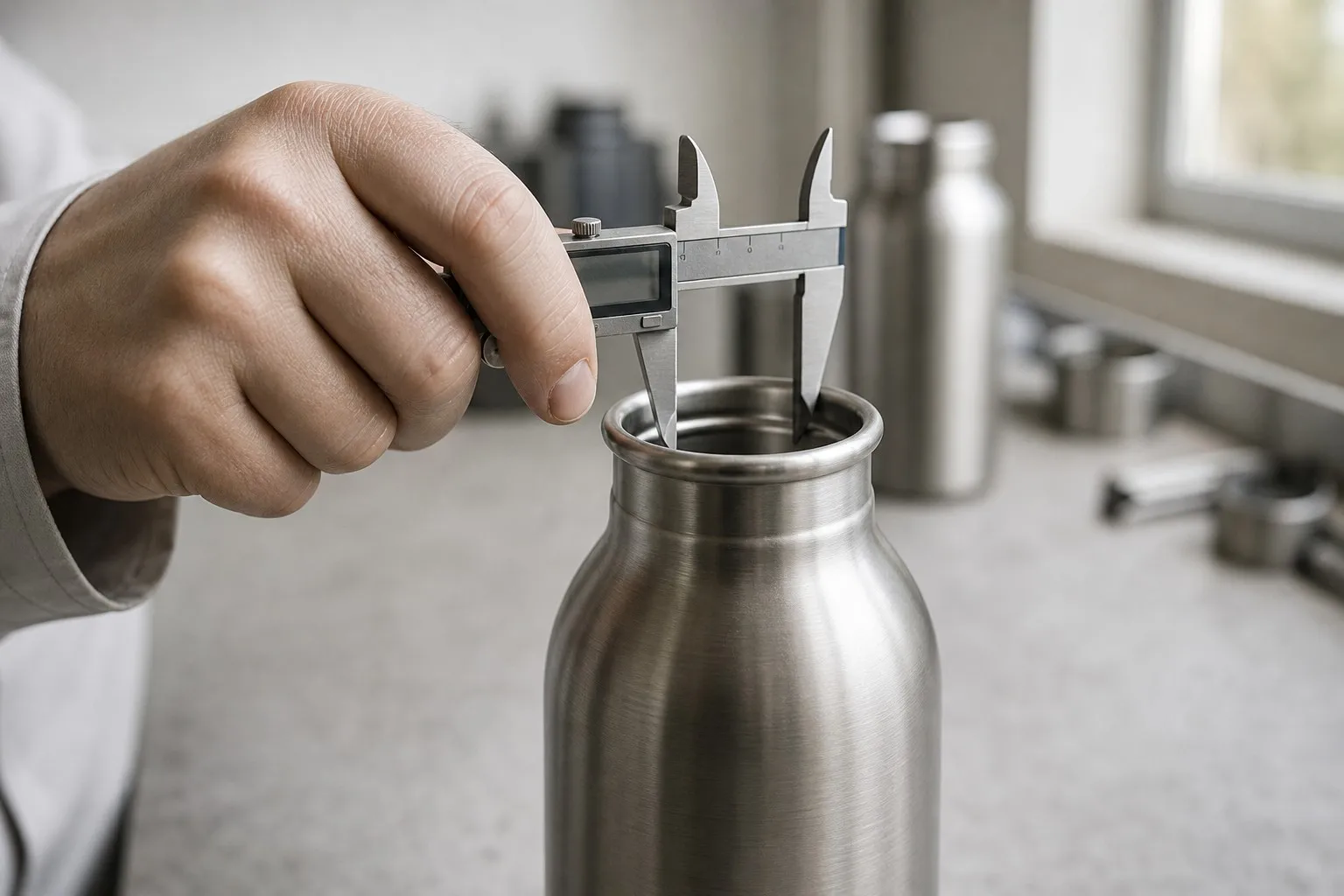
Generic defect classifications are useless because they were written for electronics. A scratch is minor on a phone case and major on a powder-coated bottle that will be photographed for a brand campaign. The classification has to be built around what the product does and who it can hurt.
We use three classes, and we insist the class definitions live in the purchase order rather than in a supplier’s own inspection standard, because that is the document a third-party inspector will actually read on the floor.
Published inspection guidance converges on a similar default for consumer goods — critical defects at zero acceptance, major at AQL 2.5 and minor at AQL 4.0 — which is why that triplet appears in so many purchase orders even when nobody can explain where it came from. QIMA’s AQL guidance treats 4.0 as the level where minor cosmetic defects are acceptable, and 2.5 as the common major-defect setting. That is a starting point, not a specification for drinkware.
| Class | Definition | Drinkware examples | Typical acceptance |
|---|---|---|---|
| Critical | Creates a safety, regulatory or functional failure the end user cannot detect before use. | Vacuum loss on a double-wall body; lid that releases under internal pressure; coating lead content above the legal limit; sharp exposed edge at the rim; wrong liner material in a food-contact zone. | Ac = 0 on the sample, or 100% test on the characteristic. |
| Major | Product is usable but fails a stated function, or would be rejected by a reasonable consumer at full price. | Weld seam seepage under a leak test; coating adhesion failure on a cross-hatch or tape pull; thread burr that binds the lid; capacity shortfall beyond tolerance; logo off-register by more than the agreed limit. | AQL 1.0–2.5 depending on channel. |
| Minor | Cosmetic deviation within a defined visual standard; does not affect function or saleability at normal viewing distance. | Faint polishing marks on the base; light orange-peel in clear coat on a hidden panel; small scuff inside the lid cavity. | AQL 4.0, occasionally 6.5 on industrial-grade lines. |
Which Defects Should Be Critical Instead of Major?
Start with the question “can the customer find this before it hurts them?” If the answer is no, it is critical. Vacuum loss is the clearest case. A bottle that has lost vacuum looks normal, feels normal when cold, and fails only when someone fills it with hot liquid and puts it in a bag. You cannot inspect that at the retail shelf, which is precisely why it cannot be sampled at AQL 2.5 with an acceptance number of 14.
We specify vacuum retention as a 100% test on double-wall bodies, using a hot-water or infrared pass, with a defined hold time and a defined failure signature. Sampling then applies to the batch record and to the retest of failures, not to the functional outcome. The same logic applies to lid pressure release on carbonated-capable models and to liner material identity on anything sold into the EU.
What Counts as Major in Vacuum Ware?
Weld seam integrity, for one. A seam that weeps under a 2-minute pressure soak at the specified test pressure is major even though the unit still holds water when upright, because the failure will present itself as a leak in a bag. Coating adhesion is major because it is the leading visible complaint after six months of dishwasher cycles, and because on a painted exterior it is also the vector for substrate exposure.
Capacity is major when it misses the declared volume by more than the tolerance you published — not because 20 ml matters to a hiker, but because your label, your Amazon listing and your retail spec sheet all state a number, and a shortfall is a misrepresentation in a market where competitors screenshot spec tables.
What Is Actually Minor?
Far less than suppliers would like. The useful discipline is to define minor defects by a physical limit and a viewing condition, not by an adjective. “Faint” and “slight” are not inspectable. A workable standard reads like this: no more than two polishing marks under 3 mm on the base, visible only under direct light at 30 cm, with no effect on the brushed grain direction. An inspector can apply that. Nobody can apply “good appearance”.
How Does the Sampling Math Actually Work?
Two worked examples, both from the tables in ANSI/ASQ Z1.4-2003 (R2018), which is technically aligned with ISO 2859-1. The caliber matters: single sampling, normal inspection, general inspection level II, attribute inspection. Change any one of those four and the numbers move.
Example 1: A 24,000-Unit Lot at AQL 2.5 and 4.0
Source and caliber: ANSI/ASQ Z1.4, Table I and Table II-A, single sampling, normal inspection, general inspection level II, lot size 10,001–35,000. See the standard overview at asq.org/quality-resources/z14-z19.
The lot band 10,001–35,000 maps to code letter M, which gives a sample size of n = 315. At an AQL of 2.5, the acceptance number is 14 and the rejection number is 15. At an AQL of 4.0 on the same sample, they are 21 and 22.
So a 24,000-unit order of 750 ml bottles, inspected at level II, means someone opens 315 cartons-worth of product, checks each unit against the defect list, and writes down a count. If that count reaches 15 major defects, the lot fails. Not “the lot is bad” — the lot fails, which triggers a commercial decision: sort, rework, re-inspect, or reject.
Notice the shape of the numbers. Moving from AQL 4.0 to AQL 2.5 cuts the allowed defect count from 21 to 14 on the same 315 units. That is a 33% tighter tolerance for zero additional inspection cost, because the sample size does not change — only the acceptance number does. This is the single most under-used lever in supplier negotiation. Buyers argue about adding inspection days when what they actually want is a tighter number on the same plan.
Example 2: An 8,000-Unit Lot at AQL 2.5
Source and caliber: same standard and tables, lot size 3,201–10,000, code letter L, n = 200, AQL 2.5, single sampling, normal inspection, level II.
Acceptance number 10, rejection number 11. The sample is smaller in absolute terms, but the sampling fraction is larger: 200 out of 8,000 is 2.5%, versus 315 out of 24,000, which is 1.3%. This is the counter-intuitive part of acceptance sampling that trips up procurement teams. Small lots are inspected proportionally harder. If your program is built from a mix of 5,000-unit replenishments and 40,000-unit seasonal builds, the small lots are already carrying a heavier relative inspection burden, and tightening their AQL further buys less than you think.
Arithmetic worth doing once: at n = 315 and Ac = 14, the plan accepts lots running at or below roughly the AQL most of the time, and still accepts a lot running at twice the AQL a meaningful fraction of the time. If a defect at that level would trigger a retail deduction you cannot absorb, the plan is mispriced for your exposure — not because the table is wrong, but because you are using a general-purpose plan against a specific financial risk.
Why Does the Sample Size Not Change When You Tighten the AQL?
Because in the Z1.4 system the sample size is a function of lot size and inspection level, while the acceptance number is a function of AQL. They are two separate dials. Inspection level controls how much you look; AQL controls how strict the verdict is. Most buyers conflate them and end up paying for more looking when they wanted more strictness.
There is a third dial: switching rules. Under ISO 2859-1, normal inspection moves to tightened inspection when a defined run of consecutive lots is rejected — the widely used trigger is two rejections out of five consecutive lots. Tightened inspection keeps the sample size and reduces the acceptance number, which is exactly the behaviour you want after a supplier has had a bad month. Write the switching rule into the PO and you get automatic escalation without renegotiating anything.
What Does a Bad Lot Actually Cost Compared With Inspecting It?
Here is the comparison we run with clients, expressed as a formula rather than a claimed industry statistic, because your landed cost and your deduction exposure are yours, not an average.
Inspection cost per lot = (man-days × day rate) + travel + report + the carrying cost of holding the container for the inspection window. Call it I.
Escape cost per lot = P(escape) × [ (defective units reaching the DC × landed cost) + deduction per occurrence × expected occurrences + handling and return freight + warranty reserve increase ]. Call it E.
The AQL you choose sets P(escape). Raising the AQL from 2.5 to 4.0 lowers I slightly — often not at all — and raises P(escape) in a way that is invisible until the season is over. Lowering from 2.5 to 1.0 raises I modestly if the sample size is unchanged and raises it sharply if you also step up the inspection level.
Run the two examples above through it. On the 24,000-unit lot, the difference between Ac 21 and Ac 14 is seven units of tolerance in the sample. Seven units in 315 is about 2.2% of the sample. If the true defect rate in that lot is drifting upward, the 4.0 plan will pass lots that the 2.5 plan rejects, and every one of those lots ships 24,000 units with the defect rate still inside it. A deduction assessed once at the DC, or a returns spike in week three of a marketplace listing, costs more than the entire inspection budget for that lot. This is not a hypothetical: it is the normal shape of the arithmetic, which is why third-party inspection is usually cheap relative to the alternative even when the invoice feels large.
The asymmetry is the point. Inspection cost is known, capped, and paid before revenue. Escape cost is unknown, uncapped, and arrives after you have already recognised the revenue. Finance teams instinctively optimise the first because it is visible in the current period. The second lands in a later period as a margin variance nobody can attribute.
How Should the Warranty and Chargeback Clause Be Written?
This is where most quality agreements fall apart. The AQL is specified in an annex, the warranty sits in clause 11, and the two never meet. An inspector rejects a lot at 15 majors; the contract says nothing about what happens next except that the supplier will “remedy defects”. That sentence is worth nothing in a dispute.
Five mechanisms do the work. Write all five.
1. A credit note tied to the inspection result, not to a future negotiation. Specify that a failed lot generates a credit equal to the value of the nonconforming units at the verified defect rate, calculated from the sample proportion with a stated confidence adjustment, or from a 100% sort if the parties agree to sort. The credit is issued within a stated number of days of the report, and it is netted against the next payment. No credit note, no shipment release.
2. Replacement obligation with a deadline. Replacement units ship within a defined window at the supplier’s freight cost, and the replacement lot is inspected at tightened level at the supplier’s expense. If the replacement lot also fails, the buyer has the right to cancel the balance without penalty.
3. Liquidated damages for late replacement. A per-day percentage of the value of the replacement order, capped at a stated share of the order value. This is the clause that converts a promise into a schedule. Keep it proportionate; an uncapped LD is unenforceable in many jurisdictions and will simply be refused.
4. A claim window that matches the failure mode. Cosmetic and dimensional claims need a short window — 30 days from receipt — because evidence degrades. Functional claims need a longer one, and vacuum retention needs the longest, because that failure often appears after weeks of use. Write three windows, not one. A single 30-day window silently waives every vacuum claim you will ever have.
5. The retest right. The buyer may require re-inspection of any lot, at the buyer’s cost if the lot passes and at the supplier’s cost if it fails. This one clause changes supplier behaviour more than any AQL number, because it makes the cost of a marginal lot fall on the party that controls the process.
One drafting note. Tie the defect classes in the warranty clause to the same class definitions used in the inspection annex, by reference and by paragraph number. If the annex calls vacuum loss critical and the warranty clause calls it a “manufacturing imperfection”, you have written two contracts.
Should the Chargeback Schedule Be in the Supply Agreement or the PO?
Both, with the PO carrying the operational numbers and the agreement carrying the principle. Purchase orders are what the factory floor and the finance team actually see; framework agreements are what lawyers read after something has gone wrong. If the deduction schedule exists only in the framework agreement, the person who books the shipment will never apply it. If it exists only in the PO, it will not survive a renegotiation cycle.
Does a Low AQL Reduce Your Warranty Exposure?
Only for defects that the inspection can actually detect. This is the uncomfortable part. AQL 1.0 on visual majors does nothing for vacuum loss, because vacuum loss is not visible and is not in the sample unless you test for it. Warranty exposure is driven by the defects your inspection plan is blind to. Map your top five warranty reasons from last year against your inspection checklist. Every reason without a corresponding test line is an unpriced risk, and no AQL value fixes it.
Which Regulatory Limits Override Your AQL Entirely?
Some characteristics are not subject to acceptance sampling at all, because the legal limit is absolute. Coating lead content is the clearest example for drinkware sold in the US.
Source: 16 CFR Part 1303, Ban of Lead-Containing Paint and Certain Consumer Products Bearing Lead-Containing Paint, §§ 1303.1–1303.2, ecfr.gov. Caliber: lead content calculated as lead metal, by weight of the total nonvolatile content or of the dried paint film, limited to 0.009% — 90 ppm — for paint and surface coatings on consumer products.
Read the exemptions carefully, because they matter for our product category. The definition of “paint and other similar surface-coating materials” expressly excludes printing inks and materials that become part of the substrate, such as pigment in a plastic article, or materials bonded to the substrate by electroplating or ceramic glazing. A powder-coated exterior and a silk-screened logo are not the same regulatory object, and treating them as one is how brands over-test one surface and under-test another.
Practically: an AQL of 4.0 on coating defects is defensible for appearance. It is not defensible for lead content, because there is no acceptance number for a legal limit. You test the coating system once per colour per production campaign, hold the certificate, and treat any material substitution as a new submission. Our broader note on testing protocols for stainless drinkware sets out how these campaign-level tests sit alongside lot-level inspection.
How Do You Negotiate AQL Without Triggering a Price Increase?
The mistake is opening with the number. Open with the cost of the failure, in the supplier’s currency, and let the number follow.
Lead with the failure, not the standard. “Last season, 340 units out of 18,000 came back with coating lift after four dishwasher cycles. That cost us the deduction and the replacement freight.” A supplier can argue with an AQL. They cannot argue with a return rate you can document.
Trade inspection level for acceptance number. If the supplier resists AQL 1.5 on majors, offer to keep the sample at n = 200 instead of stepping to n = 315. You have given up sample size, kept the stricter verdict, and the supplier’s inspection burden is unchanged. Most factories will take that trade because their objection is usually about labour hours, not about the standard.
Put the cost of a retest on the table, not the cost of the AQL. A clause that makes the supplier pay for re-inspection of failed lots converts quality into a process-control problem they own. In our experience this is a cheaper concession to win than a price increase, because it costs the supplier nothing if they are already capable.
Separate the classes in the negotiation. Factories will defend cosmetic tolerance fiercely and concede on functional defects quickly, because cosmetic variance is where their yield loss lives. Ask for critical at zero, major at 1.5, minor at 4.0 — and be willing to move minor to 6.5. You will usually get the functional package you need.
What Should You Do When a Supplier Proposes Their Own AQL?
Ask which table and which inspection level the number refers to. A supplier quoting “AQL 2.5” without a level is quoting nothing; the same AQL at level I and level III are different commercial propositions. Then ask whether the plan is single or double sampling. Double sampling plans accept on the first sample more often than buyers expect and are harder to administer on a factory floor, but they reduce inspection cost. If the supplier is proposing double sampling to hit a tighter AQL at the same cost, that is a legitimate engineering answer, not a trick — just make sure the report states which sample the verdict came from.
What Belongs on the Pre-Signature Checklist?
Eight items. If any one is missing, the quality annex is decorative.
1. Defect classification table with physical limits and viewing conditions, in the PO, not in an appendix nobody opens. 2. The sampling plan stated in full — standard, edition, table, inspection level, single or double, normal or tightened. 3. Test methods for the non-visual characteristics — vacuum hold time and pass criteria, leak test pressure and duration, adhesion method and acceptance, capacity measurement method. 4. Critical characteristics at Ac = 0 or 100% test, listed explicitly. 5. Switching rules and who triggers them. 6. The credit note mechanism with a deadline and a netting instruction. 7. Three claim windows matched to failure modes. 8. The retest right, with cost allocation in both directions.
Two more if you sell into the EU or through marketplaces: the material declaration for every food-contact component, and the packaging and labeling spec that the DC will actually enforce. Both are inspection-relevant even though neither is a defect class, because a compliant product in non-compliant packaging fails at the same dock.
What Does This Mean for Your Next Order?
Pick one number and change it this cycle. If you are running AQL 4.0 on majors because that is what the factory offered, move to 2.5 and keep the sample size where it is. Then add the retest clause. Those two changes cost almost nothing at signature and move a meaningful share of the escape risk back to the party who controls the process.
Then do the harder thing: take your last twelve months of returns and warranty claims, sort them by cause, and check each cause against your inspection checklist. Every cause without a test line is a hole in the plan, and no AQL value will cover it. That exercise, not the number in the PO, is what actually reduces the cost of quality.
Frequently Asked Questions
What AQL should a stainless steel drinkware order use?
For most US and EU retail programmes we recommend critical defects at Ac = 0 or 100% functional test, major defects at AQL 1.5 to 2.5, and minor cosmetic defects at AQL 4.0. The major number should move with your exposure: 2.5 is defensible for a value channel where returns are absorbed quietly, while 1.5 is more appropriate for a brand channel where a visible defect becomes a review and a deduction.
Is AQL 2.5 stricter than AQL 4.0?
Yes. A lower AQL means fewer defects are tolerated in the sample before the lot is rejected. On a lot of 10,001 to 35,000 units at general inspection level II, the sample is 315 units; AQL 2.5 accepts at 14 defects and rejects at 15, while AQL 4.0 accepts at 21 and rejects at 22.
Does a passed inspection mean the whole lot is defect-free?
No. A passed inspection means the sample did not contain enough defects to cross the rejection number. Defects in the unsampled portion of the lot remain in the shipment. That is why critical characteristics such as vacuum retention are tested at 100% rather than sampled.
How many units are inspected in a typical drinkware lot?
Under ANSI/ASQ Z1.4 general inspection level II with single sampling, a lot of 3,201 to 10,000 units uses a sample of 200, and a lot of 10,001 to 35,000 units uses a sample of 315. The sample size is set by lot size and inspection level; the acceptance number is set separately by the AQL.
Should vacuum loss be a critical or a major defect?
Critical. A bottle that has lost vacuum looks normal and fails only when it is filled with hot liquid and carried, so the end user cannot detect the failure before it causes harm. We specify vacuum retention as a 100% test on double-wall bodies, with sampling applied to the batch record rather than to the functional outcome.
Can a supplier refuse a third-party inspection?
Only if the contract allows it. Make inspection access an explicit term, including which premises, which production stages and what notice period, and state that a refused inspection is treated as a failed lot. A supplier that will not accept an inspection clause is telling you something useful before you place the order.
How long should the warranty claim window be for drinkware?
Use three windows rather than one. Around 30 days from receipt for cosmetic and dimensional claims, around 90 days for functional claims such as lid fit and leak performance, and twelve months or the length of your retail warranty for vacuum retention. A single short window waives the failure mode that costs the most.
Does a tighter AQL always cost more?
Not necessarily. If the sample size and inspection level stay the same, lowering the AQL only changes the acceptance number, so the inspection labour is unchanged. Cost rises when you add sample size or move to a higher inspection level, which is a separate decision from the AQL itself.