Last updated: 25 October 2026 · Reviewed against USTR Section 301 modification notices and current stainless mill surcharge practice
Short answer: at 1,000 units, roughly a quarter to a third of what you pay per bottle is not the bottle. Tooling, setup, artwork, sampling, cartons, pallet build and the fixed share of export handling do not shrink when the order shrinks — they simply get divided across fewer pieces. Between 1,000 and 5,000 units the per-unit cost of a 750 ml double-wall 304 stainless bottle in our own order book typically falls by a high-teens to low-twenties percentage band. Between 5,000 and 20,000 the fall is much smaller, usually a single-digit band, because by then the bottleneck has moved from setup cost to material, freight and duty, none of which care how many pieces you ordered.
That shape — a steep left side and a flat right side — is the single most useful thing to understand before you approve a purchase order. It tells you that buying more than you need to hit a lower unit price is usually a bad trade, and it tells you where a factory has room to move and where it does not.

Why Does the Same Bottle Cost 40% More at 1,000 Units Than at 20,000?
Because a quote is not a product price. It is a product price plus a bundle of fixed costs that have to land somewhere. When a factory quotes 1,000 units, it cannot send a fraction of a mould to your account, so it loads the whole mould into the first order. It cannot buy steel in a part-container, so it inherits whatever the mill and the service centre charge for a small heat. It cannot book a shared production slot, so it absorbs the setup, purging and first-article inspection time into 1,000 pieces instead of 20,000.
The cost curve bends differently by format, because setup and tooling amortise over very different unit counts. In our current line, 40oz Tumbler with Handle and Custom 40oz Coffee Insulated Tumbler Cup are the closest matches.
None of that is markup in the pejorative sense. It is arithmetic. The confusion comes from the fact that buyers and factories usually discuss the first number — the unit price — and almost never discuss the load, which is where the negotiation actually lives.
The practical consequence: a 40% gap between a 1,000-unit quote and a 20,000-unit quote does not mean the 1,000-unit quote is 40% overpriced. It means roughly half of that gap is genuinely irreducible at that volume, and the other half is where you can work. Knowing which half is which is the entire skill.
What Actually Sits Inside a Per-Unit Quote?
A defensible stainless drinkware quote decomposes into six layers. Ask any factory to break the number down this way and you will immediately see whether you are talking to someone who knows their cost base or someone who is marking up a competitor’s price.
- Material. Stainless coil or tube, calculated on net weight plus a documented scrap allowance, priced with the mill’s alloy surcharge mechanism. This is the layer most exposed to nickel and molybdenum movement.
- Conversion. Stamping or spinning the body and bottom, welding, vacuum brazing or the vacuum nozzle process, polishing, and — if applicable — interior coating. Priced in machine minutes.
- Decoration. Powder coating, laser engraving, UV print or sublimation, each with its own minimum run and colour setup.
- Components. Lid assembly, gaskets, silicone seals, straws, handles. These are bought in and often carry the factory’s own minimum order from its component supplier.
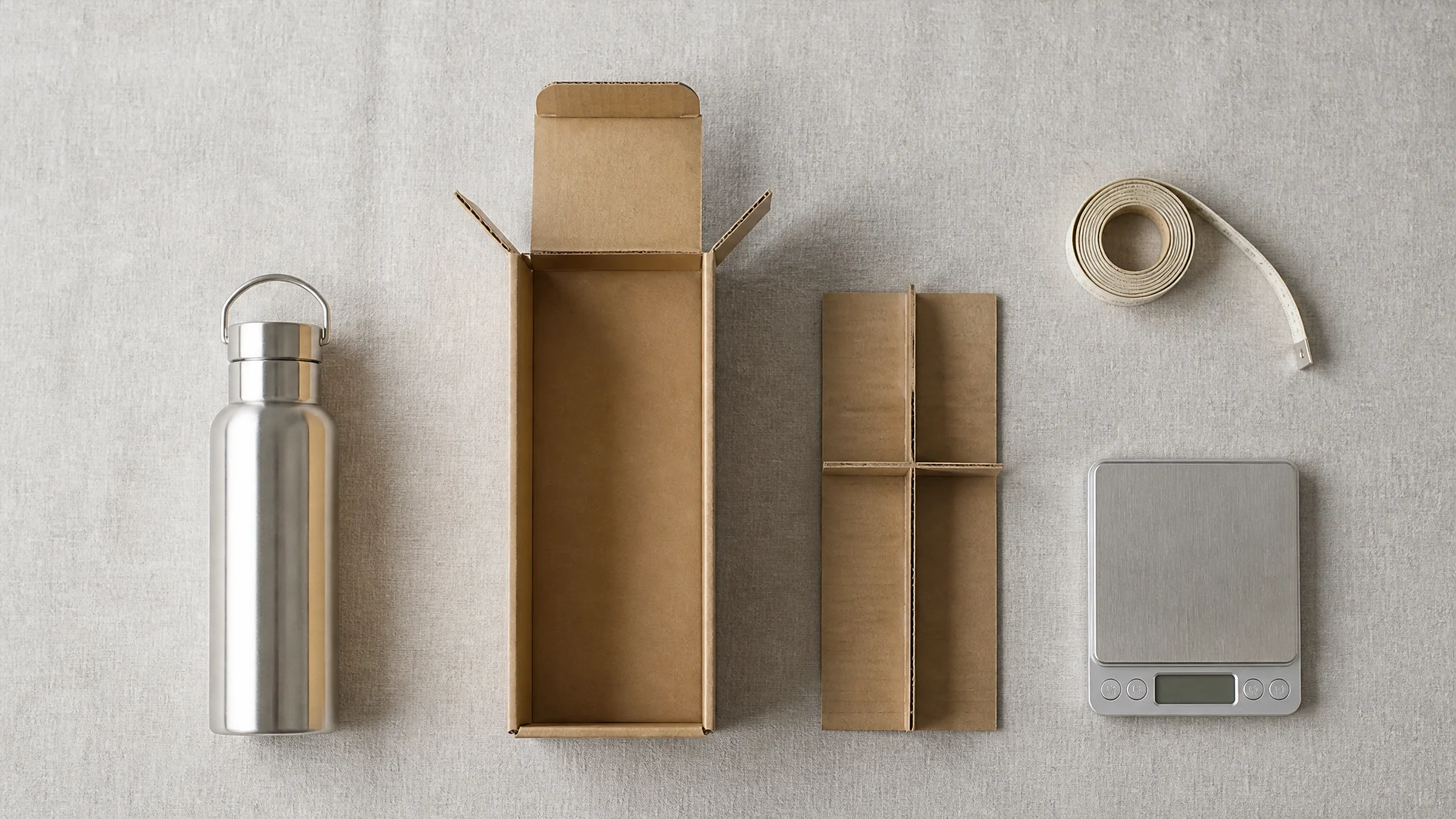
- Packaging and logistics load. Individual polybag or tissue wrap, inner divider, master carton, pallet build, labelling, and the origin-side handling that gets the goods to the port.
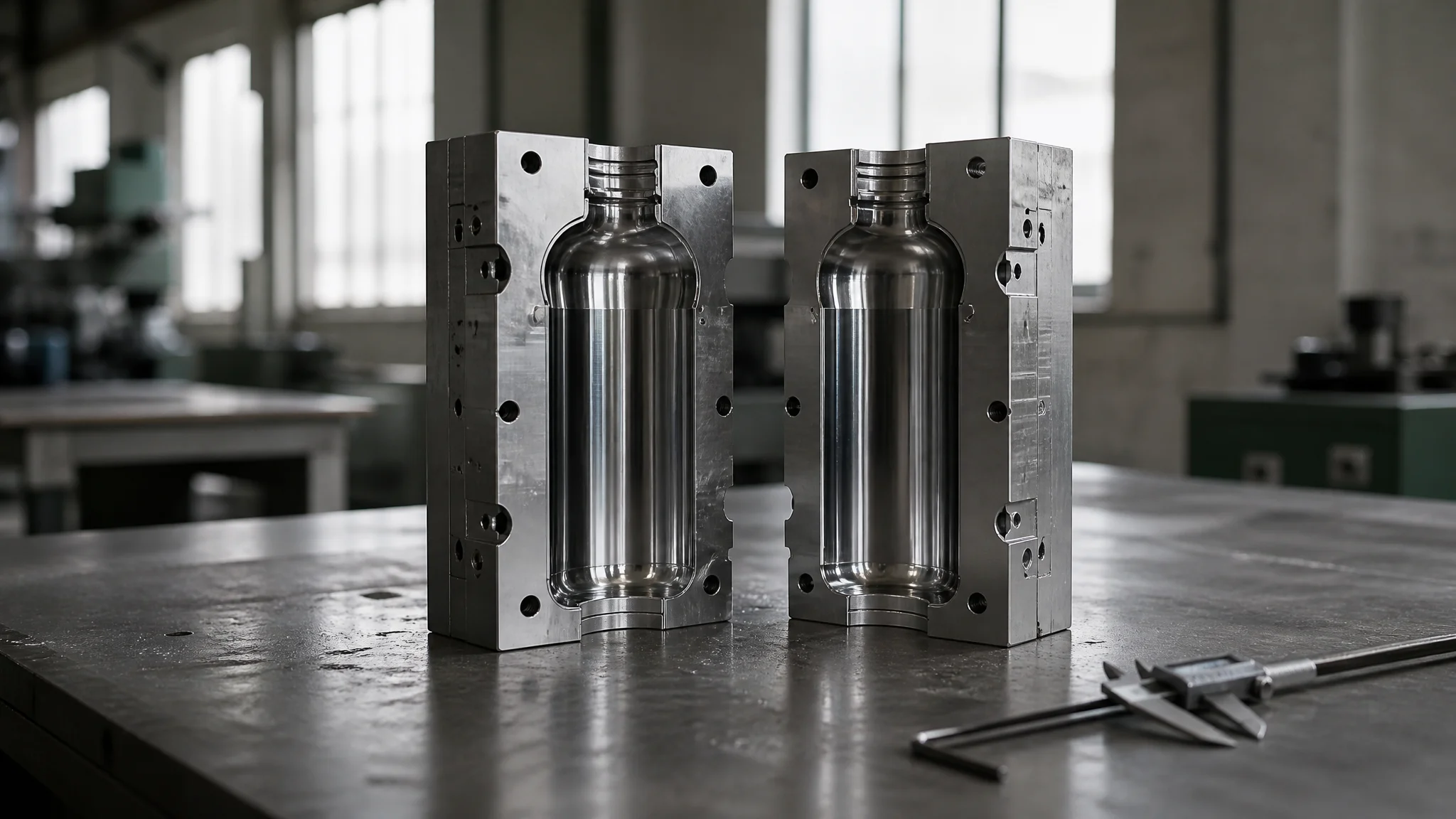
- Tooling and setup — either amortised or charged separately. This is the layer buyers should insist on seeing as a line item, not baked into the unit price.
Layers 1 through 4 scale proportionally with volume. Layer 5 scales in steps, because carton counts and pallet layers are integers. Layer 6 does not scale at all. A quote that presents one blended price hides exactly the structure you need to negotiate against.
How Do You Amortise Tooling Without Fooling Yourself?
There are three legitimate ways to handle tooling, and they produce very different first-order economics:
Charged upfront and owned by you. You pay the tooling invoice once. The unit price contains no tooling at all. This is the cleanest structure and the only one that gives you leverage later, because the tool is an asset you can move. It is also the structure that most clearly defines who holds title — a point worth reading alongside our breakdown of tooling title and US customs assists, because an assist declared incorrectly creates a duty problem years after the invoice is forgotten.
Amortised across a committed volume. Tooling is spread across, say, the first 10,000 units. This lowers the entry cost and is reasonable when the buyer genuinely expects to repeat. It becomes expensive the moment your programme changes shape, because the remaining unamortised balance tends to reappear as a charge when you reduce or cancel.
Absorbed by the factory in exchange for exclusivity. The factory carries the tool cost and recovers it across your programme. Attractive on paper, but you usually pay for it in a longer price-validity tail and a weaker position if you ever want to dual-source.
The self-deception to avoid is comparing a quote with amortised tooling against a quote with upfront tooling and concluding that one factory is cheaper. They are not comparable on unit price alone. The correct comparison is total cash out at the volume you will actually buy in the next twelve months, plus the exit cost if you stop.
What Do Our Own Order Records Show at 1,000, 5,000 and 20,000 Units?
The table below is the structure we see across our own quoted and shipped stainless drinkware orders in 2025 and 2026, normalised to a 750 ml double-wall 304 stainless bottle with a screw lid and a single-colour powder coat. It is presented as a percentage of the 20,000-unit landed cost so that you can apply it to whatever absolute price your own supplier quotes — absolute prices move with steel, freight and duties far too fast to be useful as a benchmark in a published article.
| Cost line | 1,000 units | 5,000 units | 20,000 units |
|---|---|---|---|
| Material (304, net + scrap allowance) | index 100 | index 97 | index 95 |
| Conversion (forming, weld, vacuum, polish) | index 128 | index 106 | index 100 |
| Decoration (single-colour powder coat) | index 145 | index 112 | index 100 |
| Components (lid, gasket, seals) | index 112 | index 103 | index 100 |
| Packaging and pallet build | index 138 | index 108 | index 100 |
| Tooling and setup load | index 620 | index 124 | index 100 |
| Blended FOB per-unit index | index 146 | index 108 | index 100 |
Basis: internal order-book ranges for 2025–2026 quotations and shipments, ±10% band depending on artwork complexity, colour count and current mill surcharge. Index values, not currency, deliberately: absolute figures in this category go stale within a quarter. Treat the shape as transferable and the magnitudes as indicative — then verify against your own live quotation.
Two things in that table matter more than the numbers. First, tooling is the only line that behaves like a cliff: at 1,000 units it can be six times the per-unit weight it carries at 20,000. Second, material is almost flat. A buyer who attacks the steel price at low volume is negotiating the wrong line — there is at most a few points of movement there, and the mill surcharge will overwrite it next month anyway.
Which Cost Lines Scale, and Which Do Not?
A useful test when you read any quote: ask whether the line is driven by pieces or by events. Pieces scale. Events do not.
Setup is an event. A powder-coat line has to be cleaned and charged; a laser cell needs a fixture and a program; a polishing line needs a first-article check. At 20,000 units the event cost per piece is noise. At 1,000 units it can be the difference between a programme that works and one that does not.
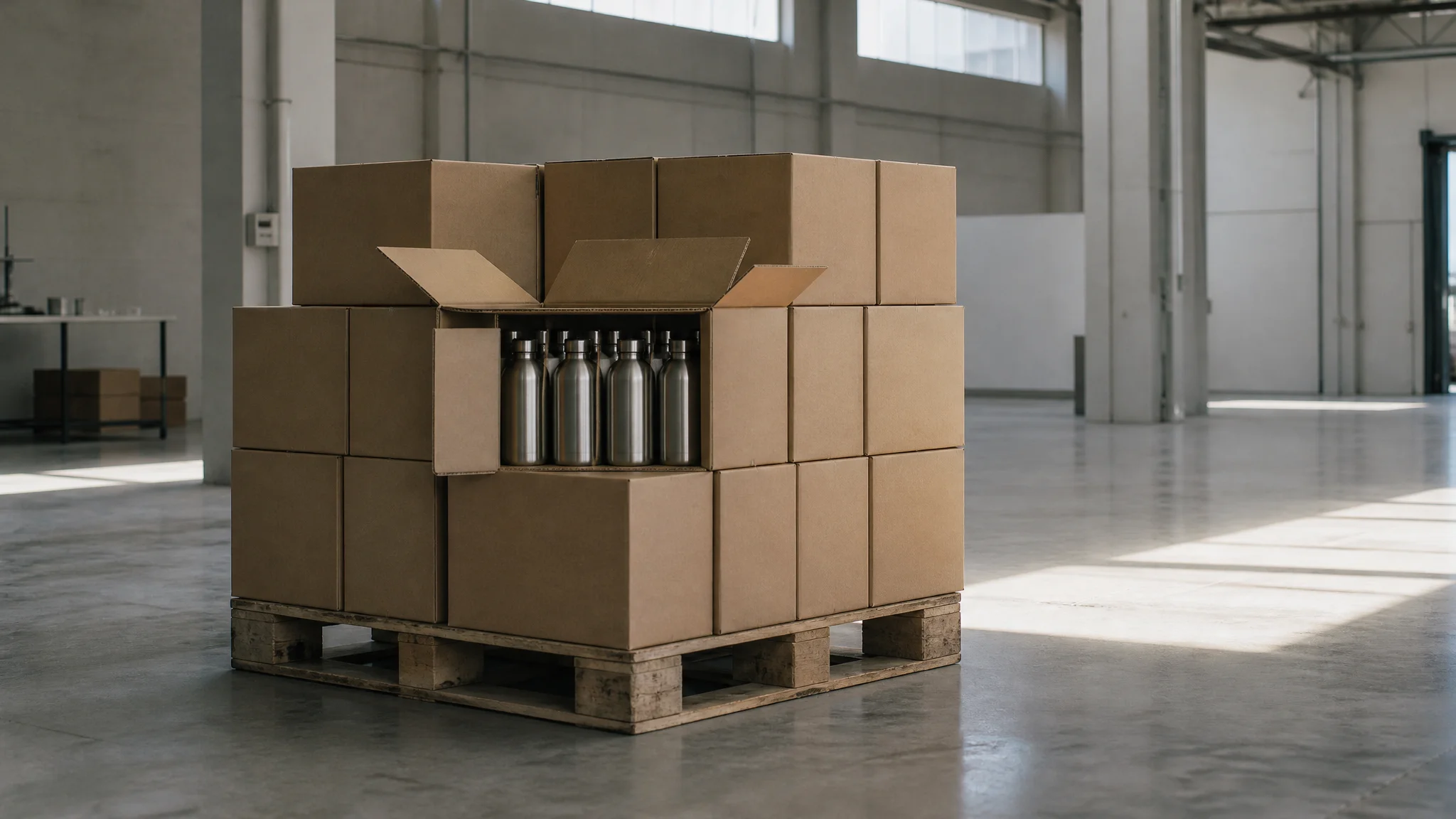
Cartons and pallets are events in disguise. A master carton holds a fixed count. A pallet holds a fixed number of cartons. If your order quantity lands just below a pallet-layer boundary, you pay for air — literally, in the form of a partially built pallet whose volume is billed but whose capacity is not used. Rounding an order up by a few percent to complete a carton and pallet pattern is one of the few volume increases that reliably pays for itself. The same logic, applied more aggressively at container level, is why container loading optimisation so often beats unit-price haggling on total landed cost.
Material does not scale much because mills price in heats and service centres price in coil widths, and those thresholds sit far above a typical first order. You only reach a genuinely better material price when your volume justifies a dedicated coil width and a mill-direct booking — usually well above 20,000 units, and often only if you commit to a rolling twelve-month forecast.
How Much Does Freight Change the Picture?
Freight is where small orders quietly lose. A 40-foot high-cube to the US West Coast has a fixed terminal handling, documentation and drayage load, and a 1,000-unit shipment occupies a fraction of the container while paying the same origin and destination events. On our own outbound records the all-in freight, insurance and origin handling per unit at 1,000 units commonly lands in a band two to two-and-a-half times the per-unit figure at a full container. That is not a carrier issue; it is the same “events do not scale” problem wearing a different hat.
The practical move is not to chase a bigger order. It is to separate the goods from the freight decision: buy the quantity your sell-through justifies, and consolidate that quantity with other SKUs into a single container. Consolidation recovers most of the freight penalty without adding inventory risk. It does, however, require that all the SKUs come from the same factory or the same consolidator, and that they are ready within the same two-week window — a scheduling problem, not a pricing problem.
Where Does Tariff Treatment Interrupt the Curve?
Tariffs are the reason a purely volume-based cost model can be badly wrong in 2026. Section 301 treatment of Chinese-origin goods has been revised repeatedly, and the September 2024 modification notice — published in the Federal Register and available from USTR — set out a staged increase for steel and aluminium products, moving to 25 percent in 2025 and a further increase to 50 percent in 2026. Those rates apply to the value of the goods, not to your unit count, so they compress the difference between a small order and a large one in absolute terms and change which sourcing route wins.
Two implications follow. First, at higher ad valorem rates, the per-unit penalty for a small order shrinks relative to duty, so “buy more to save freight” becomes a weaker argument, not a stronger one. Second, duty interacts with structural questions — whether your product classifies under the vacuum-vessel heading or the tableware heading, and whether Section 232 treatment applies to the metal content — which can move landed cost more than any volume discount you will ever negotiate. Our own treatment of Section 232 duty and the metal-content threshold is worth reading before you treat a unit-price win as a cost win.
Authoritative starting points, in order of reliability: the USTR Section 301 modification determination, the corresponding Federal Register notice, and your own broker’s classification opinion for the specific SKU. Do not accept a factory’s tariff assumption as a planning input.
Is a Higher MOQ Ever the Cheaper Choice?
Sometimes — but far less often than the unit-price table suggests. The correct comparison is not unit cost; it is total cost of ownership across the life of that inventory.
Take a realistic case. A brand expects to sell 6,000 units in twelve months. Option A: order 5,000 now and 1,000 later. Option B: order 20,000 now at the 20,000-unit price. Option B lowers the unit price by a high single-digit to low double-digit percentage, but it converts working capital into stock that may sit for two years. If the product carries a licensed design, a seasonal colour, or a lid system that your market may not accept, the markdown and write-off risk dwarfs the price gain. On top of that, 20,000 units of packaging cannot be changed mid-flight; a carton revision or a regulatory label change strands inventory.
The honest rule: raise order size only when three conditions hold together — demand is proven over at least two reorder cycles, the design is stable, and the cash is genuinely idle. If any one is missing, buy to the sell-through and pay the small-order premium as an insurance premium. It is usually cheaper than the inventory you would otherwise carry.
How Should You Structure a First Order?
A structure that consistently survives contact with reality looks like this:
- Split the tooling out of the unit price. Pay it as a separate invoice so it is auditable, so title is clear, and so the recurring unit price stays clean for future reorders.
- Buy to a container-friendly quantity, not to a round number. Ask the factory for the carton count per pallet and the pallet count per container for your specific bottle, then choose the quantity that fills layers rather than the quantity that looks tidy on a PO.
- Fix the material basis in writing. Agree the steel grade, the net weight and the tolerance, plus the surcharge mechanism and the price-validity window. A unit price without a material basis is an option, not a commitment — the same reason price negotiation in this category is mostly about structure rather than pressure.
- Keep the second order visible in the first PO. State the expected reorder volume and date. Factories price the first order partly on the expectation of the second.
- Reserve decoration for a separate run where possible. Bare goods are far easier to re-plan than decorated goods, and decoration is the line where small volumes hurt most.
What Should You Put in the PO to Protect the Per-Unit Price?
Five clauses do most of the work. Volume and tolerance: state the ordered quantity and the accepted over/under shipment band, because a factory that ships short has effectively raised your unit price. Material basis: grade, weight, and the surcharge mechanism with a stated review date. Tooling: who owns it, where it is held, and what happens on transfer. Packaging: exact carton specification, count and pallet pattern, since packaging is the line most often quietly re-specified after the quote. And price validity: an explicit window, with the formula that applies afterwards.
How Do You Sanity-Check a Quote in Ten Minutes?
Ask for the split, then test three ratios. Tooling divided by order quantity should not exceed roughly a tenth of the unit price at the volume you intend to buy; if it does, you are either being charged for capability you do not need or you are buying too few pieces. Packaging and carton cost as a share of the unit price should sit in a low single-digit to mid-single-digit band for a standard bottle; if it is double digits, someone has specified retail-ready packaging you may not require. And the material line should be verifiable against net weight times a mill price you can independently check — if it cannot be reconstructed, the whole quote is unauditable.
None of this requires a consultant. It requires the factory to show its structure, which is exactly why the first question in any serious sourcing conversation should be “can you break this price down by line”, not “can you do better on the number”.
Frequently Asked Questions
What is a realistic minimum order quantity for custom stainless steel drinkware?
For a stock mould and stock lid, custom decoration is often viable from a few hundred to a thousand units. A new body mould, a custom lid, or a bespoke capacity typically pushes the economic minimum into the low thousands, because the tooling has to be recovered. The binding constraint is usually not the factory’s willingness but the tooling amortisation.
Should tooling be included in the unit price or billed separately?
Separately, in almost every case. A separate invoice keeps the tooling auditable, makes ownership explicit, keeps the recurring unit price clean for reorders, and avoids the unamortised-balance argument if your programme changes.
Does ordering 20,000 units instead of 5,000 always reduce landed cost per unit?
No. It reduces the factory-side unit price, but landed cost also includes freight, duty, insurance and the carrying cost of inventory. Above roughly 5,000 units the factory-side gain is usually a single-digit percentage, while the working-capital and obsolescence exposure grows in proportion to the extra units.
Why is a small order’s freight per unit so much higher?
Because terminal handling, documentation, drayage and origin handling are events, not per-piece costs. A partial container pays the same events as a full one. Consolidating several SKUs into one shipment recovers most of the difference without increasing inventory.
How often does a stainless drinkware quote need to be re-validated?
Material and duty assumptions move fastest. A practical cadence is to re-validate the material basis and the price-validity window every quarter, and to re-check tariff classification whenever the product construction, capacity or metal content changes. Do not assume last quarter’s landed cost still holds.
Can I get the 20,000-unit price on a 5,000-unit order?
Rarely on the unit price, but often on the total. Ask instead for the structural concessions that carry no volume risk: fixed material basis with a defined surcharge, tooling billed separately, packaging specified to your carton pattern, and a stated reorder price for the second order. Those are worth more than a cosmetic discount, and they survive the next steel movement.
What single number should I use to compare two quotes?
Twelve-month total cash out at your realistic sell-through, including tooling, freight, duty and the cost of unsold inventory. Unit price is a component of that number, not a proxy for it.
About the author
Written by the OEM Water Bottle sourcing team — a stainless steel drinkware manufacturing and export operation supplying private-label and OEM programmes to North American and European buyers. The cost structures described here come from our own quotation and shipment records for 2025–2026 and are published as indices rather than absolute prices, because steel surcharges, freight and tariff treatment move faster than any published benchmark. Figures are indicative ranges, not a quotation. Verify every number against a current, line-itemised quote for your own specification.
Commercial terms
| Minimum order quantity | 100 pcs per SKU |
| Sampling lead time | 3 days |
| Production lead time | 7 days at MOQ 100 |
Applies to existing tooling and standard colours. New mould development or custom colour matching carries its own lead time — confirm the schedule with our team before committing to a delivery date.