Last updated: 2026-10-22 | Based on ASTM A480/A480M finish designations, ISO 21920 surface texture parameters, EU 1935/2004 food-contact requirements and plant QC ranges from stainless drinkware polishing lines in Guangdong and Zhejiang.
Quick Take
Hairline, mirror and bead blast are not three grades of the same thing. They are three different promises about scratch visibility, light behaviour, cost and inspectability — and each one fails in a different way after six months in a customer’s bag. For most drinkware programmes the correct answer is hairline on the body, bead blast on the base and grip zone, and mirror only where the design needs a reflective focal point, because hairline hides handling marks, bead blast hides the abrasion that nothing else survives, and mirror is the finish that turns every touch into a service complaint. What actually goes wrong in sourcing is not the choice of finish. It is the specification: “No. 4 finish” and “hairline” are used interchangeably by factories and buyers who mean different things, and neither ASTM A480 nor a purchase order written in trade shorthand gives an inspector anything measurable to reject against. This article sets out what each finish is, what it costs, how it degrades, and — most importantly — the exact clause structure that makes a finish claim enforceable at goods-in.
Three sentences cover the commercial reality. Mirror polishing on a 500 ml vacuum body typically consumes several times the finishing labour of a hairline pass and carries a visibly higher rework rate, so it is a design decision with a cost line attached, not a free upgrade. Hairline is the cheapest finish that still looks intentional on a shelf. Bead blast is the only one of the three that resets the surface after a defect, which is why factories quietly prefer it on high-volume programmes where cosmetic rejects hurt most.
Finish choice changes both the visual result and the coating cost per unit, so it is normally settled against a specific body. In our current line, Custom Stainless Insulated Tumbler and 40oz Tumbler with Handle and Straw are the closest matches.
What Do Hairline, Mirror and Bead Blast Actually Describe?
All three are mechanical surface treatments applied after forming, and all three change the same physical property: the topography of the outer steel. What differs is the scale of that topography and its directionality, and those two variables control everything downstream — how light scatters, how a scratch reads against the background, how much of the surface a polishing operator has to touch, and whether an inspector can measure it.
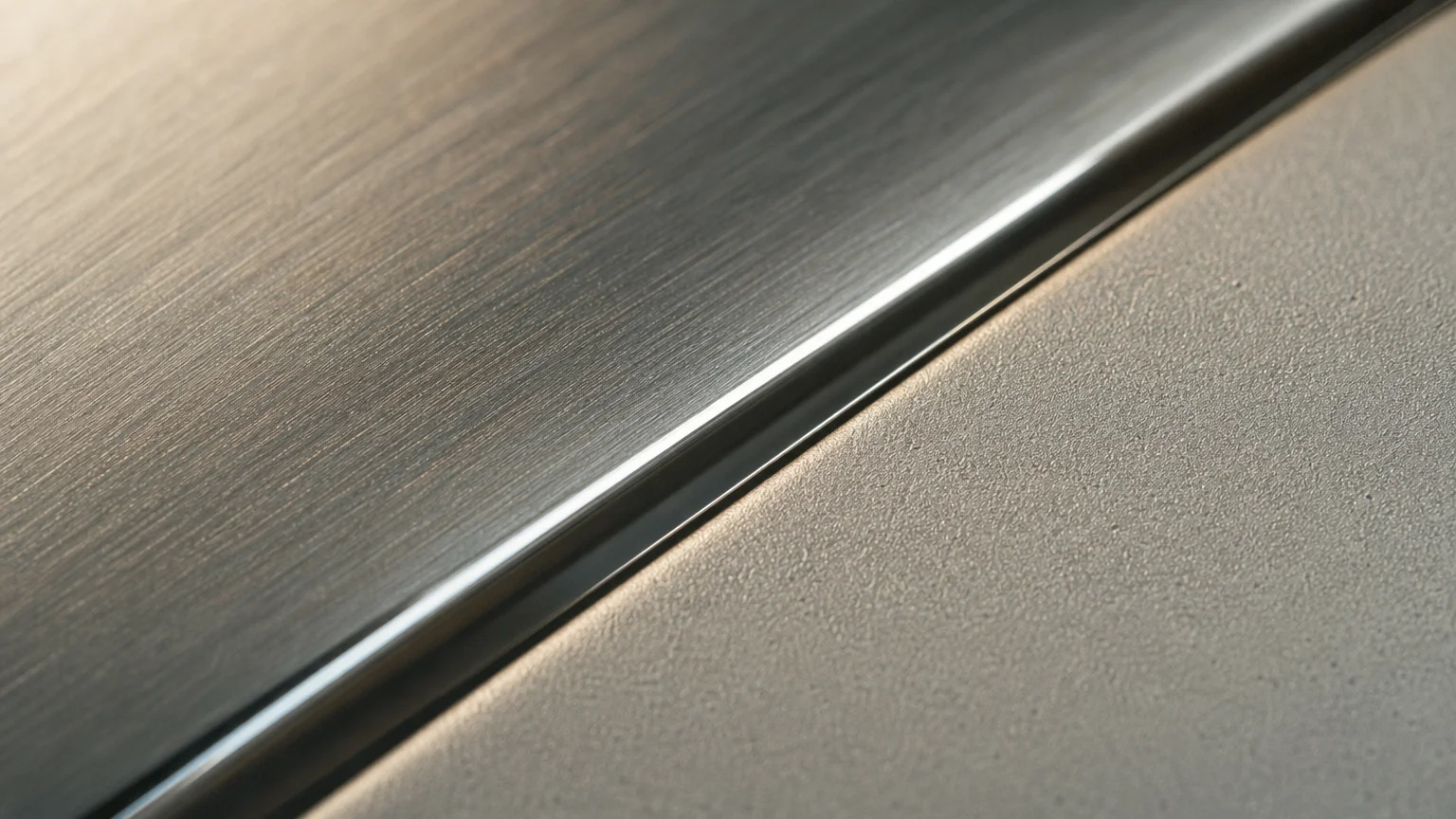
Hairline (also sold as “long grain”, “satin”, “brushed” or “No. 4 hairline”) is a continuous unidirectional grain produced by abrasive belts or brushes drawn along one axis of the part. The grain is fine and the lines run parallel, which is why a hairline surface reads as a soft silver rather than a grey haze. The critical property is direction: light reflects in a narrow band perpendicular to the grain, so the surface appears to change brightness as the part rotates.
Mirror (No. 8 in mill terminology, “super mirror” or “8K” in trade language) is produced by progressing through successively finer abrasives and then buffing, until the surface reflects an image with defined edges. It is not a coating. It is the same steel, with the topography flattened to a scale below visible light scattering.
Bead blast (also “sand blast”, “shot blast” or “matte”) is the opposite operation: media is projected at the surface to create a random, non-directional crater pattern. It is the only one of the three that is deliberately non-directional, and that single fact explains most of its commercial behaviour.

| Attribute | Hairline | Mirror | Bead blast |
|---|---|---|---|
| Mill designation | No. 4 or finer, applied after forming | No. 8 | No mill designation exists |
| Topography | Unidirectional, fine, parallel | Near-flat, image-forming | Random, isotropic, cratered |
| Typical Ra (plant QC range) | 0.35 – 1.2 µm | 0.02 – 0.10 µm | 1.8 – 4.5 µm |
| Gloss at 60° (ASTM D523) | 12 – 25 GU | 88 – 96 GU | 3 – 8 GU |
| Scratch visibility | Low if scratch runs with the grain | Very high | Lowest |
| Finishing labour index | 1.0 (reference) | 3.5 – 6.0 | 1.2 – 1.8 |
| Can it be repaired in-plant? | Yes, local re-grain | Rarely — full re-polish | Yes, spot re-blast |
Ra and gloss values are plant QC ranges, not standard limits: stylus profilometer to ISO 21920-2, λc 0.8 mm, three traces per unit at mid-height, five units per lot; gloss to ASTM D523 at 60° geometry, ten units per shift. Labour index is a quotation-model ratio against a hairline pass on the same geometry, derived from cycle-time studies on 500–750 ml double-wall bodies.
Why Does “No. 4 Finish” Not Tell You What You Will Receive?
Because ASTM A480/A480M, the general requirements specification that governs flat-rolled stainless finishes, defines No. 4 by process and appearance rather than by a numeric surface parameter. It describes a polished, unidirectional, non-reflective finish produced with a relatively coarse abrasive, and it points inspection at comparison with a reference sample. That is entirely workable when a mill and a warehouse are arguing about sheet. It collapses the moment a deep-drawn bottle body, a laser-welded seam and a spun rim enter the conversation, because the “No. 4” a polishing cell produces on a curved, work-hardened surface is not the “No. 4” that left the mill.
Two suppliers quoting “No. 4” can deliver surfaces that differ by a factor of three in Ra, in opposite grain directions, with different line density. Both are defensible in the trade sense. Neither is rejectable without a number.
There is a second layer of ambiguity specific to drinkware. In Asian trade usage, “hairline” has drifted away from No. 4 into a family of finer, denser grains — often applied with 180 to 320 grit equivalents, or produced by a long-grain brush after a No. 4 belt pass. A buyer who writes “hairline, same as approved sample” gets whatever the sample happened to be that day. A buyer who writes “No. 4” gets the coarser end of the same family and is surprised by visible belt lines under retail lighting.
Which Standard Should the Ra Number Be Written Against?
Write it against the ISO 21920 series, not ISO 4287. The 2021 publication of ISO 21920-1, -2 and -3 replaced the older profile standards — ISO 4287, ISO 4288, ISO 1302, ISO 3274 and ISO 13565 — and it changed how a surface texture specification is constructed. If your specification still cites ISO 4287, you are quoting a withdrawn document to a supplier who may or may not be measuring to the current one. That is an argument you lose at the worst possible moment.
A defensible Ra callout needs five things, and most purchase orders contain one of them:
- The parameter and the limit — Ra, with a maximum value (upper limit) rather than a nominal, because finish defects are one-sided: too rough is the failure mode, too smooth is free.
- The cut-off wavelength λc — Ra is meaningless without it. The conventional mapping carried into ISO 21920-3 puts Ra between 0.1 and 2 µm at λc = 0.8 mm with a 4 mm evaluation length. Specify it so the supplier cannot choose a smoothing filter that flatters the reading.
- The measurement location — mid-height of the body on the axis parallel to the grain, clear of the shoulder radius and the base weld. Say it explicitly. A shoulder reading and a mid-wall reading on the same bottle differ by more than the tolerance you are trying to hold.
- The instrument class — stylus profilometer with a 2 µm or 5 µm tip, calibrated against a certified reference specimen. Optical or confocal instruments read bead blast differently and should not be mixed into the same acceptance decision.
- The sample basis — how many units per lot, how many traces per unit, and what happens on a single out-of-limit trace.
That is a five-line clause. It costs nothing to write and it converts a cosmetic argument into a measurement. Buyers who run multi-year programmes with the same factory often formalise it into a one-page finish annex that travels with every PO revision, so nobody renegotiates the definition each season.
What Does Each Finish Actually Cost, and Where Does the Money Go?
Finishing is the most labour-exposed step in drinkware, which is why it is the first place a quotation moves when a factory is asked for a price reduction. The steel is priced per tonne and the forming is priced per press stroke; the finish is priced per minute of a skilled operator’s attention, and that minute is not compressible in the way buyers assume.
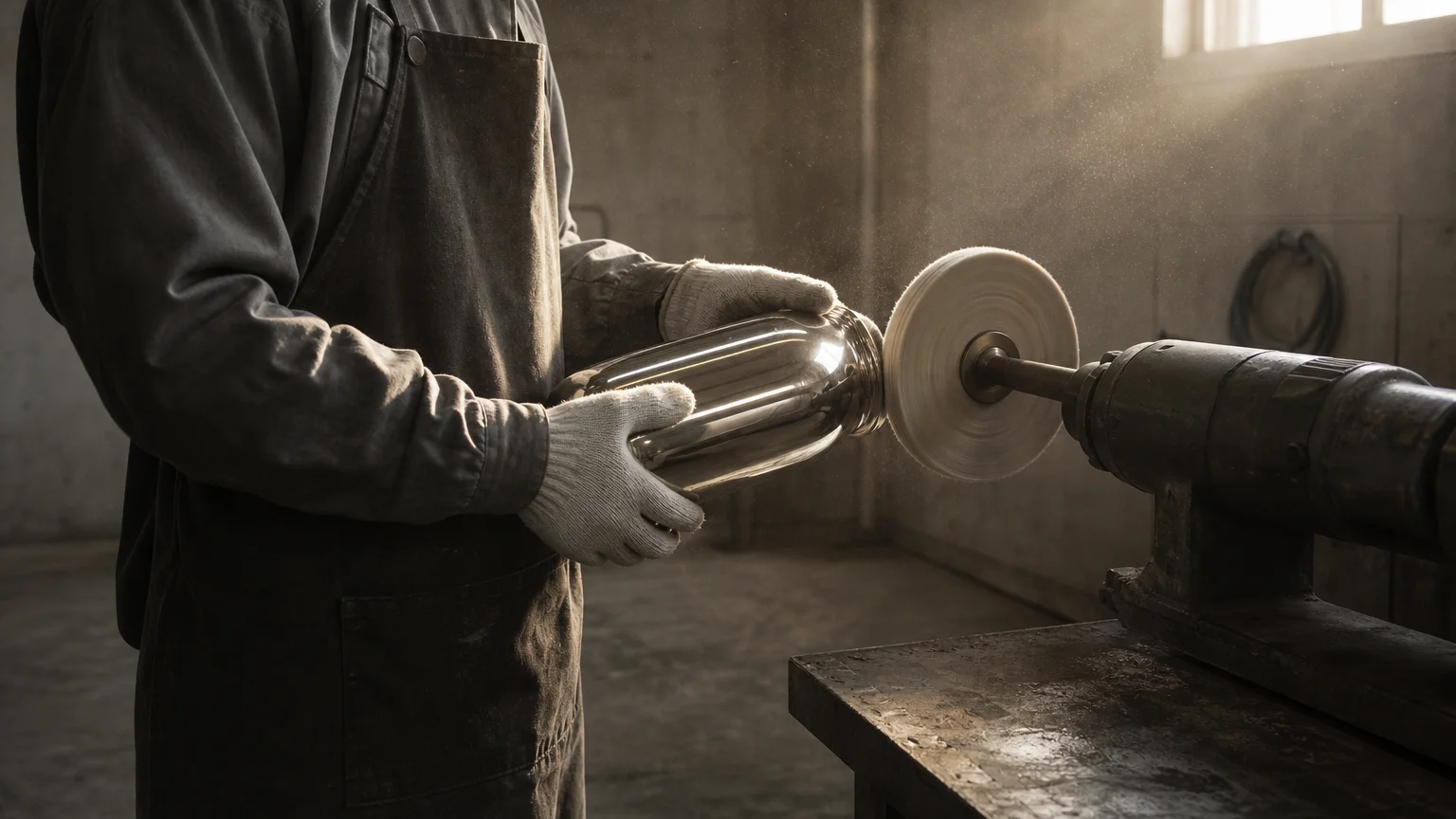
The cost driver is stage count, not effort per stage. A hairline pass is one or two belt operations with a fixed orientation, and a competent operator holds the grain. Bead blast is a single cabinet operation plus masking if any area must stay bright. Mirror is a sequence: coarse abrasive to remove the forming marks and any weld dressing, then progressively finer abrasives, then buffing with compound, then a cleaning step to remove compound residue from the interior — and each stage adds a handling event, a chance of a scratch, and an inspection point.
| Cost element | Hairline | Mirror | Bead blast |
|---|---|---|---|
| Process stages per body | 2 – 3 | 5 – 9 | 2 – 4 |
| Cycle time, 500 ml body | 45 – 70 s | 6 – 9 min | 60 – 100 s |
| Consumables | Belts, low value | Belts plus buffing compound, high value | Media, recyclable |
| Cosmetic reject rate at finishing | 1 – 2 % | 3 – 8 % | 1 – 3 % |
| FOB impact vs hairline baseline | Reference | +8 to +15 % at 10k units, +20 to +30 % at 1k units | +2 to +6 % |
| Hardware knock-on | None | Interior must be masked or re-cleaned; laser logo contrast unstable | Masking needed for two-tone; logo legibility improves |
Cycle times and reject rates are plant QC and costing ranges from double-wall body lines, quoted on 0.4 mm 304 bodies with a welded base; FOB sensitivity is modelled at 2026 labour rates and scales with volume because the labour content is fixed per unit while the amortised setup is not.
The volume effect is the part buyers underestimate. Mirror’s penalty is almost entirely variable labour, so it does not amortise: 10,000 units cost nearly proportionally more than 1,000 in labour terms, and the apparent saving at high volume comes from yield improvement and better line balance, not from the process getting cheaper. On promotional programmes with 8-week windows and 1,000–3,000 unit runs, mirror can consume the whole margin the distributor planned to make.
How Do You Write a Finish Specification a Factory Can Actually Hold?
Six lines. Everything else is commentary. The following is the clause structure that survives a factory change, a tooling transfer and an inspection dispute — and it works whether the finish is hairline, mirror or bead blast.
FINISH SPECIFICATION — REV C, applies to all POs unless overridden
1. Exterior finish: hairline, unidirectional, grain axis vertical (base to shoulder).
2. Surface texture: Ra max 0.80 µm, ISO 21920-2, λc 0.8 mm, evaluation length 4 mm,
   stylus 2 µm, measured at mid-height, 3 traces/unit, 5 units/lot.
3. Gloss: 15–25 GU at 60°, ASTM D523, 10 units/shift, same units as Ra where possible.
4. Appearance: judged against signed limit samples (low / nominal / high) under
   1,000 lux D65 diffuse light at 500 mm, 45°/0° viewing, 10 s per unit.
5. Defect classes: scratch >15 mm visible at 500 mm = major; grain discontinuity at
   weld = major; isolated pit <0.3 mm = minor, max 3 per unit.
6. Repair rule: local re-grain permitted on hairline; mirror units with any rework
   trace are reclassified; bead blast re-blast permitted once.
Note what the clause does not do. It does not name a grit number, because grit is a process instruction, not an acceptance criterion — the factory is free to reach Ra 0.80 µm with whatever sequence it validates. It does not say “as per sample” as the primary definition, because a sample is a reference for appearance and a number is a reference for texture; you need both, in that order of authority. And it does not use the word “premium”, which has never rejected a shipment.
The limit-sample discipline matters more than buyers expect. Three samples — one at the rough edge of acceptable, one nominal, one at the smooth edge — signed by both parties and photographed under the specified lighting, retained by the factory and replaced every six months as the belts wear and the reference drifts. Without them, an inspector’s judgement of “grain too coarse” is an opinion, and opinions lose to a production schedule.
How Does Each Finish Behave Under Scratch and Abrasion?
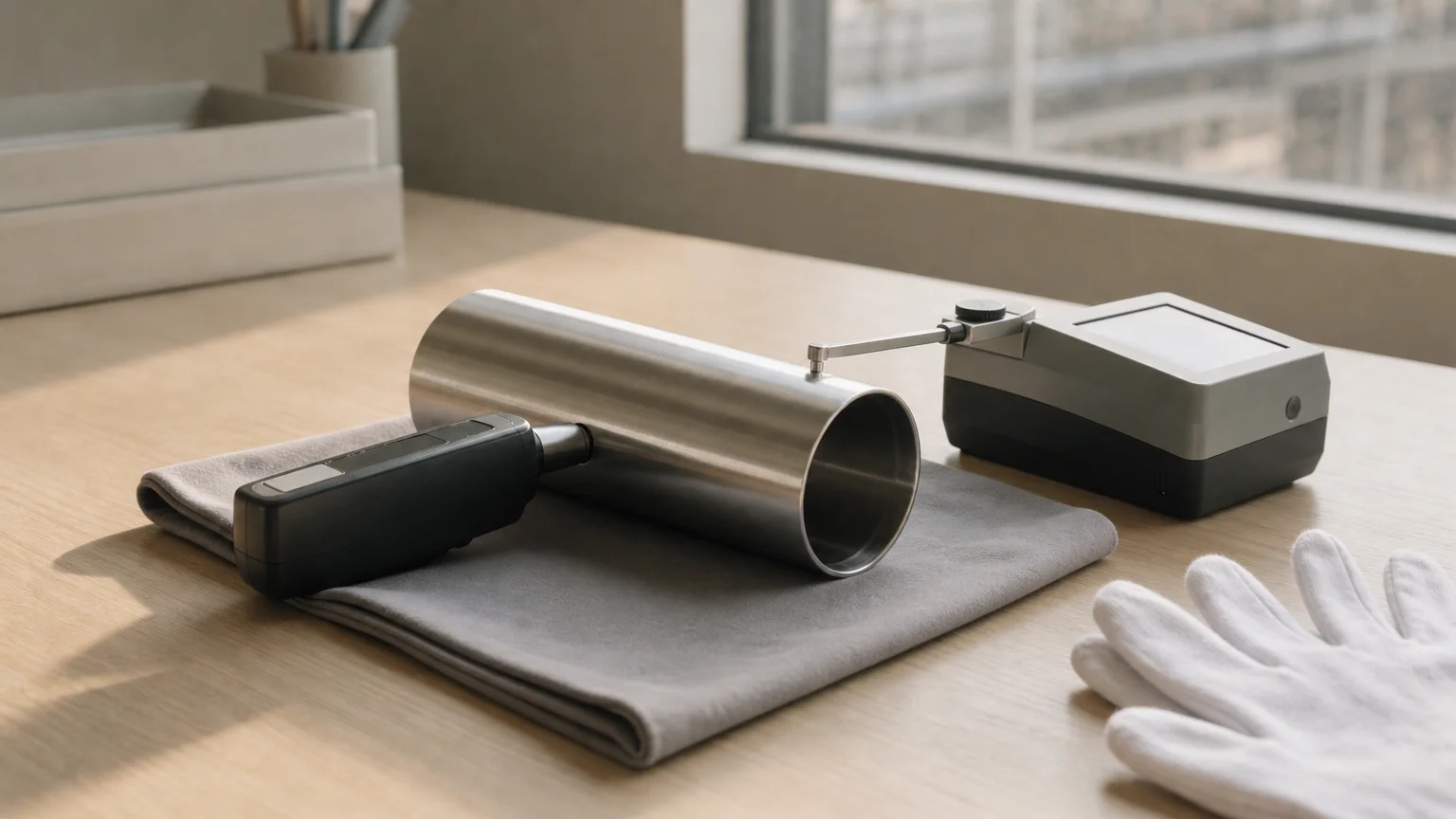
This is the question that decides returns, and it is answered differently by a lab test and by a handbag. The lab test asks whether the surface resists penetration. The handbag asks whether a scratch that already exists is visible — and those are not the same property. Stainless is soft enough that all three finishes will scratch under a key ring. What differs is whether the scratch announces itself.
On a mirror surface, any discontinuity in the topography scatters light. A 5 µm deep scratch on a 0.05 µm surface is a 100-fold step change: it reads as a bright line on a dark field and it is visible from across a room. On hairline, the same scratch disappears when it runs parallel to the grain and reads as a dull interruption when it crosses it. On bead blast, the crater field is already scattering light in every direction, so a scratch adds almost nothing to the visual noise. The steel is equally damaged in all three cases. The perceived damage is not.
| Test (plant method) | Hairline | Mirror | Bead blast |
|---|---|---|---|
| Gloss loss after 50 strokes, 0000 steel wool, 1 kg load, across grain | 15 – 25 % | 55 – 75 % | 5 – 12 % |
| Visible scratch threshold at 500 mm, D65 1,000 lux | ~8 µm deep, if across grain | ~2 µm deep | ~15 µm deep |
| Neutral salt spray, 96 h, ASTM B117, scribed panel | Scribe creep localised, rating per ASTM D1654 | Scribe creep more visible against bright field | Pitting blends into texture; hardest to judge visually |
| Fingerprint visibility | Moderate | Severe | Low |
| Dent visibility (same depth) | Visible as grain distortion | Very visible, image breaks | Least visible |
Gloss-loss ranges are plant QC results, method: 1 kg load, 0000 steel wool, 50 back-and-forth strokes across the grain, gloss measured before and after to ASTM D523 at 60°, five units per finish per lot. Scratch thresholds are visual determinations under the specified lighting, not instrument values. Salt spray per ASTM B117 is a comparative laboratory method; it does not predict field corrosion life and should not be written as a service-life guarantee.
Read the table as a design tool rather than a scorecard. Mirror loses three quarters of its gloss under an abrasion level that bead blast barely registers — but gloss loss on bead blast is a meaningless metric, because the finish started at 3 to 8 GU. The meaningful question is whether the change is perceptible, and that is exactly what the visible-scratch threshold row answers.
Do Mirror Finishes Really Fail Faster in the Field?
They do not corrode faster. They show faster. That distinction is worth defending in a supplier meeting, because “mirror is less durable” is technically wrong and easy to disprove, while “mirror has a lower cosmetic failure threshold in use” is correct and commercially decisive.
Three mechanisms drive the field experience. First, handling: every touch deposits oil, and oil on a mirror surface is visible in a way it never is on hairline or blast. That produces complaints that are not defects, and no quality system prevents them. Second, the base and rim — the two areas that contact surfaces — take the abrasion, and on a mirror body those marks are on the most reflective part of the product. Third, and least discussed, mirror surfaces make every other cosmetic variable visible: a 0.2 mm out-of-round at the shoulder, a slightly uneven weld dressing, a faint polishing swirl from an over-worn buff. On hairline those hide inside the grain.
There is a manufacturing consequence too. Because mirror rejects at finishing are expensive, factories tend to over-polish to be safe, which thins the surface and can round over the shoulder geometry enough to affect lid fit. That is not a finish problem; it is a finish decision propagating into a functional dimension. It is one more reason to keep the finish callout measurable and to inspect the shoulder radius separately from the surface.
What Does Each Finish Do to Perceived Quality?
Perceived quality is not a function of smoothness. It is a function of consistency and of whether the surface matches the product’s price story. A perfectly uniform bead blast on a $14 tumbler reads as deliberate and industrial. The same finish with a visible transition line where the masking tape sat reads as cheap. A mirror finish with a single swirl reads as a second. Consistency beats polish, every time, at every price point.
The practical ranking for B2B buyers selling into the US and EU looks like this. Hairline is the default because it is legible as “brushed stainless” to a consumer who has never thought about finishes, and because it photographs well in e-commerce — a diffuse, low-contrast reflection that does not blow out under studio light. Bead blast reads as matte, modern and grippy, and is the strongest choice for categories where the product is handled wet or with gloves. Mirror reads as premium in a display case and as fragile in daily use; it is best deployed as an accent — a band, a lid, a logo plate — rather than across an entire body the customer will hold for years.
One commercial detail worth knowing: mirror finishes are the hardest to photograph consistently across a retailer’s image set, because a mirror body reflects the studio, the photographer and the softbox. Brands that sell primarily online often choose hairline for exactly this reason, even when their design team prefers mirror. That is a legitimate, cost-driven retail decision, not a compromise.
Can You Combine Finishes on One Product, and What Does It Cost?
Yes, and it is the highest-value move in this whole article — but it is a tooling and process decision, not a cosmetic one, and it must be priced as such.
Three combinations work reliably. Hairline body with bead-blast base and grip zone hides the two areas that take the most abuse, needs only one masking operation, and reads as intentional. Bead-blast body with a hairline band at the shoulder or a mirror lid gives the design a focal point without exposing the whole body to fingerprint complaints. Mirror only on a logo plate or a spun rim delivers the premium cue at a fraction of the labour, because the polished area is small and the buffing is local.
The costs that appear on the quotation are masking labour, alignment tolerance and a second inspection. Masking is usually a silicone plug or a die-cut film applied by hand; on a curved body with a band, misalignment of 0.3 mm is visible, so the operation needs a fixture rather than an operator’s eye. Add a transition-line criterion to the finish clause: the boundary must be a clean, continuous line with no blast overshoot into the polished zone, and overshoot beyond 0.5 mm on more than 10 % of units is a major defect. That single sentence prevents the most common two-tone complaint.
How Should Goods-In Inspection Actually Judge a Finish?
With lighting, distance and time fixed before the first carton is opened. Finish is the only cosmetic attribute where the inspection environment determines the result, and most disputes are really arguments about the light the inspector was standing under.
Set the conditions in the purchase order, not in the QC manual: 1,000 lux of D65 diffuse illumination, measured at the inspection surface; a 500 mm viewing distance; 45°/0° geometry so that specular reflection does not enter the inspector’s eye; 10 seconds per unit; and a matte grey background so that a mirror body reflects nothing distracting. Under those conditions, three inspections of the same lot produce the same verdict. Under a window at 4 pm, they do not.
Then instrument what can be instrumented. Ra and gloss are the two numbers that travel: they are fast, they do not require the inspector to have taste, and they are reproducible between the factory and a third-party lab. A gloss meter at 60° separates hairline from mirror cleanly; for the mirror range, note that 60° readings saturate near the top of the scale and a 20° geometry discriminates better — ASTM D523 provides both, and a serious supplier will specify which one it uses.
For the AQL structure itself, treat finish defects as major rather than minor unless they are below the visibility threshold you have defined, and align the sampling plan with the general inspection level already used for the programme. The related discipline of what else to check before shipment is covered in our guide to testing protocols that matter before shipment, and the finish clause should be attached to that protocol rather than run as a separate inspection.
Which Finish Should Your Programme Specify? A Decision Matrix
Match the finish to the handling profile and the price story, then price the labour before you commit the design.
| Programme profile | Specify | Why |
|---|---|---|
| Promotional, 1k–5k units, 8-week window | Hairline body, bead-blast base | Lowest labour, fastest ramp, no mirror rework risk in a short window |
| Retail brand, 20k+ units, multi-season | Hairline, Ra max 0.80 µm, limit samples | Photographs predictably; grain masks handling marks across the product life |
| Gym, outdoor, wet or gloved use | Bead blast, full body | Highest abrasion tolerance, best grip, lowest complaint rate |
| Gift, hospitality, display-led | Mirror accent + hairline body | Premium cue at localised labour; keeps the handled area forgiving |
| Full mirror, high volume | Re-quote before design freeze | 8–15 % FOB penalty plus 3–8 % finishing rejects; must be modelled, not assumed |
What Do Food-Contact Rules Say About Surface Finish?
Less than suppliers imply, and more than buyers assume. EU Framework Regulation (EC) No 1935/2004 requires that food-contact materials not transfer constituents in quantities that endanger health or unacceptably change the food, and it sets an overall migration limit of 10 mg/dm² or 60 mg/kg. It does not prescribe a surface roughness. What it does do is make the surface relevant, because a rougher surface holds residue, retains cleaning chemistry and increases the contact area available for metal release.
For stainless steel specifically, the practical reference is the Council of Europe technical guide on metals and alloys in food contact, which addresses alloy composition — including the minimum chromium content that keeps the passive layer intact, a point national rules also pick up, with France commonly cited at 13 % minimum chromium. Roughness enters through the cleaning and release argument rather than through a numeric limit: a bead-blast interior is harder to validate than a smooth one, which is why interior surfaces on drinkware are normally left smooth or electropolished while the exterior carries the decorative finish.
If the finish includes any coating — a coloured powder coat over the exterior, for example — the regulatory frame widens, and in the US the relevant provision for resinous and polymeric coatings on food-contact articles is 21 CFR 175.300. Bare stainless has no coating, so that provision does not apply, but the migration principle does. None of this is a substitute for a test report: ask for migration testing on the finished article, and read the finish clause and the test report as two halves of the same claim. The material-grade side of that argument is set out in our analysis of 304 versus 316L grade fraud detection, and the geometry side in wall thickness engineering — a finish specification is only meaningful on a body whose substrate is what it claims to be.
What Are the Three Finish Disputes That Cost the Most?
Almost every finish argument that reaches a third-party inspection body falls into one of three patterns, and each is prevented by a clause rather than by a better relationship.
The grain-direction dispute. The buyer’s sample was polished with a vertical grain; the production lot came with a horizontal grain, often because the belt ran the other way on a different fixture. Both are hairline, both are cosmetic, and the argument is unwinnable without a written axis. Fix: name the axis in degrees or relative to the base, and add it to the limit sample.
The weld-area dispute. The laser or TIG seam on the body is dressed before finishing, and dressing leaves a local topography that no finish fully hides. Under raking light the seam reads as a change in grain density. Suppliers call it normal; buyers call it a defect. Fix: define the permitted appearance within 10 mm of the seam as a separate acceptance class, and inspect it as its own item, not as part of the body.
The repaired-unit dispute. A unit rejected for a scratch is re-grained and shipped. On hairline it is nearly invisible; on mirror the repair zone scatters differently and is obvious at an angle. Fix: state the repair rule explicitly — permitted, permitted once, or not permitted — and require repaired units to be counted in the lot inspection, not silently returned to the line.
Frequently Asked Questions
What is the difference between a No. 4 finish and a hairline finish?
No. 4 is a mill designation under ASTM A480/A480M for a polished, unidirectional, non-reflective finish produced with a relatively coarse abrasive. Hairline is a trade term, not a standard designation, and usually means a finer, denser unidirectional grain than No. 4, often produced with a long-grain brush after a belt pass. Because neither term carries a numeric surface parameter, two suppliers can deliver hairline surfaces that differ by a factor of three in Ra. Specify Ra and the grain axis if you need the result to be repeatable.
Which stainless steel finish is best for a water bottle that gets used daily?
Bead blast for the areas that take abrasion, hairline for a body that must photograph well, and mirror only as a small accent. The reason is visibility rather than durability: all three finishes scratch, but a scratch on bead blast is nearly invisible while a scratch on mirror is visible at a depth of about 2 µm. For a product handled daily, finish choice should be driven by how damage reads, not by how hard the surface is.
How much more does mirror polishing cost than hairline?
On a 500 ml double-wall body, mirror typically adds 8 to 15 percent to FOB at 10,000 units and 20 to 30 percent at 1,000 units, based on line costing with 5 to 9 process stages against 2 to 3 for hairline. The penalty is mostly variable labour, so it does not amortise with volume the way buyers expect. Mirror also carries a 3 to 8 percent cosmetic reject rate at finishing against 1 to 2 percent for hairline.
How is surface finish measured and specified?
By Ra, written against ISO 21920-2 with the cut-off wavelength λc stated, typically 0.8 mm with a 4 mm evaluation length for Ra in the 0.1 to 2 µm range. The callout must also name the measurement location — normally mid-height, clear of the shoulder radius — the instrument class, and the sample basis. Gloss measured to ASTM D523 at 60° is a useful second number for distinguishing hairline from mirror, and at 20° for high-gloss surfaces where the 60° reading saturates.
Should the inside of the bottle have the same finish as the outside?
No. Interior surfaces are normally left smooth or electropolished and are never bead blasted, because a rough interior holds residue, retains cleaning chemistry and is harder to validate for food-contact cleaning. The decorative finish belongs on the exterior. If a supplier proposes blasting the interior to hide forming marks, treat it as a red flag about their forming process, not as a finish upgrade.
Does a bead-blast finish hide defects or create them?
It hides small dents, weld dressing marks and handling scratches better than any other finish, which is why factories favour it on high-volume programmes. It also creates a new defect class of its own: blast overshoot past a masking line, uneven blast density from a worn nozzle, and media contamination that leaves dark specks. Those are only controllable if the specification names the masking boundary tolerance and the inspection lighting.
Can a mirror finish be repaired if it is scratched during production?
Rarely, and never invisibly. Repairing a mirror surface means re-polishing the affected area through several stages, which changes the local topography and usually reads as a patch under angled light. Most factories reclassify rather than repair, and the honest approach is to write that rule into the purchase order: mirror units with any rework trace are second grade. Hairline and bead blast, by contrast, can be locally re-grained or spot re-blasted.
What lighting should be used to inspect a stainless steel finish?
Around 1,000 lux of D65 diffuse light measured at the inspection surface, a 500 mm viewing distance, 45°/0° geometry so specular reflection does not reach the inspector’s eye, and about 10 seconds per unit against signed limit samples. Fix these conditions in the purchase order. Finish is the one cosmetic attribute where the inspection environment decides the verdict, and most disputes are arguments about the light rather than about the product.
Do EU or US rules set a required surface roughness for drinkware?
No. EU Regulation (EC) No 1935/2004 sets an overall migration limit of 10 mg/dm² or 60 mg/kg and requires that materials not change food unacceptably, but it does not prescribe roughness. Roughness matters indirectly because it affects cleaning and the surface area available for metal release. In the US, coated articles fall under provisions such as 21 CFR 175.300 for resinous coatings; bare stainless carries no coating, so the applicable question is migration testing on the finished article.
Get a Finish Specification Review Before You Place the Order
If you are about to commit a drinkware programme and your purchase order currently says “No. 4 finish” or “same as sample”, that is the highest-return hour you can spend this quarter. Send us the drawing, the target price and the intended market, and we will return a finish clause with Ra limits, grain axis, gloss band, defect classes and a masking tolerance written into it — plus a costing comparison of hairline, mirror and bead blast on your actual geometry.
Jason B. — Senior Procurement Analyst, oemwaterbottle.com
Fifteen years sourcing vacuum flasks and drinkware from Guangdong and Zhejiang factories, including finish-specification and goods-in inspection programmes for US and EU brands.