Last updated: October 27, 2026
Almost every drinkware program we quote eventually stalls on the same line item. Not the body alloy, not the powder coat, not the lid mechanism — the gasket. A component that weighs four grams and costs a few cents becomes the single hardest decision in the bill of materials, because it is the part that touches the beverage, survives the dishwasher, carries the food-contact declaration, and quietly determines whether the lid leaks in month nine. Buyers ask us for “food-grade silicone” as if that were a complete specification. It is not even a complete sentence.
This article is written for the people who have to sign off on that line item: sourcing managers, product developers, and quality engineers at brands and retail programs in the United States and the European Union. It compares the three elastomers that realistically appear on a drinkware gasket drawing — silicone (VMQ), thermoplastic elastomer (TPE, usually SEBS-based), and EPDM — on the properties that show up in test reports and in warranty claims. It then walks through the compliance path for each, the real cost arithmetic behind the per-piece quotes you receive, the recyclability claims you can and cannot make, and the exact wording to put into a purchase order so that the material you approved is the material you receive in month fourteen.
If you are still deciding between closure architectures — a screw cap, a flip lid, a straw lid, a chug cap — start with our breakdown of lid systems engineering and which closure fits which use case. Gasket material selection sits one level below that decision: the closure tells you the geometry, the seal load, and the cleaning regime; the material has to survive all three.
Gasket behaviour changes with body shape and lid geometry, so the specification has to be read against a real product rather than in the abstract. In our current line, Vacuum Flask Water Bottle With Rope Handle and 600ML Double Walled Vacuum Flask are the closest matches.
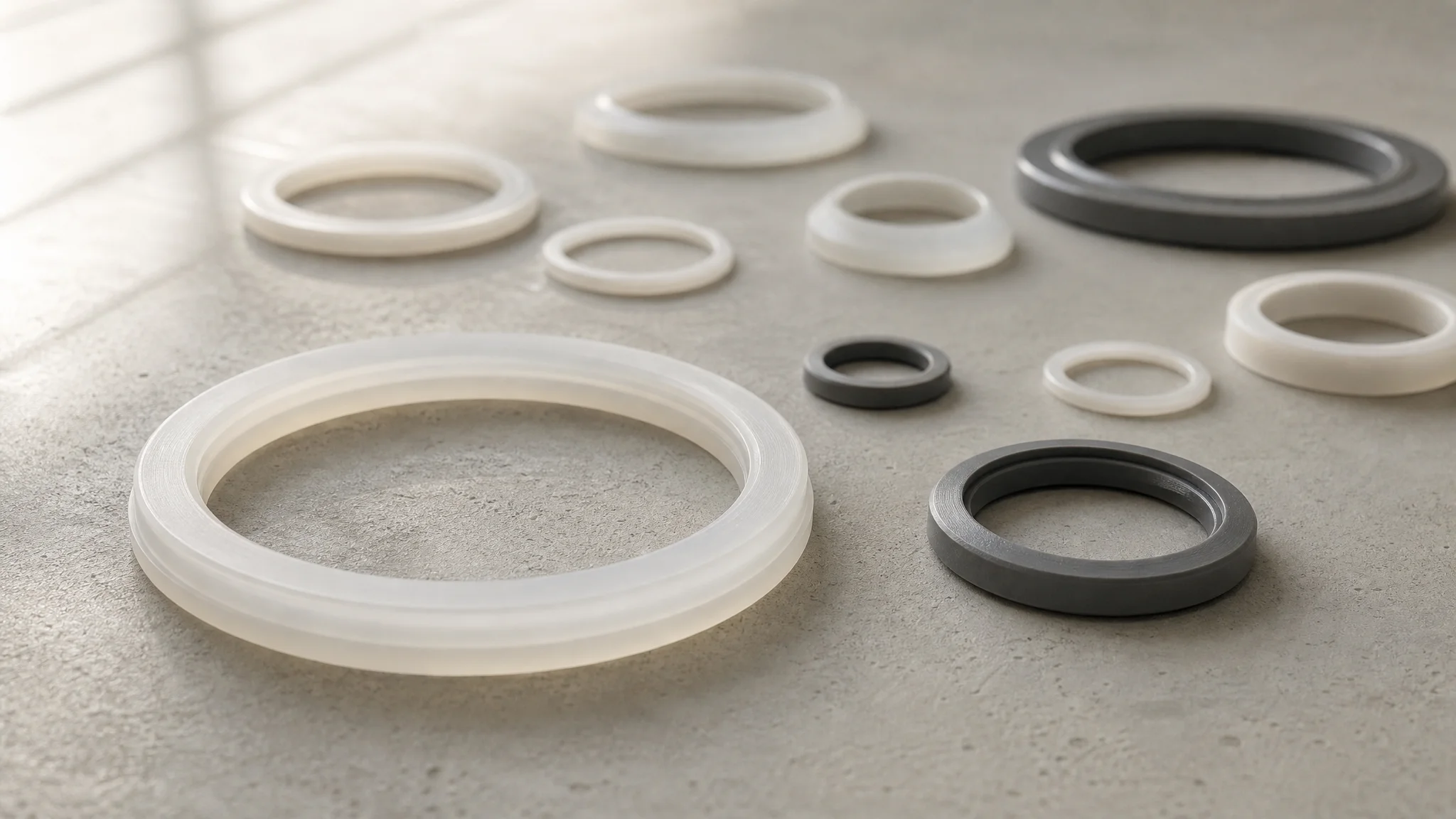
What Does a Lid Gasket Actually Have to Do in a Reusable Bottle?
A gasket in a drinkware lid performs four jobs simultaneously, and most material failures come from optimizing for one and ignoring the other three.
It seals under a defined compression. The lid applies a known deflection — typically a few tenths of a millimeter — to a ring that sits in a groove. The material must generate enough restoring force at that deflection to resist the internal pressure of a shaken, carbonated, or thermally cycled bottle, and it must keep generating that force after the bottle has been through five hundred wash cycles.
It recovers. Between uses the gasket is unloaded. A material with poor elastic recovery takes a permanent set, the sealing line flattens, and the lid that passed a leak test in the lab weeps onto a customer’s laptop in the field. This is the failure mode behind most one-star reviews, and we covered its mechanics in detail in why leak-proof lid claims fail in real-world use. Material choice is half of that story.
It stays chemically boring. It must not give the water a smell, must not bloom a white haze onto the sealing surface, must not absorb coffee oils so deeply that a bottle rinsed with water still tastes of yesterday’s latte, and must not degrade into a sticky film when exposed to citrus, dairy, or acidic sports drinks.
It stays legal. It is a food-contact article in every market that regulates food-contact articles, and the burden of proof — the declaration, the migration data, the traceability — lands on the party placing the finished bottle on the market, not on the molder.
How Do Silicone, TPE and EPDM Compare on the Properties Buyers Actually Test?
The three materials are not interchangeable grades of the same idea. Silicone is a thermoset with a silicon-oxygen backbone. EPDM is a thermoset with a saturated hydrocarbon backbone and residual diene sites for vulcanization. TPE is a thermoplastic block copolymer — usually styrene-ethylene-butylene-styrene — that behaves like rubber at room temperature and like plastic when heated. That last difference is the source of both its commercial advantage and its technical ceiling.
What Does Compression Set Tell You That Hardness Does Not?
Hardness, measured as Shore A per ASTM D2240, tells you how stiff the ring feels on the bench. It tells you almost nothing about whether the ring will still seal after a year. Compression set — the permanent deformation remaining after a specimen is held at a defined deflection for a defined time and temperature, measured per ASTM D395 — tells you whether the material remembers its shape.
This is where the specification conversation usually goes wrong. A buyer writes “50 Shore A silicone” on a drawing, receives samples that feel correct, and never asks for a compression set value. Two molders can both supply 50 Shore A rings from the same nominal polymer family and deliver very different set behavior, because set is governed by crosslink density, cure completeness, filler loading, and post-cure — variables that live in the molder’s process, not in the material name. Instead of specifying a percentage we cannot responsibly attribute to a published source, we ask buyers to specify a test condition and a maximum: ASTM D395 Method B, constant deflection, 22 hours at 70 °C, with a maximum set written into the drawing. The number is then a contract term your supplier must demonstrate on their own compound, and it becomes auditable batch to batch.
Qualitatively, the ranking is consistent across seal-industry literature: silicone holds compression set resistance better than EPDM in static sealing duty, and both thermosets outperform unfilled or lightly filled SEBS-based TPE once the service temperature climbs. That is the trade: TPE wins on cost and processability, thermosets win on memory.

Which Material Survives the Dishwasher — and What Does “Dishwasher Safe” Actually Mean?
Silicone has the widest published service envelope of the three, and the difference is not marginal. In published seal-industry comparison tables, silicone is rated from roughly −60 °C to +230 °C continuous, with short-term excursions to about 250 °C, while EPDM is rated from about −50 °C to +135 °C continuous with short-term exposure to roughly 150 °C. A dishwasher’s heated drying cycle and the localized temperature near the heating element sit comfortably inside the silicone envelope and uncomfortably close to the EPDM ceiling. (See the EPDM versus silicone service-temperature comparison published by DXT Seals for the table this ranking comes from.)
But temperature is only half of the dishwasher story. The other half is chemistry and mechanics. Dishwasher detergent is alkaline and contains builders and enzymes that attack hydrocarbon elastomers at the surface; TPE and EPDM both lose gloss and can chalk, while silicone generally does not. More importantly, the dishwasher is a mechanical torture test: the gasket is repeatedly compressed, released, heated, cooled, and blasted with water at pressure. A material that passes a static hot-water soak can still fail because it has crept.
For practical procurement purposes, treat “dishwasher safe” as a claim that requires a defined cycle count and a defined pass criterion. A statement such as “top-rack dishwasher safe” without a cycle count is marketing copy, not a specification. We recommend the drawing carry a cycle count (for example 500 cycles), the detergent type used in the test, and a post-test acceptance criterion covering compression set recovery, visible cracking, hardness change, and seal function. If your supplier cannot state how many cycles they tested, they have not tested.
How Do the Three Materials Handle Citric Acid, Coffee and Dairy?
Beverage contact is a narrower chemical environment than the dishwasher, but it is a more intimate one — the gasket sits against the liquid for hours at a time, often warm, often for years.
Citric acid and acidic sports drinks. All three materials are generally acceptable. Silicone is chemically inert against dilute organic acids. EPDM is rated good against many acids. TPE is acceptable but is the most likely of the three to show surface dulling and slight swelling under prolonged acidic contact, because the styrene blocks and the plasticizing oil phase are more vulnerable than a crosslinked backbone. The real risk with acid is not the gasket body — it is the plasticizer and process aid migrating out of a cheaply compounded TPE and into the beverage, which is a migration-test question, not a visual one.
Coffee and tea. This is the taste-critical case. Coffee contains oils and polyphenols that adsorb into elastomer surfaces. Silicone is the least absorptive of the three in practice and, critically, it releases odor on washing more completely. TPE and EPDM both have a greater tendency to retain coffee odor and to develop a persistent stale note in the lid even after the bottle body has been washed. If your program sells to coffee drinkers — and most reusable bottle programs do — this single property justifies a meaningful part of the silicone premium.
Dairy and protein drinks. The risk is not chemical attack but biological: milk residue in a microporous or heavily plasticized surface is difficult to rinse out and becomes a bacterial substrate. Dense, well-cured silicone with a smooth mold finish cleans best. Porous, poorly consolidated TPE with visible flow lines or heavy deflashing burrs cleans worst. Surface finish, not just polymer identity, determines cleanability.
Why Does Taste and Odor Transfer Disqualify Some Materials?
Sensory failure is the most under-specified and most expensive defect class in drinkware. It does not show up in incoming inspection, it does not show up in a leak test, and it does not show up in a migration test unless the lab is specifically looking for it. It shows up as a return.
Two mechanisms drive it. The first is residual volatiles: uncured oligomers, peroxide decomposition products, and low-molecular-weight process oils that outgas slowly into the headspace of a closed bottle. Silicone is normally post-cured (a heated secondary bake) precisely to drive off these volatiles; a supplier who skips or shortens post-cure to save cycle time will ship gaskets that smell faintly of rubber for the first twenty washes. The second is adsorption: the material takes up flavor compounds from the beverage and gives them back later. Silicone’s low adsorption is one of its genuine functional advantages in this application.
The procurement response is to make both mechanisms testable. Require a sensory panel or a trained-nose evaluation after a defined soak and wash protocol, and require the supplier to declare the post-cure condition (temperature and duration) in the process sheet. A gasket that smells of nothing is a specification, not an accident.
Does Tear Resistance Matter More Than Tensile Strength?
For a lid gasket, yes. Tensile strength per ASTM D412 is the number that appears on datasheets because it is easy to market. Tear strength per ASTM D624 is the number that predicts field failures, because the failure mode of a lid gasket is almost never bulk tensile rupture — it is a nick that propagates.
Consider the real handling sequence: the gasket is pried out of its groove with a fingernail or a spoon handle for cleaning, stretched over the rim of the lid, and pushed back in. Every one of those actions concentrates stress at the mold parting line and at the gate. Silicone’s known weakness is exactly here — it has comparatively poor tear and abrasion resistance, and a thin silicone ring with a poorly placed gate or a heavy parting line will tear at the flash within a few cleaning cycles. EPDM is tougher. TPE sits between them, with the advantage that a TPE gasket can often be co-molded or over-molded directly onto a PP lid, eliminating the manual installation step that causes most tears in the first place.
The design consequence is concrete: if you specify silicone, specify a minimum cross-section and require the gate location to be in a low-stress region away from the sealing line. A 1.0 mm silicone ring looked at on a drawing becomes a 0.7 mm ring at the flash after trimming, and 0.7 mm of silicone is a tear waiting to happen.
Which Material Comparison Should Your Product Team Actually Put on the Table?
The table below is the summary we use in supplier reviews. It deliberately separates published material properties (which come from standards and industry data) from commercial characteristics (which come from how the material behaves in a factory), because the two are usually conflated in supplier presentations.
| Decision factor | Silicone (VMQ) | TPE (SEBS-based) | EPDM |
|---|---|---|---|
| Published service temperature | Approx. −60 °C to +230 °C continuous; short-term to about 250 °C | Material-dependent; the lowest ceiling of the three in sustained heat | Approx. −50 °C to +135 °C continuous; short-term to about 150 °C |
| Compression set resistance (ASTM D395) | Best of the three in static sealing duty | Weakest; degrades fastest as temperature rises | Good, but behind silicone |
| Tear / abrasion resistance (ASTM D624) | Recognized weakness; needs section and gate design | Moderate; improved by over-molding onto the lid | Good |
| Taste and odor | Low adsorption; best performer if post-cured properly | Higher risk of retained coffee and process-oil notes | Higher risk than silicone; rubber-typical |
| Dishwasher durability | Best; alkaline detergent and heat tolerated well | Chalking and gloss loss likely over high cycle counts | Acceptable at low cycle counts; heat margin is thin |
| Tooling and process | Compression molding or LSR injection; deflashing labor common | Injection molding; can be over-molded onto PP; least secondary labor | Compression or injection molding; deflashing typical |
| Food-contact route (US) | 21 CFR 177.2600 lists silicone elastomer types | Not a “rubber” article; assessed as a plastic or via a closure regulation | 21 CFR 177.2600 lists ethylene-propylene elastomers |
| Food-contact route (EU) | Outside Regulation 10/2011; national rules plus BfR Recommendation XV | Inside Regulation 10/2011 as a plastic | Outside Regulation 10/2011; national rules plus BfR Recommendation XXI |
| Recyclability | Not recyclable in practice; must be removable | Compatible with PP streams only if PP-based and separable | Not recyclable in practice; must be removable |
Read the table as a set of trade-offs rather than a scorecard. Silicone wins on the properties that generate warranty claims. TPE wins on the properties that generate purchase orders. EPDM is the compromise that makes sense in a narrow band: outdoor equipment, low wash-cycle programs, and cost-driven promotional goods where the gasket will not sit against hot coffee.
What Is the Correct Food-Contact Compliance Path for Each Material?
Here is the part of the conversation where supplier declarations most often turn out to be decorative. The three materials do not share a regulatory route in either the United States or the European Union, and a certificate that is correct for one is meaningless for another. If you accept a generic “FDA and LFGB approved” sheet covering all three, you have accepted nothing.
Does FDA 21 CFR 177.2600 Cover TPE?
No — and this is one of the most common misstatements in Chinese supplier documentation. Section 177.2600 of Title 21 is titled “Rubber articles intended for repeated use,” and it applies to articles made from natural and synthetic rubbers. Its permitted elastomer list explicitly includes silicone basic polymer types (designated Si, Psi, Vsi, Fsi and PVsi in the regulation) and ethylene-propylene elastomers, including ethylene-propylene-dicyclopentadiene copolymer. Both silicone and EPDM therefore have a clear home in 177.2600. A thermoplastic elastomer does not: it is a thermoplastic, and its compliance is normally established through the applicable polymer regulation for its base resin or, for a gasketed closure, through the closure provisions referenced within Part 177. In practice this means a TPE gasket needs a different set of extraction data and a different regulatory citation on its declaration than a silicone gasket from the same factory.
The quantitative requirements in 177.2600 are the numbers to write into your test request, because they are the ones your US retail customer’s compliance team will look for. For articles intended for repeated use in contact with aqueous food, the food-contact surface extracted with distilled water at reflux temperature must yield total extractives not exceeding 20 milligrams per square inch during the first 7 hours, and not more than 1 milligram per square inch during the succeeding 2 hours. For repeated use in contact with fatty foods, extraction with n-hexane at reflux must yield not more than 175 milligrams per square inch in the first 7 hours and not more than 4 milligrams per square inch in the succeeding 2 hours. Those four figures come directly from 21 CFR 177.2600(e) and (f) on eCFR, and they are the reason a gasket with a large food-contact surface area is harder to qualify than a thin O-ring.
Note the wording: per square inch of food-contact surface. A wide, flat gasket that sits across the mouth of a bottle exposes far more area than a thin round ring in a groove. Two gaskets made from the same compound can pass and fail the same specification because of geometry. This is why we ask for the extractables result expressed against the actual gasket drawing, not against a generic 10 cm² plaque.
Why Is Silicone Outside the Scope of EU 10/2011?
Because Regulation (EU) No 10/2011 governs plastic materials and articles, and its own recitals say so explicitly. Recital 7 of the regulation notes that plastics, ion exchange resins, rubbers and silicones are all macromolecular substances obtained by polymerisation, that specific measures may be adopted for rubbers and silicones, and that because those materials are composed of different substances with different physico-chemical properties, they are not within the scope of this Regulation. The full text is on EUR-Lex as Regulation (EU) No 10/2011.
This has three practical consequences for a drinkware program.
One: a TPE gasket is a plastic article and is inside 10/2011. It needs overall migration testing against the limits in that regulation — the overall migration limit is 10 mg per dm² of food-contact surface, which corresponds to 60 mg per kg of food — plus specific migration testing for any restricted substance in its formulation, plus a declaration of compliance naming the substance list and the restrictions applied.
Two: a silicone gasket is outside 10/2011 and therefore cannot be certified “EU 10/2011 compliant” in any meaningful sense. What it needs is a declaration against the general safety requirements of Regulation (EC) No 1935/2004, plus evidence against whichever national measure applies in the member state where your customer sells. In Germany that means the LFGB framework and, for silicone, BfR Recommendation XV (“Silicones”), which lists permitted base polymers, crosslinkers and additives. For rubber articles, the corresponding German reference is BfR Recommendation XXI.
Three: an EPDM gasket follows the rubber path, not the plastic path. Same 1935/2004 baseline, same national-measure logic, BfR XXI rather than XV in Germany.
Why Do “LFGB §XVII” Certificates Keep Appearing — and What Should You Ask For Instead?
Because they circulate. We regularly receive supplier packs containing a certificate headed “LFGB Section XVII” for silicone parts, and buyers reasonably assume the section number is the specification. It is worth being precise here, because a wrong citation in a compliance file is worse than a missing one: it signals that nobody in the chain read the document. The German food-contact framework operates through LFGB Articles 30 and 31 (the general prohibition on transferring constituents to food in quantities that endanger health or change the food’s composition, character or sensory properties), with material-specific BfR Recommendations doing the technical work underneath. For silicone, the operative recommendation is XV. For natural and synthetic rubber commodities, it is XXI.
So when you receive a certificate, ask three questions and expect three specific answers. Which BfR recommendation, by number and title, was the test based on? Which simulant, temperature and contact time were used? And which laboratory issued the report, with a report number and a date that can be verified independently? A supplier who cannot answer all three has sent you a logo, not a test.
What Must a Declaration of Compliance Actually Contain?
A declaration of compliance — the DoC that accompanies a food-contact article in the EU — is not a certificate of “food grade.” It is a document with defined content, and for a drinkware gasket the useful version contains the following.
- Identification of the article and the material, specific enough to tie the declaration to a drawing revision and a compound code, not to a product family name.
- The regulatory basis, named by number: 1935/2004 for the general framework; 10/2011 for a TPE; the relevant national measure and BfR recommendation for silicone or EPDM.
- Migration test results with conditions — simulant, temperature, duration, number of repeated-use exposures, and the surface-area-to-volume ratio used in the calculation.
- Specific migration results for restricted substances relevant to the compound: heavy metals, primary aromatic amines where applicable, and any substance with a restriction in the formulation.
- A statement on substances of concern covering the current EU restrictions the buyer’s compliance team will ask about, including per- and polyfluoroalkyl substances. Our own position on that topic is set out in the PFAS-free declaration guide for stainless steel drinkware; the gasket is one of the few places where a PFAS question is genuinely relevant, since some processing aids and mold-release agents sit in the supply chain rather than in the polymer.
- Traceability and validity: batch or lot reference, issue date, expiry or review date, and the name and signature of the responsible person at the converting company.
One clarification that saves programs a lot of confusion: this article is about the gasket material and does not re-open the liner question. If your lid uses a liner or a coated sealing disc rather than a molded ring, the BPA and bisphenol-free considerations in our analysis of bisphenol-free lid liners and the EU BPA ban apply on top of everything here. The two decisions are adjacent but not the same.
What Drives the Real Cost Difference Between Silicone and TPE?
The quote difference between a silicone and a TPE gasket is rarely a material-price difference, even though that is how it is usually explained. Material price sets a floor. Everything above the floor is process.
Where Does the Per-Piece Cost Actually Come From?
Silicone compound is a specialty elastomer and costs a multiple of a commodity SEBS-based TPE compound per kilogram. But a lid gasket weighs very little, so the absolute material cost per piece is small in both cases. The parts of the quote that actually move are the ones buyers tend to gloss over.
Cycle time and cavitation. Thermoset silicone requires a cure in the mold — the material must be heated until crosslinking is complete, then demolded. Thermoplastic TPE requires only cooling. That difference shows up in cycle time and in how many cavities a tool can run economically, and it compounds across a production run.
Secondary operations. Compression-molded silicone rings almost always need deflashing — manual or cryogenic trimming of the flash line. That is labor, and labor is the least predictable cost in any quote. Injection-molded TPE in a well-designed tool can come out essentially flash-free, and if the gasket is over-molded directly onto the PP lid, the entire separate-component handling step disappears.
Scrap and yield. Thermoset scrap cannot be re-melted. A bad silicone shot is waste. TPE runners and rejects can often be regrind, subject to the compound’s regrind policy and the food-contact declaration covering regrind content.
How Do Tooling, MOQ and Deflashing Change the Arithmetic?
Tooling is where the two paths diverge most for small programs. A simple compression mold for a silicone ring is modest by injection-molding standards; an injection tool for a TPE gasket, or an over-mold tool that combines gasket and lid, is a larger investment with a longer lead time. That inverts the economics depending on volume. At low volumes the cheaper tool wins even if the piece price is higher. At high volumes the lower cycle time and eliminated deflashing of the TPE route pay back the tool many times over.
Minimum order quantity follows the same logic. A silicone ring can be run in a compression press at relatively low quantities because the tool is cheap and the setup is short. A TPE program wants to amortize an injection tool, so the molder will push for a higher MOQ or a higher tooling charge to compensate. If a supplier quotes you an unusually low MOQ on an injection-molded TPE gasket without a tooling charge, ask where the tool cost went — it is either in the piece price or it is not their tool.
Mold ownership is the clause that determines what happens when you want to move. Our guidance on mold ownership and customs assists applies unchanged to gasket tools, and it matters more here than for the bottle body, because a gasket tool is inexpensive enough that suppliers sometimes treat it as their own property. Get it in writing: who owns the tool, where it is stored, what the buyer must pay to retrieve it, and whether the tool is dedicated to the buyer’s compound.

Does Cheaper Material Ever Make the Assembly More Expensive?
Regularly. The gasket is not purchased in isolation; it is installed. A loose silicone ring requires a manual or semi-automatic seating step, and that step has a yield. Rings get twisted, inverted, over-stretched, or seated with a fold that survives visual inspection and fails a leak test three weeks later. Every one of those outcomes costs more than the material saving.
Assembly tolerance is the hidden variable. The groove depth, the ring cross-section, and the lid’s compression travel form a stack-up; if the ring’s cross-section tolerance is loose, the stack-up either under-compresses (leak) or over-compresses (hard seating, accelerated set, cracked lid skirt). A material with a wider allowable cross-section tolerance is cheaper to buy and more expensive to assemble. When you evaluate two quotes, ask both suppliers for the cross-section tolerance they will hold and the compression range their design assumes. If one cannot answer, the lower price is not comparable.
Automation changes the answer again. If your program runs an automated capping or lid-assembly line, a gasket that arrives pre-assembled to the plug — the classic TPE over-mold — removes a pick-and-place operation and a whole class of defects. If your line is manual, the labor saving is smaller and the silicone ring remains perfectly rational. This is the point at which material choice stops being a purchasing decision and becomes a manufacturing-engineering decision.
How Does Gasket Choice Affect Recyclability and PPWR Claims?
Recyclability is where marketing ambition most often outruns engineering fact, and the gasket is the usual casualty.
Can You Legally Call a Silicone Gasket Recyclable?
Not in any consumer-facing sense, and probably not in a technical one either. Silicone is a thermoset: it does not re-melt, so it cannot be mechanically recycled into new silicone parts through the routes available to municipal or industrial plastic recycling. It can be downcycled into filler or processed by specialized chemical routes at very small scale, but neither supports a mainstream recyclability claim. The same is true of EPDM. TPE is thermoplastic and therefore technically re-meltable, but a TPE gasket only belongs in a recycling stream if it is compatible with the dominant material of the item it is attached to.
That is the whole argument. A stainless steel bottle is recycled through metals streams; the gasket is a contaminant that must be removed by the consumer, and in practice it often is not. A PP lid is recycled through polyolefin streams; a TPE gasket is only welcome if it is PP-compatible and, ideally, the same color, or if the whole lid is designed to be processed together. A silicone ring on a PP lid is a contamination risk in that stream.
What Does “Mono-Material” Mean for a Bottle With a Gasket?
It means the gasket has to earn its place. The EU’s Packaging and Packaging Waste Regulation — Regulation (EU) 2025/40 — has been in force since 11 February 2025 and applies from 12 August 2026, and its design requirements push toward recyclability at scale by 2030. The European Commission’s packaging waste page sets out the framework and the timeline. Note carefully what the regulation governs: packaging. A reusable drinkware product is a durable good, not packaging, so PPWR does not directly regulate your bottle. But it regulates the box the bottle ships in, and it shapes what retail buyers, especially grocery and mass-market accounts, now ask of every component in the pack — including claims made on the product itself.
The honest claims available to you are conditional, and they should be written as conditions rather than as adjectives:
- “Gasket removable for recycling” — defensible if you can demonstrate that a consumer can remove it without tools in a few seconds, and if the lid design makes the removal obvious. Tool-required removal is not consumer-recyclable.
- “Lid recyclable with PP stream where facilities exist” — defensible only for a PP lid with a PP-compatible TPE gasket, and only with the “where facilities exist” qualifier.
- “Mono-material PP lid” — defensible only if the gasket is PP-based TPE and the color is compatible. A white silicone ring in a black PP lid is not mono-material in any operational sense.
- “Gasket made from recyclable material” — not defensible for silicone or EPDM in a consumer context, even though both are technically re-processable by specialty routes.
What you should not do is allow a supplier to describe a silicone gasket as “eco-friendly” or “recyclable” in a specification sheet that then flows into your product page. That is the exact pattern regulators now treat as greenwashing, and the enforcement risk sits with the brand, not the factory.
How Should You Write the Gasket Into the Specification and the Purchase Order?
A material decision that is not written into a document with a number in it will drift within two production runs. Compound substitutions are the norm in the category: a molder runs short of the approved compound, substitutes an equivalent from a second supplier, and the “equivalent” has a different cure system, a different post-cure, or a different plasticizer load. The gasket still looks right. The compression set is worse. Three months later you have a returns problem with no traceable cause.
The specification block below is the minimum we would accept as a factory, and the minimum we recommend you demand as a buyer.
What Belongs in the Material Specification Block?
- Polymer identity, not marketing language. “Silicone (VMQ), platinum-cured” or “SEBS-based TPE, Shore A as specified” or “EPDM, sulfur-cured, peroxide-cured where specified.” Not “food grade rubber.”
- Hardness with a tolerance. Nominal plus tolerance, measured per ASTM D2240 on the finished part, with the measurement location defined. A ring measured at the gate reads differently from a ring measured at the sealing line.
- Compression set. Method and condition plus a maximum: ASTM D395 Method B, 22 hours at 70 °C, maximum set value stated. This is the single most valuable line in the block.
- Tensile and tear. ASTM D412 for tensile strength and elongation at break, ASTM D624 for tear strength, both with minimum values agreed with the compound supplier rather than copied from a generic datasheet.
- Color and finish. Color to an approved master chip or Pantone reference under defined lighting; finish defined as molded, matte, or post-processed, with a surface-roughness or visual-standard reference. Include a statement on whether the surface may be talc-dusted or siliconized — a mold-release residue is a food-contact and a sensory issue.
- Dimensional tolerances on cross-section, inner diameter, and free height, with the measurement method and the inspection frequency stated.
- Dishwasher cycle requirement: cycle count, detergent type, and post-test acceptance criteria.
- Compliance citations by number: 21 CFR 177.2600 with the extractables limits for the applicable food type; EU 1935/2004 plus the applicable national measure and BfR recommendation; and a RoHS and REACH SVHC statement. For TPE, the 10/2011 overall and specific migration position must be stated explicitly.
- Batch traceability and retention samples: compound lot, molding date, cavity identification where relevant, and a retained sample per lot held for a defined period.
Which PO Clauses Prevent Batch Drift?
Specifications describe the part. Purchase orders control the supplier. The clauses that actually prevent drift are these.
No substitution without written approval. Any change of compound, compound supplier, cure system, or post-cure condition requires a new sample submission and written buyer approval before shipment. State that unapproved substitution is a rejectable defect, not a deviation to be negotiated after arrival.
Retained samples per lot. One sample per production lot, labeled with lot number and date, retained for a defined period — typically the warranty period plus a margin. When a customer complains in month ten, the retained sample is the only physical evidence of what you actually shipped.
Certificate of analysis per lot. Hardness, specific gravity, compression set on a lot basis, plus the compound lot number traceable to the material supplier’s certificate.
Golden sample and boundary samples. A signed golden sample with the drawing revision, plus boundary samples for the visual defects that are hardest to describe in words: flash height, parting-line witness, gate vestige, and color variation. This is the same discipline described in our guide to which QC checks actually matter before shipment, applied to a component that most inspection plans barely cover.
AQL and defect classification specific to the gasket. Cosmetic defects and functional defects need different acceptance levels. A flash burr is cosmetic until it sits on the sealing line, at which point it is functional. Write both classes separately, or the inspection will default to whichever class is easier to pass.
Change-notification window. A defined notice period before any change in the manufacturing site, the compound, or the tool, with the buyer’s right to re-qualify. This is the clause that stops the slow migration of your program to a cheaper compound six months after launch.
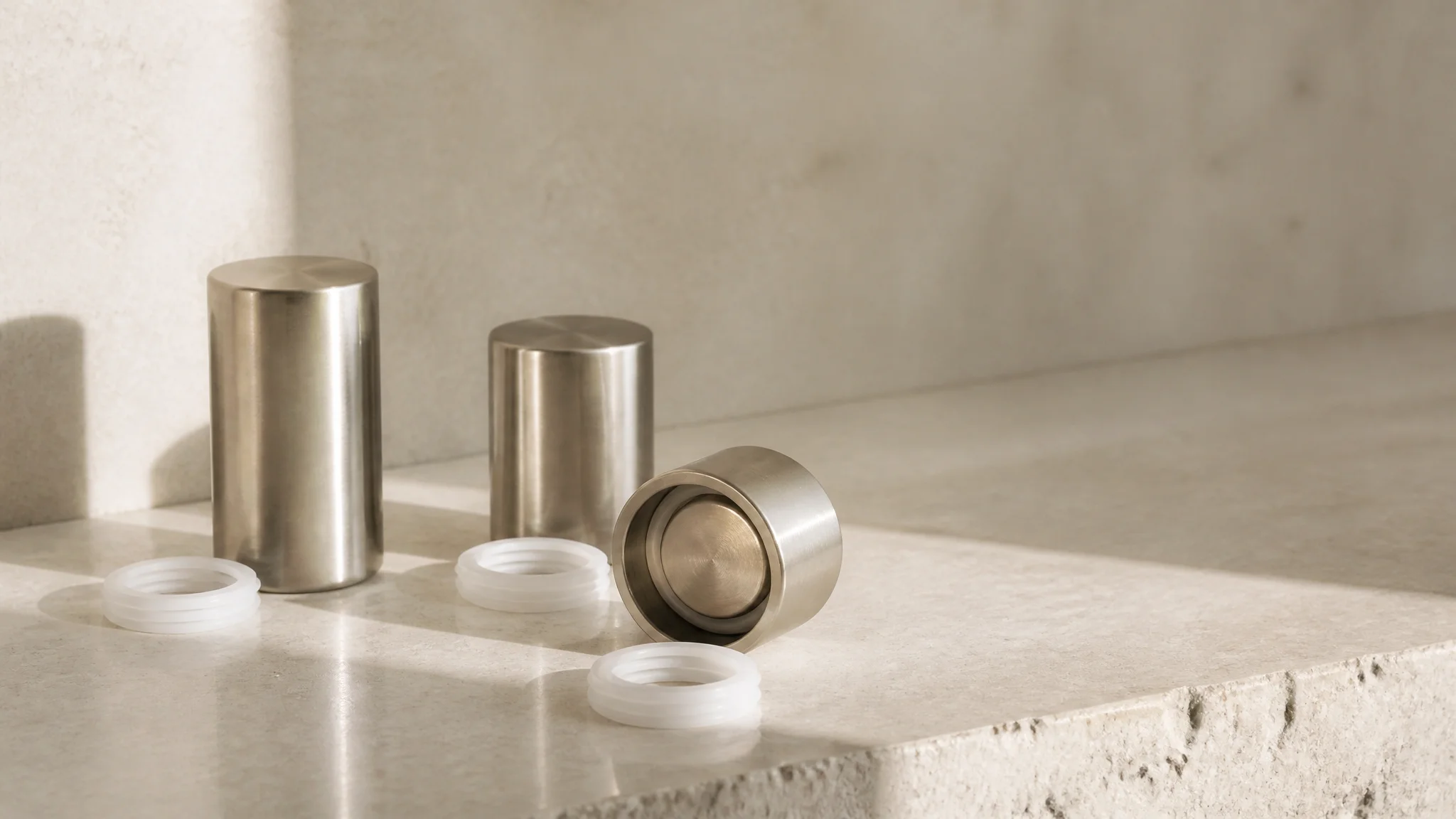
Which Material Should You Specify?
After all the comparison, the decision rules are short. What follows is how we advise buyers when they ask us to recommend rather than quote.
| Program profile | Recommended gasket | Why |
|---|---|---|
| Premium insulated bottle, coffee or tea use, dishwasher claim, multi-year warranty | Platinum-cured silicone, post-cured, 21 CFR 177.2600 extractables data on the actual part | Lowest sensory risk, best set recovery, widest temperature margin; the material cost is a small share of retail price |
| High-volume PP lid, automated assembly, cost-sensitive channel | PP-compatible TPE, over-molded onto the plug | Removes a manual seating step, eliminates deflashing labor, and supports a mono-material lid claim |
| Promotional or seasonal goods with a short life and low wash-cycle exposure | TPE, with an explicit temperature ceiling on the care label | The economics dominate; the risk is manageable if you do not claim dishwasher durability |
| Outdoor, sports, or cold-climate program where the lid may be stored below freezing | Silicone, or EPDM where cost rules and wash cycles are low | Both retain flexibility well below freezing; silicone has the wider margin and better set behavior |
| Kids’ drinkware under EU or US import scrutiny | Silicone with full DoC and BfR XV data, or a PP-compatible TPE with 10/2011 migration data | Documentation depth matters more than the material difference; the compliance file will be reviewed |
Three closing observations that we would put in front of any product team. First, the gasket is a serviceable part, not a permanent one. Design it to be visible, graspable, and replaceable, and sell replacements — the design decision costs nothing and removes most of the complaints that come from a gasket that failed after two years of hard use. Second, hardness is the number buyers ask for and compression set is the number that predicts failure; insist on both, and put the set limit in the drawing. Third, material identity and regulatory route are inseparable. A silicone gasket and a TPE gasket from the same factory ship under different regulations, need different test data, and support different marketing claims. Writing “food-grade silicone or equivalent” on a drawing is how programs end up with a TPE gasket, a 177.2600 citation that does not apply, and a compliance file that cannot survive a retailer audit.
Frequently Asked Questions
Is silicone always better than TPE for a water bottle gasket?
No. Silicone is better on compression set recovery, service temperature, taste neutrality and dishwasher durability, which are the properties behind most warranty claims. TPE is better on piece price, cycle time, deflashing labor and the ability to be over-molded onto a PP lid, which drives total landed cost at high volume. Specify silicone when the gasket sits against coffee or tea and the program promises multi-year durability. Specify TPE when volume, automation and a mono-material lid claim dominate the business case.
What Shore A hardness should a lid gasket be?
There is no universal number, and any supplier who names one without asking about your groove depth is guessing. The hardness must be chosen together with the groove geometry and the available compression travel: a softer ring seals with less closing force but is easier to over-compress and tear during installation, while a harder ring resists creep but demands more compression. Write a nominal value with a tolerance and a measurement location into the drawing, and validate it on a leak test, not on a durometer alone.
Can I claim “dishwasher safe” if the gasket is TPE?
Only if you have tested it and can state a cycle count. TPE survives dishwashers, but alkaline detergent and repeated heated drying cycles tend to dull the surface, and some grades chalk or harden over high cycle counts. The defensible approach is to specify a cycle count, name the detergent used in testing, and define pass criteria covering hardness change, visible cracking, compression set recovery and seal function. A claim without a cycle count is marketing copy that your retailer’s compliance team may ask you to substantiate.
Is “FDA food-grade silicone” the same as LFGB approval?
No, and the two are not interchangeable. In the United States, silicone for repeated-use food contact is assessed against 21 CFR 177.2600, which sets extractables limits per square inch of food-contact surface. In Germany, silicone falls under the LFGB framework with BfR Recommendation XV providing the material-specific rules, and it sits outside EU Regulation 10/2011 entirely. A supplier claiming both should be able to produce two separate test reports with different methods, simulants and limits.
Why did my silicone gasket harden and crack in the dishwasher?
Three likely causes, in order of frequency. The compound was not post-cured, leaving residual volatiles that migrate and embrittle the surface. The compound used a cheap filler system that does not tolerate repeated alkaline exposure. Or the gasket is under-designed — too thin a cross-section in a high-stress location, so thermal cycling and mechanical compression combine to initiate a tear at the flash line. Ask for the post-cure condition and the compound datasheet, then examine where the crack started.
Do I need a custom molded gasket, or can I use a standard O-ring?
A standard O-ring works when the groove is designed for a round cross-section and the lid geometry gives you a proper squeeze percentage. Most drinkware lids do not: they use a wide, flat, or D-shaped profile to seal against a wide rim with low closing force. Forcing an O-ring into a groove designed for a flat gasket usually produces a leak that no material upgrade will fix. Decide the seal geometry first, then the material — the reverse order causes most of the re-tooling we see.
What compression set limit should I write into the purchase order?
Write the method and the condition, then agree the maximum with your supplier based on their compound data rather than inventing a number. The condition matters as much as the limit: ASTM D395 Method B at 22 hours and 70 °C is a reasonable proxy for a bottle left in a warm car or run through a dishwasher’s drying phase, while a higher temperature tests a different failure mode. What is not acceptable is leaving compression set off the drawing entirely, which is the most common omission we see.
How do I keep hardness and color consistent batch to batch?
Make both lot-tested rather than type-tested. Require a certificate of analysis per lot covering hardness and specific gravity, tie each lot to the compound supplier’s own certificate, and retain a physical sample per lot for the warranty period. For color, approve a master chip under defined lighting and add boundary samples for acceptable variation. Then enforce the no-substitution clause: most batch drift we investigate traces back to an unapproved compound change, not to molding variation.
About the Author
This article was written by the oemwaterbottle.com Sourcing Team. We are a stainless steel drinkware OEM factory team working daily with US and EU brand owners on material selection, tooling, compliance documentation and mass production. Our engineers specify gaskets, run compression set and leak validation, and resolve the field failures that follow a wrong material call.