Description
600ML Double Walled Vacuum Flask
Vacuum insulation is a process, not a feature
Every supplier claims double-wall vacuum insulation. The difference between a flask that holds temperature for four hours and one that holds it for eighteen is not the wall thickness. It is whether the vacuum space was actually evacuated and whether it stayed evacuated. Those are process questions, and they are answerable with two documents and one test.
Pump-before-weld versus weld-before-pump
In the common process, the body is assembled with a small copper tube left protruding from the base, air is drawn out through that tube, and the tube is then crimped and sealed. The alternative is to seal the body first and evacuate through a getter material that absorbs residual gas once heated.
The tube method reaches a harder vacuum and is more common for 600ml bodies. Its weakness is the crimp: a crimp that is not fully cold-welded will leak slowly, and the failure appears months later as a warm body rather than a cold drink. Ask how the crimp is inspected, and whether every unit or a sample is checked. The answer separates a real vacuum line from an assembly shop.
Copper plating inside the vacuum gap
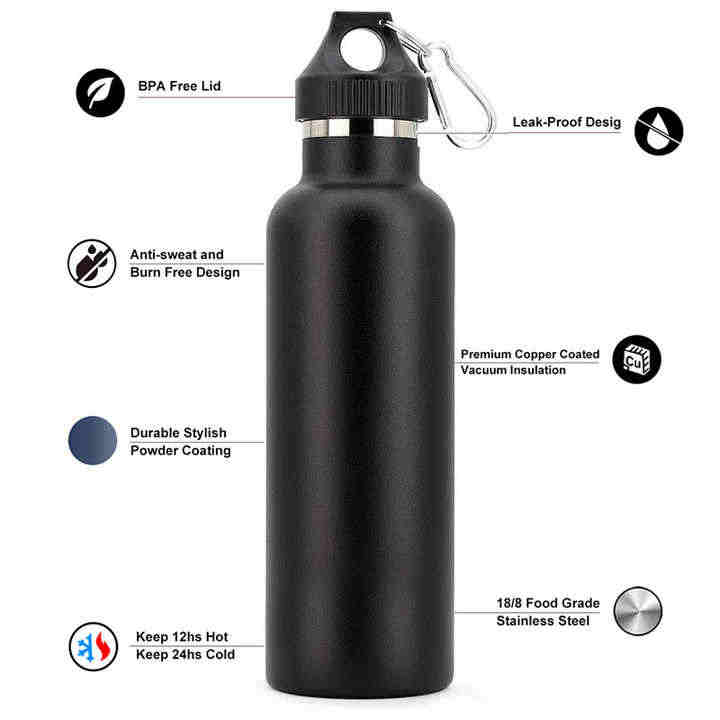
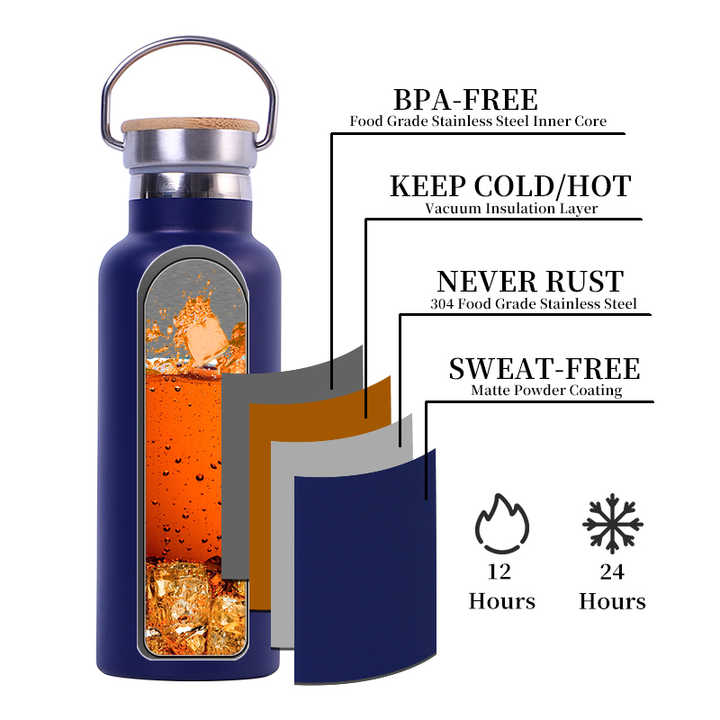
Radiation is the dominant heat path across a vacuum gap. A copper or copper-alloy coating on the inner surface of the outer wall cuts radiative transfer substantially. It is invisible from outside and it is the single cheapest upgrade to thermal performance. If a quote is unusually low for a claimed 18-hour hold time, this coating is usually what was omitted.
Ask whether the coating is applied to the inner surface of the outer wall, and at what thickness. A supplier who cannot answer has not built the product they are quoting.
Thermal testing that means something
The useful test is not a marketing number. Fill with water at 95 degrees Celsius, cap, and record the internal temperature at 1, 6, 12 and 24 hours with the flask standing at 20 degrees ambient. A 600ml vacuum flask with copper plating typically retains above 65 degrees at 6 hours and above 45 degrees at 24 hours. Anything claiming 24 hours above 60 degrees is either a larger body, a thicker wall, or an optimistic measurement.
Run the test yourself on a production sample, not on the sample the supplier selected.
How vacuum failure actually presents
A failed vacuum does not announce itself. The outer wall becomes warm to the touch when the flask is filled with hot water, and condensation forms on the outside of a cold-filled flask. Both are visible in a five-minute check. If your quality process does not include that check on a sampling basis, a slow leak in the crimp line will reach customers without anyone noticing.
Ordering & lead time
| Minimum order quantity | 100 pcs per SKU |
| Sampling lead time | 3 days |
| Production lead time | 7 days |
| Monthly capacity | 100,000 pcs |
Lead times apply to existing tooling and standard colours. New mould development or custom colour matching carries its own schedule — confirm before committing to a delivery date.