Description
32oz / 64oz Vacuum Insulated Water Bottle
Buyers usually compare insulated bottles on capacity, lid style and unit price. The specification that decides whether a program holds up in the market is the wall construction: steel grade, vacuum layer treatment, seam welding and interior finish. Get those four wrong and no amount of lid variety will save the review scores. This page walks through each one in the order they affect performance, so you can put the right requirements on an RFQ instead of discovering the difference after the first container arrives.
How the double wall actually works
A vacuum bottle is two stainless shells with the space between them evacuated and sealed. Heat moves through that gap only by radiation once the air is gone, which is why a properly evacuated bottle holds temperature far longer than a single-wall bottle of the same thickness. In practice the vacuum quality is set at the furnace stage and cannot be inspected visually afterward, so the manufacturing control that matters is the evacuation and sealing process, not the marketing claim on the box.
Where programs need longer retention, some constructions add a copper or reflective coating inside the vacuum gap to cut radiative transfer. This is a genuine upgrade, but it only helps if the vacuum itself is sound. We treat the coating as a secondary step and the vacuum as the primary one.
Steel grade: 304 and 316 are not interchangeable
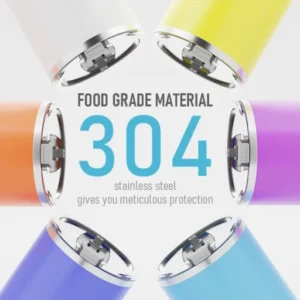
The inner shell touches the beverage, so its grade matters more than the outer shell’s. 304 (18/8) covers the large majority of drinkware programs and is what most retail specs call for. 316 (18/10 with molybdenum) is specified when the use case involves chlorides, saltwater environments, or a longer service life expectation — marine, outdoor and some medical-adjacent channels.
Mixing grades between inner and outer shell is common and legitimate: 304 inside for food contact, 201 or 304 outside to control cost. What is not acceptable is an unmarked substitution. If your spec says 304 inner and the shipment arrives with 201 inner, the failure is invisible until a lab test, which is why grade verification should be written into the inspection plan rather than assumed.
Interior finish and residue risk
After forming and welding, the interior carries drawing lubricant and weld scale. Two finishing routes are used: mechanical polishing and electrolytic passivation. Polishing leaves a bright surface but can trap residue in the weld zone if the rinse is weak. Electrolytic treatment removes surface iron and rebuilds the passive chromium oxide layer, which is the more reliable route for food contact and the one to specify when the end market is strict on migration testing.
Ask for the rinse and drying sequence, not just the finish type. Residual moisture inside a sealed bottle is a common cause of odor complaints that have nothing to do with the steel.
Seam welding and leak behavior
The longitudinal seam and the base weld are the two places a vacuum bottle fails. Automated welding with consistent penetration is the baseline; the variable is how the seam is protected after welding, since the weld zone loses its passive layer. Post-weld passivation or an internal coating restores corrosion resistance.
Leak testing should happen twice: once at the shell stage before assembly, and once on the finished bottle after the vacuum is pulled. A single end-of-line test catches gross failures but misses shells that will fail in transit.
Coating, printing and what survives handling
Powder coating, spray painting and rubberized finishes all sit on top of the same steel, but they behave differently through drop tests, dishwasher cycles and retail handling. Matte and soft-touch finishes look premium and mark more easily; gloss powder coat hides scuffs better. If the program runs through e-commerce with high return rates, specify the finish against an abrasion test rather than a color chip.
What to put on the RFQ
- Inner shell grade and outer shell grade, stated separately
- Vacuum gap treatment (plain or reflective)
- Interior finish route: polished or electrolytic, with rinse and dry sequence
- Post-weld treatment for seam and base
- Leak test points: pre-assembly and post-vacuum
- Finish type with an abrasion or dishwasher reference
Send the requirement list before sampling. Most retention and corrosion complaints trace back to a spec that was never written down, not to a manufacturing limit.