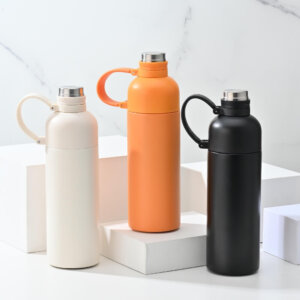
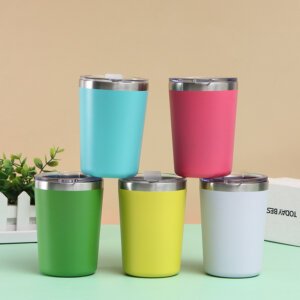
Description
Large Water Bottle
Steel versus plastic at volume
A large water bottle, from two litres upward, can be made in stainless steel, Tritan, or polypropylene. The choice is usually presented as a quality decision, and it is really a decision about what the user does with the bottle: carry it, drop it, leave it in a car, or fill it once and leave it on a desk.
The weight penalty of steel
Steel is about eight times the density of plastic. A 2 litre steel bottle weighs 700 to 900 grams empty; the same volume in Tritan weighs 250 to 350 grams. Filled, the difference is marginal in percentage terms, but the empty weight is what the customer feels in the shop and what determines shipping cost.
Shipping a container of steel bottles costs substantially more than the same container of plastic ones, and that difference is usually larger than the unit cost difference.
Plastic grades that survive drops
Tritan is the grade that behaves like polycarbonate without bisphenol A, and it survives a drop from a table onto a hard floor. Polypropylene is cheaper and more flexible, which helps it survive impact but makes a large body feel flimsy and prone to scratching.
Polycarbonate is still used in some markets and is the wrong choice where BPA-free claims are required.
Cost per litre of capacity
Steel cost scales with surface area, and surface area scales with the two-thirds power of volume, so large steel bottles are relatively cheaper per litre than small ones. Plastic cost scales more directly with material mass, which also grows sub-linearly with volume. The result is that the price gap per litre narrows as the bottle gets larger.
This is why steel makes more economic sense at 2 litres than at 500ml.
Choosing by use case
Gym and outdoor use where the bottle is dropped and left in heat: steel, for durability and because it does not retain taste. Office and desk use where the bottle is filled once: plastic, for weight and cost. Anything that has to go in a bag with a laptop: plastic or a slim steel bottle, never a wide steel one.
Ordering & lead time
| Minimum order quantity | 100 pcs per SKU |
| Sampling lead time | 3 days |
| Production lead time | 7 days |
| Monthly capacity | 100,000 pcs |
Lead times apply to existing tooling and standard colours. New mould development or custom colour matching carries its own schedule — confirm before committing to a delivery date.