Description
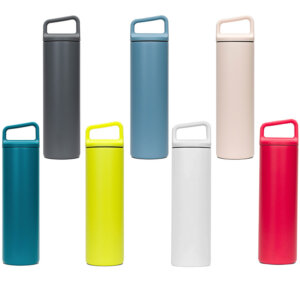
Custom Travel Flask Insulated Bottle
Travel flasks fail at the cap, not the body
A travel flask is carried in a bag, wedged into a door pocket, and opened one-handed while moving. The body survives all of that. The cap is where the product either works or becomes a story about a soaked laptop. Designing a travel flask is mostly the discipline of making one moving part behave under bad conditions.
One-hand operation and the false-lock problem
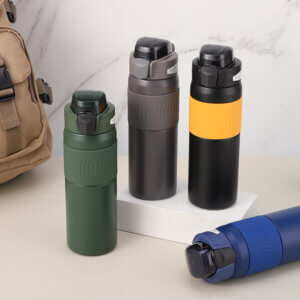
An auto-flip cap needs a spring, a latch and a button, and those three parts create the category’s signature failure: the latch releases in a bag. The fix is a secondary sliding lock, which adds a part and a step. Buyers often cut it to reduce cost and unit assembly time, and the returns rate that follows is predictable.
If the flask is positioned for commuters, keep the secondary lock. If it is positioned for desk use, the lock is optional and the money is better spent on the gasket.
Two openings, two different jobs
A drink opening and a pour opening are not interchangeable. A drink opening is small, has a silicone lip and is designed for contact with the mouth. A pour opening is wider and designed for flow without glugging. A cap that tries to serve both with one hole ends up too large to drink from comfortably and too small to pour cleanly.
The practical compromise for a travel flask is a single drink opening at 18 to 20mm with a vent hole opposite it. The vent is what prevents glugging, and it must be positioned so it is covered by the lip when drinking.
Sealing against pressure and temperature swing
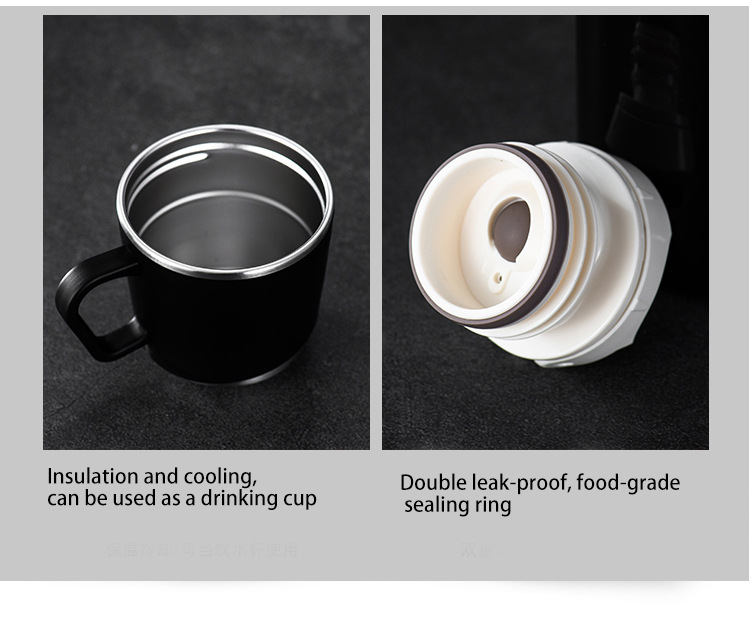
A capped flask filled with hot liquid and then carried into a cold environment develops a pressure differential. The gasket must hold against that without being so tight that the cap becomes hard to open. Silicone at 50 Shore A with a defined compression window handles it. A flat gasket cut from sheet material will hold initially and take a set within weeks.
Ask for a pressure-hold test: cap the flask at 80 degrees Celsius, cool to 5 degrees, then open and check for weeping at the thread.
Cup-holder compatibility is a dimension, not a feature
A flask that does not fit a standard cup holder is a flask that gets left in the car. The working base diameter for universal fit is under 74mm. Many 500ml travel flasks are designed at 76 to 80mm for thermal volume, which is exactly why they do not fit. If cup-holder use is part of the positioning, the base diameter is a hard constraint that overrides the capacity target.
Ordering & lead time
| Minimum order quantity | 100 pcs per SKU |
| Sampling lead time | 3 days |
| Production lead time | 7 days |
| Monthly capacity | 100,000 pcs |
Lead times apply to existing tooling and standard colours. New mould development or custom colour matching carries its own schedule — confirm before committing to a delivery date.