Last updated: October 26, 2026
A stainless steel bottle that rusts is almost never a steel problem. It is a surface-state problem — free iron left on the surface, an oxide scale that was never removed after welding, or a passive film that was asked to survive an environment it was never specified for. That distinction is worth money, because “bad steel” is a material dispute you will probably lose, while “uncontrolled surface state” is a process deviation your supplier owns under a properly written purchase order.
This article is written for the person signing the PO, not for the metallurgist. It covers where rust actually comes from in a drinkware factory, what passivation under ASTM A967 does and does not do, which tests generate evidence you can put in front of a supplier, how grade choice (201 / 304 / 316L) changes the error budget, and the specific clauses and receiving checks that turn a corrosion complaint into a documented claim instead of a negotiation. Where a number depends on the supplier’s process rather than a published standard, it is marked as a typical range rather than presented as a measured result.
Why Does a Stainless Steel Bottle Rust at All?
Stainless steel is not rust-proof. It is rust-tolerant, and the tolerance comes from a chromium-rich oxide film that forms spontaneously on a clean surface in the presence of oxygen. That film is extremely thin — of the order of a few nanometres — and it is self-repairing, but only under specific conditions: the surface must be clean, oxygen must be available, and the local chemistry must not exceed what the film can tolerate.
Passivation only holds when the body is drawn and finished consistently, which is why rust complaints cluster around specific formats. In our current line, Custom 34oz Insulated Flasks Thermos Bottle, Insulated Vacuum Flask Thermoses and Custom Travel Flask Insulated Bottle are the closest matches.
Rust appears when one of those three conditions fails. In practice, on new drinkware, it is almost always the first one. A bottle leaves the polishing line with microscopic particles of iron embedded in the surface — from tooling, from grinding media, from a shared brush that also touched carbon steel, from the water used in the final rinse. That iron is not protected by chromium, because it is not alloyed with chromium; it is sitting on top of the alloy. It oxidises within hours in humid air and shows up as an orange bloom, and the customer photographs it, and the claim lands on your desk three weeks later.
What Is the Passive Film, and What Breaks It?
The passive film is a mixed iron-chromium oxide, but only the chromium oxide portion does the protecting. Where the film is chromium-rich, it is chemically inert, electrically insulating, and slow to dissolve. Where iron dominates — at the outer surface before passivation, or anywhere free iron has been smeared onto the steel — the film behaves like ordinary rust: it is porous, it conducts, and it grows.
This is why passivation chemistry is essentially a controlled etch. An acid passivation bath dissolves free iron considerably faster than it attacks the chromium oxide that is already there. The result is not a coating and not a thicker layer in any meaningful sense; it is a surface whose outermost few atomic layers have had their iron removed, letting the chromium oxide film re-form at full strength. The measurable effect is a higher chromium-to-iron ratio at the surface, which is what a competent supplier should be able to show you.
The film has real limits, and buyers should know them before writing a performance claim:
- Chlorides break the film locally. Chloride ions migrate to weak points, the film breaks down in a spot rather than uniformly, and you get pitting — a dark pit with a rust collar — instead of an even bloom. Pitting is the failure mode that matters for pool, coastal and sports-drink use.
- Low pH and stagnation prevent repassivation. A sealed bottle left with residue, or a bottle stored with a damp interior, keeps the surface in a low-oxygen, low-pH micro-environment where the film cannot rebuild.
- Deposits and crevices do the same thing geometrically. Under a gasket seat, in a thread root, or under a dried film of sports drink, oxygen cannot reach the surface, and the area becomes anodic relative to the surrounding steel.
- Temperature accelerates everything. A dishwasher at 60–70 °C does in one cycle what a sink does in a month.
Which Manufacturing Steps Leave Iron on the Surface?
Buyers tend to ask “is it 304?” and stop there. The more useful question is which steps in the process can deposit iron, because that is where the escape happens. In a typical drawn-and-welded bottle line:
- Cutting and trimming with blades or dies that have seen carbon steel, and laser cutting that leaves iron-rich dross at the cut edge.
- Deep drawing and ironing, where the part is formed against tooling and lubricated with drawing compounds that carry metal fines.
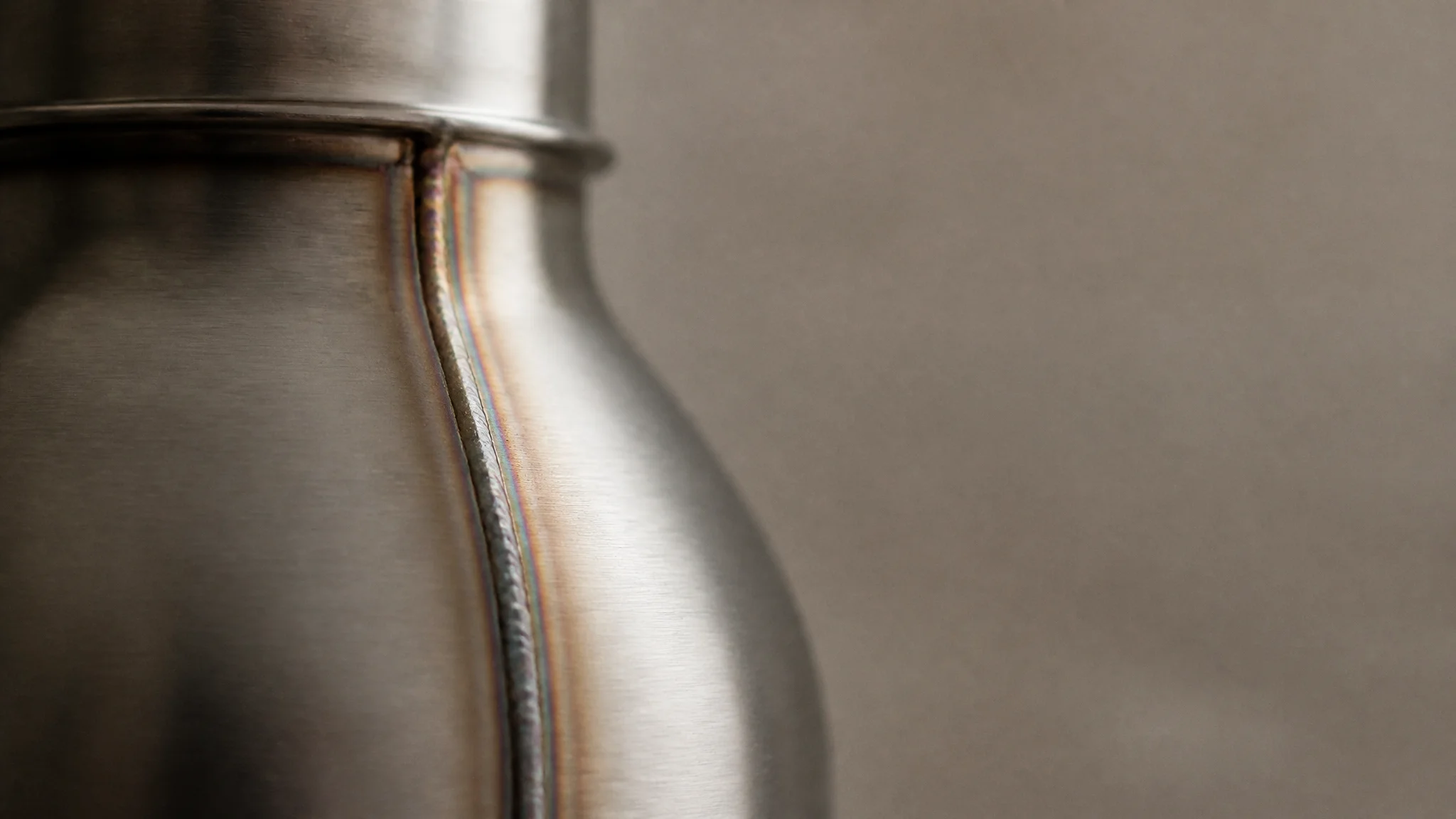
- Welding the body seam and the base, which produces a high-temperature oxide (heat tint) and, without back purging, an oxidised interior weld.
- Grinding and polishing with belts, brushes and compounds that may be shared across materials, plus the polishing compound itself, which is a contamination source in its own right.
- Tumbling and blasting with media that has processed other alloys, which embeds particles rather than removing them.
- Rinsing with chlorinated or hard water, which can leave both chloride and mineral deposits that interfere with the next step.
- Handling — bare hands, shared gloves, cardboard contact in a humid warehouse.
Every one of these is a process control point that can be written into a supplier qualification and audited. None of them is fixed by buying a more expensive grade, which is the single most common and most expensive mistake buyers make after a rust claim.
Which Contaminant Is Actually Causing the Rust?
Diagnosis drives the remedy, and the remedy drives who pays. The six failure patterns below cover most drinkware corrosion complaints, and they have different owners: some are welding process failures, some are cleaning-line failures, some are design failures, and one is a logistics failure that no amount of passivation will fix.
| What you see | Most likely cause | Where to look | Fix at source |
|---|---|---|---|
| Orange speckle in a line, following the seam or the base weld | Weld heat tint plus iron-rich oxide, never removed | Weld zone, both faces | Back purge, then pickle or mechanically remove tint before passivation |
| Uniform light rust bloom across the interior | Free iron smeared by forming, polishing or contaminated blast media | Whole wetted surface | Dedicated stainless tooling and media, citric passivation |
| Brown ring at the waterline, or rust under the gasket seat | Crevice corrosion from trapped liquid and deposits | Thread roots, gasket groove, base radius | Drainable geometry, radius control, drying instruction |
| Discrete pits with dark centres and rust collars | Chloride pitting — salt water, pool water, electrolyte drinks | Lower body, base, exterior | Grade or surface upgrade; honest use claims |
| Grey film plus rust only after dishwashing | Alkaline detergent attacking residual iron; hot wet dwell | Whole unit | Lower surface iron, shorter wet dwell, specified cycle test |
| Rust on one pallet only, cartons damp | Condensation in transit or storage, not a factory defect | Carton interiors, liner, pallet base | Packaging and container controls, not passivation |
That last row matters more than its position suggests. If a claim is actually transit condensation, chasing the factory for a re-passivation run wastes months and damages the relationship. The transit-corrosion problem has its own control set, covered in Container Rain and Transit Corrosion: How Do You Keep Stainless Steel Drinkware Shipments Rust-Free? — read the two together before you assign blame.
Why Is Weld Heat Tint Worse Than the Weld?
A weld seam is not the weak point people assume it is. Modern TIG and laser welding of 304 body seams produces a sound joint; what damages corrosion resistance is the thermal cycle around it, not the fusion line. At welding temperatures the chromium at the surface oxidises preferentially, and the oxide that forms is thick, coloured (straw, then bronze, then blue as it grows) and chromium-depleted underneath. The tint you see is not a protective chromium oxide film. It is a mixed iron-chromium oxide with a chromium-starved zone beneath it, sitting exactly where chlorides will collect.
Three practical consequences follow:
- Tint must be removed, not passivated over. The British Stainless Steel Association is blunt about the sequence: stainless steels cannot be passivated unless the surface is clean and free from contamination and scale from welding, and scale may need to be removed first by pickling or mechanical abrasion. A supplier who says “we passivated it” while the tint is still visible has not solved the problem.
- Interior welds need atmosphere control. A base weld made without back purge or forming gas oxidises on the inside face — the face that holds the drinking water. Ask for the purge gas and the weld parameter record, not just a weld photo.
- Grinding tint off is not free. Mechanical removal changes the surface finish and adds labour. If your price target assumes “weld and go”, the tint will still be there when the bottles ship, and the claims will arrive in month three.
What Does a Dishwasher Do That Hand-Washing Does Not?
A dishwasher combines four stressors that a sink never does at the same time: sustained temperature around 45–70 °C depending on the programme, an alkaline detergent solution that commonly sits near pH 10 (typical domestic formulation, confirm the actual product chemistry with your detergent supplier), a long wet dwell of an hour or more, and a drying phase that leaves concentrate films in crevices before evaporating.
The alkalinity is not the problem in itself — austenitic stainless steel handles alkaline solutions well within normal detergent ranges. The problem is what the alkalinity attacks: residual free iron, polishing compound, drawing lubricant, and any iron-rich weld oxide. Detergent plus heat plus time is an efficient strip of exactly the contaminants that passivation was supposed to have removed. That is why a bottle can pass a factory copper sulfate test and still show a grey bloom after twenty household cycles.
There is no universal “dishwasher safe” corrosion test that a supplier can simply pass. IEC 60436 defines performance measurement for household dishwashers, not a corrosion acceptance criterion for a bottle. If your marketing says dishwasher safe, the defensible route is to write a cycle count and a detergent into the PO — commonly 20 to 50 cycles in a domestic machine with a standard powder or tablet — and to define what “no unacceptable change” means in photographs. That is a typical range used in buyer specifications, confirm the number with your supplier and test lab before you print a claim.
Where Do Chlorides Come From in Normal Use?
Chloride is the single most predictable cause of pitting on drinkware, and it arrives from ordinary use rather than abuse: municipal tap water, swimming pool water, coastal air and sea spray, sweat and sunscreen on the exterior, electrolyte drink powders and tablets, salted food residue, and cleaning with hypochlorite bleach. Road salt and beach sand in a car cup holder are enough.
There is useful published guidance on the margin. The Australian Stainless Steel Development Association notes in its technical FAQ on general corrosion resistance that 316 performs well in potable water below roughly 250 ppm chloride, and pits rapidly above that; 304 has materially less margin at the same chloride level. That is a rule of thumb for potable water at ambient temperature, not a design limit for a warm, stagnant, sealed bottle — treat it as a reason to test rather than a number to print.
The commercial implication is straightforward. Two bottles from the same production run, made to the same specification, will behave differently if one is sold to an office user and the other to a swimmer. If your channel includes gyms, outdoor retail, sailing, or schools near the coast, the surface specification should be written for that channel, not for the average.
What Is Passivation, and What Is It Not?
Passivation is a final chemical treatment that removes free iron from a stainless surface and allows the chromium oxide film to form to its full thickness in a controlled way. It is a cleaning-and-oxidation step. It is not a coating, it does not add a visible layer, it does not change the alloy, and it does not repair damage that has already occurred.
Buyers frequently expect more from it than it can deliver. Four things passivation will not do:
- It will not remove heat tint or welding scale. Those require pickling or mechanical removal first.
- It will not fix a pitted or already-rusted surface. Once a pit has formed, the geometry remains; passivation can stop the corrosion from spreading but cannot restore the appearance.
- It will not upgrade the alloy. A 201 bottle passivated to the highest standard is still a 201 bottle.
- It will not survive a contaminated rinse. Rinsing passivated parts in chlorinated tap water re-introduces the problem the bath just solved.
How Do Nitric and Citric Passivation Compare Under ASTM A967?
ASTM A967, Standard Specification for Chemical Passivation Treatments for Stainless Steel Parts, covers both nitric acid and citric acid treatments and is the reference most drinkware factories are actually working to, whether or not they say so. Its nitric treatments are similar to those in ASTM A380, and it adds citric acid options along with five verification practices.
The published process windows are the useful part for a PO, because they let you spot a supplier who is improvising. According to the British Stainless Steel Association’s technical summary of A967 and A380:
| Route | Solution | Temperature and time | Trade-offs |
|---|---|---|---|
| Citric, A967 treatment 1 | 4–10 wt% citric acid | 60–71 °C, 4 min | Fast, no NOx, easiest waste stream; tightest temperature control needed |
| Citric, A967 treatment 2 | 4–10 wt% citric acid | 49–60 °C, 10 min | Most common shop-floor compromise |
| Citric, A967 treatment 3 | 4–10 wt% citric acid | 21–49 °C, 20 min | Ambient, long bath time, higher iron loading in the bath |
| Nitric, A380 code F (A967 similar) | 20–50 vol% nitric acid | 50–70 °C, 10–30 min | More aggressive on light scale; NOx fume scrubbing and acid waste handling |
| Nitric plus dichromate, A380 codes G/K | Nitric acid with sodium dichromate | As coded, 50–70 °C | Strongest oxide removal; carries hexavalent chromium waste burden |
Process windows above are as summarised by the British Stainless Steel Association from ASTM A967 and ASTM A380; confirm the current edition values and your supplier’s actual bath parameters in writing.
The practical difference for a buyer is not which acid is “better”. Both are accepted by A967, and the standard is explicitly permissive: any combination of citric acid concentration, temperature and time is allowed provided the acceptance test criteria are met. The differences that matter commercially are hazard control, waste cost, bath life, and how the supplier verifies the result. A citric line with a sloppy rinse and no test is worse than a nitric line with records.
Does Immersion, Spray or Circulation Matter for a Bottle?
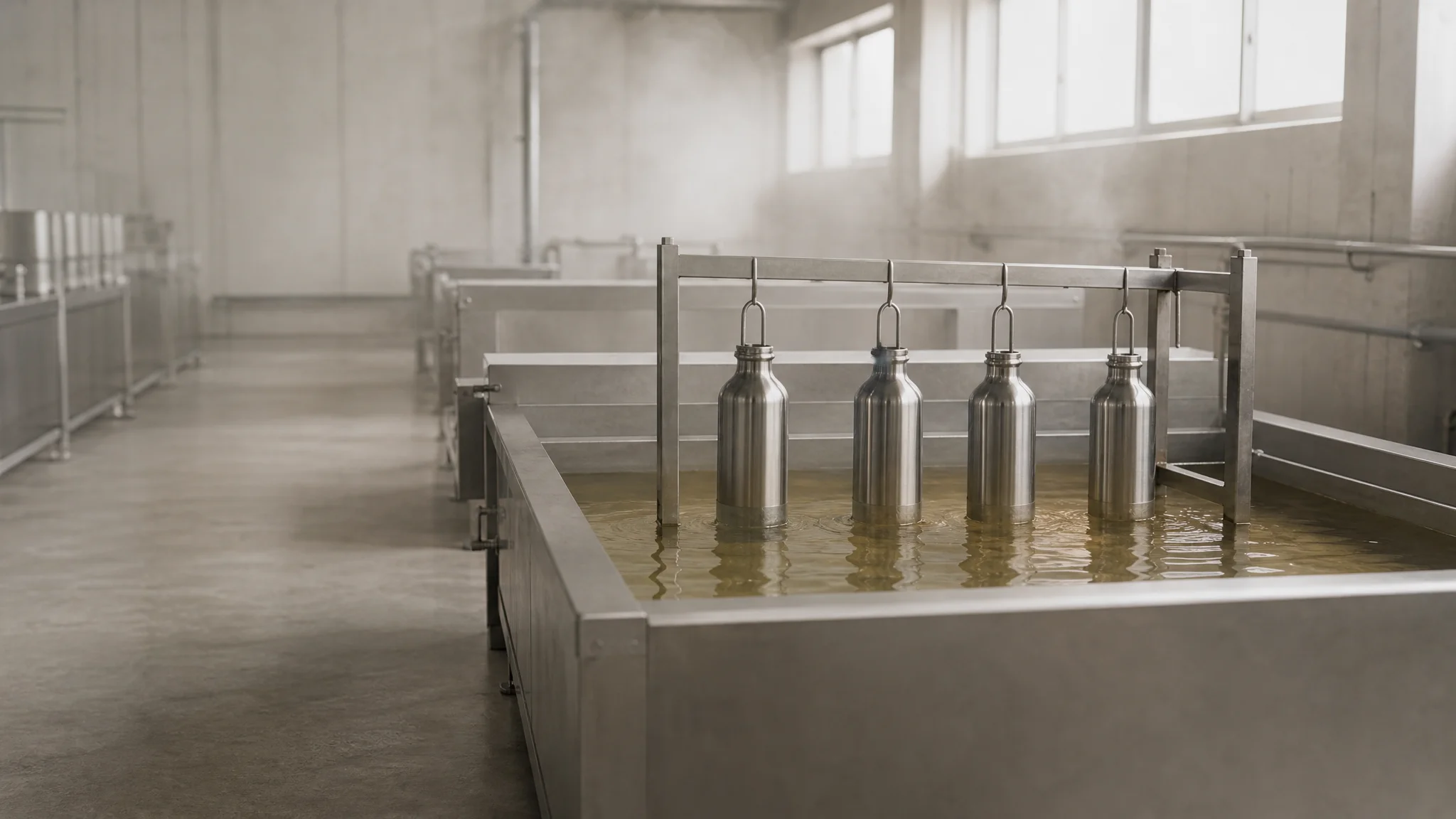
For flat parts, passivation method barely matters. For a deep, narrow, double-walled bottle it matters a great deal, because the interior is a cavity with one small opening and a domed base. The three failure modes are air locks, shadowing, and contaminated rinse water.
An air lock is the most common and the least visible. Immerse a bottle upright and the dome traps air; invert it carelessly and the base traps air. Either way, a region of the wetted interior never sees the bath, never gets passivated, and becomes the rust site eighteen months later. Shadowing happens when spray nozzles cannot reach the base radius or the underside of the shoulder. Contaminated rinse happens when the final rinse is ordinary tap water with residual chlorine and hardness, which deposits exactly the contaminants the bath removed.
What to specify: the part orientation during treatment, a requirement that the wetted interior be fully flooded with no air pockets, a defined rinse sequence ending in demineralised water, bath iron-loading control (a bath that has processed too many parts becomes an iron source rather than an iron sink), and witness coupons run through the same cycle as production parts. These are process clauses, and they are the ones that separate a factory that passivates from a factory that owns a passivation tank.
Why Is Passivation Not Pickling?
These two are routinely conflated in quotations, and the confusion is expensive in both directions. Pickling removes scale and a thin layer of base metal, typically with a nitric-hydrofluoric acid mixture, and it leaves a matte, slightly dulled surface. Passivation removes free iron and forms the oxide film without significant metal removal, so the brushed or polished finish survives.
If a supplier quotes “pickling and passivation” as one line item, ask for two process records. If they quote only passivation on parts with visible weld tint, you have found a process gap before it becomes a claim. Over-pickling carries its own risks on thin-wall drinkware — dimensional change, loss of surface finish, and hydrogen pickup — so the right answer is usually targeted removal of scale at the weld, then passivation of the whole part.
How Do You Prove the Passivation Worked?
You do not prove it with a certificate that says “passivated”. You prove it with a named test, a sample plan, an acceptance criterion, and a retained record. ASTM A967 defines five verification practices, and each answers a slightly different question. Knowing which one you are buying prevents the most common dispute in this area: a supplier submits a test report, the bottles still rust, and nobody can say whether the test was wrong or the batch changed after testing.
| Test | What it detects | Practical duration | Where it fits |
|---|---|---|---|
| A967 Practice A — water immersion | Free iron that rusts under wet conditions | Hours to a day | Batch qualification |
| A967 Practice B — high humidity | Surface iron under condensing conditions | Typically 24 h at elevated humidity | Simulating warehouse exposure |
| A967 Practice C — salt spray | Iron plus film weakness in chloride environment | Buyer-defined (see below) | Coastal and marine channels |
| A967 Practice D — copper sulfate | Free iron, by visible copper plating | Minutes | Per-lot screening, field use |
| A967 Practice E — potassium ferricyanide / nitric acid (ferroxyl) | Trace iron, by blue colour development | Seconds to minutes | Supplier qualification and disputes |
What Does the Copper Sulfate Test Actually Detect?
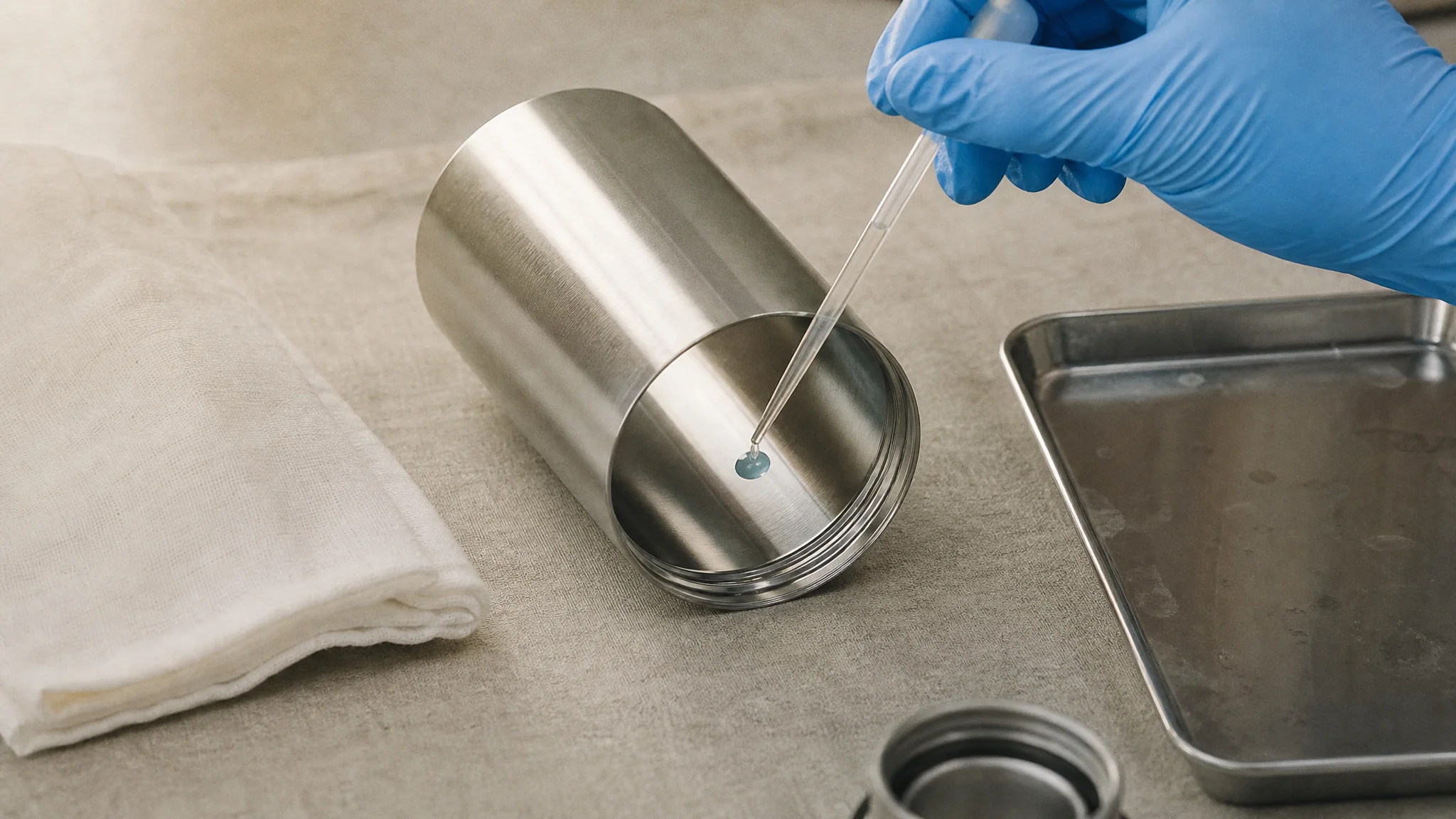
A copper sulfate solution applied to the surface plates out metallic copper wherever free iron is exposed, because iron is the more active metal and displaces copper from solution. No plating within the specified contact time is a pass. Because the result is a visible colour change rather than an instrument reading, the test travels well: it works in a lab, it works on a receiving dock, and it produces a photograph you can attach to a claim.
Its limits matter just as much. It detects free iron, not chromium depletion and not heat tint; a surface covered by an oxide scale can pass while remaining defective. It also needs a clean, degreased surface, and the contact time must be written down — A967’s copper sulfate practice specifies a defined immersion period in the order of minutes rather than hours, so confirm the exact time in the current edition and put it in the PO instead of letting each shift improvise.
When Is the Ferroxyl Test Worth the Extra Cost?
The ferroxyl test uses potassium ferricyanide in nitric acid and turns blue in the presence of iron ions. It is more sensitive than copper sulfate at low contamination levels, which makes it the right tool for qualification and for settling a disputed lot, and the wrong tool for 100% inspection — the reagent is hazardous and the waste stream is a real cost. A workable split is copper sulfate on every lot, ferroxyl on five units per lot plus any lot where the copper sulfate result is marginal.
How Many Salt Spray Hours Belong in the PO?
ASTM B117 defines the apparatus and the procedure — a continuous 5% sodium chloride fog at 35 °C with the solution pH controlled in the mildly acidic to neutral range — but it does not define how many hours constitute a pass. That number is a commercial decision, which is exactly why it belongs in the contract.
In buyer specifications for stainless drinkware, the bands that appear most often are 24–96 hours for light decorative expectations, 240 hours as a common wetted-surface requirement, and 480 hours or more where a marine or pool claim is being made. Treat those as typical industry bands rather than a published standard, and confirm the number with your supplier and your test lab, because the population of bottles, the rack orientation and the acceptance criterion change the outcome more than the hour count does.
Two clauses prevent most salt spray arguments. First, define whether cut edges and unpassivated internal threads count — cut edges always rust, and a supplier will argue they are outside the wetted surface. Second, define the acceptance visually: no red rust on the wetted surface, pitting below a stated diameter and count, photographed under stated lighting. “No corrosion” is not an acceptance criterion; it is an invitation to argue.
Does Grade Choice Change the Passivation Answer?
Grade and surface state are separate variables, and conflating them is how buyers end up paying for 316L and still receiving rust claims. Grade metallurgy, mill certificates and fraud detection are covered in 304 vs 316L Stainless Steel: How to Detect Material Grade Fraud Before Your Container Ships. This section is only about how grade interacts with surface condition.
Why Is 201 Riskier in a Damp Warehouse?
201 achieves its austenitic structure by substituting manganese and nitrogen for part of the nickel. That substitution saves cost and it narrows the margin. Two consequences are relevant to corrosion claims. First, lower nickel leaves the passive film less stable under chloride exposure, so the same surface contamination that produces a light bloom on 304 can produce pitting on 201. Second, manganese sulphide inclusions — present to some degree in most austenitic steels and more influential in free-machining and cost-optimised heats — are classic pit initiation sites: the inclusion dissolves, leaves a micro-crevice, and the pit starts there.
The operational translation is simple. 201 does not forgive process errors the way 304 does. A 201 programme can be perfectly sound, but it needs tighter control of free iron, cleaner rinsing, and a receiving test that actually gets run. If you are buying 201 and skipping the copper sulfate check because the price is tight, you are not buying a cheaper bottle; you are buying a higher claim rate.
When Should You Escalate to 316L or Electropolishing?
Escalation is a decision with thresholds, not a default. Three situations justify it:
- Chronic chloride exposure in use. Pool, salt water, sailing, coastal schools, electrolyte drinks as a marketed use case. This is a 316L conversation, and it should be paired with an honest use claim.
- Bare interior as a visible product feature. When the wetted surface is the product — no coating, no liner, retail shelf presence — electropolishing buys a smoother, more chromium-rich surface that photographs well and resists residue buildup.
- Repeated dishwasher exposure written into marketing. Hot alkaline cycling is unforgiving of residual iron; EP plus 316L is the combination that survives a 50-cycle claim.
Two situations do not justify escalation, and this is where money is usually wasted. If failures are concentrated at weld seams, the problem is heat tint and purge gas, and upgrading to 316L will simply produce rust on a more expensive bottle. If failures appear only after ocean transit or storage in an unconditioned warehouse, the problem is the packaging and the container, not the alloy. Electropolishing also carries real cost and lead time, so ask for evidence rather than adjectives: a surface roughness figure and a chromium-to-iron ratio at the surface, reported by a lab, on the actual process the factory runs.
Can Free Iron Change Taste and Food-Contact Status?
Corrosion products do not stay on the surface. Iron released at a contaminated site reacts with chlorides and organic acids in the drink, and the resulting species are tasted before they are seen: a metallic, bitter or “old coin” note, sometimes a grey tint in the water, sometimes visible particles at the base. A bottle can be entirely safe and still be returned, and the returns arrive as reviews rather than claims.
What Do FDA and EU Rules Actually Require Here?
In the EU, Regulation (EC) No 1935/2004 sets the framework: food-contact materials must be sufficiently inert to preclude transfer of constituents in quantities that endanger health or bring about an unacceptable change in the composition of the food or a deterioration in its organoleptic properties. That last clause is the one that matters for a rusty bottle — an organoleptic deterioration is a compliance failure under the framework regulation, not merely a quality complaint. Metals are addressed through member-state measures and Council of Europe guidance, so the practical document you should hold is a declaration of compliance supported by migration test data from a competent lab, with the specific release limits confirmed for the metals in your alloy.
In the US, there is no “FDA approved stainless steel” status, and any supplier who claims one is telling you something about their paperwork rather than the material. Bare stainless steel is not covered by a substance-specific food-contact regulation the way coatings are; 21 CFR 175.300 governs resinous and polymeric coatings used as food-contact surfaces, so it is the applicable section if your bottle has an interior coating, lacquer or a decorated interior, and it sets extraction limits for that coating. For bare steel, the operative controls are the alloy specification, the surface condition and current good manufacturing practice — which is exactly why the corrosion test record is the document that carries the compliance argument.
Which Clauses Actually Stop the Argument?
A rust claim is won or lost on wording written before production. These six clauses cover the gaps that appear in most OEM purchase orders for drinkware.
| Clause | What to write | Why it decides the claim |
|---|---|---|
| 1. Pre-treatment condition | “All weld zones free of visible heat tint and scale before passivation; scale removed by pickling or mechanical means, not by passivation alone.” | Removes the “we passivated it” defence on a tinted weld |
| 2. Passivation method | “Citric acid passivation per ASTM A967, 4–10 wt%, ≥20 min at ≥21 °C; or nitric per ASTM A967. Supplier to declare chemistry, concentration, temperature, time and bath iron-loading control per lot.” | Turns a vague process into an auditable parameter set |
| 3. Verification test and sampling | “Copper sulfate test per A967 Practice D on base and weld of every unit, contact time ____; ferroxyl per Practice E on 5 units per lot; report retained and supplied with shipment.” | Creates contemporaneous evidence; blocks after-the-fact certificates |
| 4. Salt spray | “ASTM B117, 240 h; no red rust on wetted surfaces; cut edges and internal threads excluded; pitting ≤ ___ mm and ≤ ___ per unit.” | Defines pass and fail instead of leaving it to interpretation |
| 5. Rework liability | “Lots failing verification are re-processed at supplier cost; one re-passivation attempt permitted; a second failure converts to remake; inbound and outbound freight at supplier cost.” | Caps the buyer’s exposure and prevents endless rework loops |
| 6. Change control | “No change to steel mill, weld parameters, passivation bath chemistry, polishing media or rinse water source without written approval and re-qualification.” | Most “sudden” corrosion problems are an unannounced process change |
Two supporting definitions make these clauses enforceable: define the lot (one production run, one heat number, one passivation bath cycle — not “one shipment”), and define the notification window with a cure period. A claim process without a lot definition cannot be sampled, and a claim process without a cure period escalates to chargebacks before anyone has inspected the parts.
What Should Receiving Do in the First Hour?
Incoming inspection is where a claim is made cheap or expensive. Seven steps, in order, on the first carton of every lot:
- Photograph the pallet before opening. Damp cartons, stained liners and condensation on the shrink wrap indicate transit exposure. If the packaging is wet, stop and document before touching the product.
- Inspect ten units under strong light — 500 lux or better, angled to catch surface reflections. Look at the weld seam, the base radius and the thread. Tint and bloom are visible at this scale; photographs taken with a scale reference become claim evidence.
- Run the 24-hour salt-water wipe on three units: wipe with 5% sodium chloride solution, leave at ambient, inspect at 24 hours. This is a field screen, not a specification test, but it separates clean lots from contaminated ones faster than any certificate.
- Spot-test with copper sulfate on the interior base and across the weld of five units. Record the contact time. Photograph any plating.
- Run the organoleptic check: fill with room-temperature water, cap, hold 24 hours, then smell and taste. A metallic or bitter note means corrosion products are present even if nothing is visible.
- Send one unit through five dishwasher cycles with the detergent your market actually uses. If your marketing claims a cycle count, test to that count instead.
- Quarantine pending documents. Match the mill certificate, the passivation process record and the test report to the lot before releasing to stock. A report that cannot be tied to a lot is not evidence.
Steps three through six are crude by laboratory standards and they are deliberately so: they cost almost nothing, they run the same day, and they generate dated evidence. Combine them with the formal pre-shipment checks in Testing Protocols: Which QC Checks Actually Matter Before Shipment so that receiving is a confirmation step rather than the first real inspection.
Who Pays When a Batch Fails the Test?
Cost allocation follows discovery location, and the multiplier between them is brutal. A failure caught in the factory costs a re-passivation run or a remake. The same failure caught in your warehouse costs freight in both directions, sorting labour, and a schedule slip. Caught at retail, it costs returns, marketplace penalties and shelf space you do not get back — which is why the factory-side test is the cheapest insurance in the entire programme.
One technical point changes the financial answer. If a bottle has already rusted to the point of pitting, re-passivation will not restore it: passivation removes free iron and rebuilds the film, but it does not fill a pit, and the cosmetic defect remains. In practice a pitted lot is scrap, not rework. That distinction should be written into the clause set, because suppliers routinely propose “we will re-passivate” for a lot that can never be sold.
The evidence pack that wins these claims is boring and consistent: dated photographs with a scale reference, the test method and contact time, retained samples from the disputed lot, lot traceability to a heat number and a bath cycle, and the original process record. Suppliers rarely dispute a claim that arrives with all five. They almost always dispute one that arrives as a customer photograph forwarded by email six weeks later.
What Should You Do This Week?
Three actions, in order of return. Add the pre-treatment, method and verification clauses to your next PO template — that is an afternoon of work and it changes every subsequent conversation. Buy a copper sulfate test kit and use it on the next two receipts; the first result will tell you more about your supply base than a year of supplier questionnaires. And run one bottle from your current stock through a dishwater cycle series, because that is the failure your end customer will actually experience.
Rust on drinkware is a controlled process outcome, not an act of nature. The buyers who stop receiving claims are not the ones who specified the most expensive alloy; they are the ones who defined the surface, tested the surface, and wrote down who pays when the surface fails.
About the oemwaterbottle.com engineering team
We are the engineering and quality team behind oemwaterbottle.com, an OEM stainless steel drinkware factory producing vacuum-insulated bottles, tumblers and thermal mugs for brand, retail and promotional programmes. Our work covers material specification, weld and surface process control, passivation and test documentation, and the inspection standards that sit behind every PO we accept. If you are rewriting corrosion clauses, qualifying a new passivation line, or trying to close out a rust claim, send us the specification and we will tell you what we would test and where the risk sits.
Contact: Talk to our engineering team — include your volume, target market and current surface specification, and we will respond with a process route and the test set that supports it.
Related reading: The “Food-Grade” Lie: Why SUS 304 Testing Reports Don’t Guarantee Safety and Leak-Proof Lid Engineering: Why “100% Leak-Proof” Claims Fail in Real-World Use.
What Do Buyers Ask Most Often About Rust Claims?
Can passivation remove rust that has already formed?
No. Passivation removes free iron from a clean surface and allows the chromium oxide film to re-form. It does not remove visible rust, fill a pit or restore a stained finish. A bottle that has already rusted to the point of pitting is normally a scrap decision, not a rework decision, which is why the rework clause should distinguish between re-passivating a contaminated lot and trying to rescue a corroded one.
Is citric acid passivation as good as nitric acid?
ASTM A967 accepts both, and the standard permits any combination of citric acid concentration, temperature and time provided the verification test criteria are met. Citric treatments are specified at 4–10 wt% citric acid with three published temperature and time options; nitric treatments broadly follow the ASTM A380 windows of 20–50 vol% nitric acid at 50–70 °C for 10–30 minutes. The commercial differences are fume control, waste handling, bath life and how consistently the line runs the parameters — not which acid is fundamentally superior.
Does a copper sulfate test guarantee the bottle will never rust?
No. It confirms that free iron is below the detection threshold of that test on the area you tested, at that moment. It does not measure chromium depletion under weld tint, it does not predict chloride pitting resistance, and it says nothing about what happens after twenty dishwasher cycles. It is a fast production screen, and it should sit alongside a salt spray check and a process record rather than replace them.
Why does my bottle rust only after dishwashing?
Because the dishwasher is the harshest environment the product routinely meets: 45–70 °C, an alkaline detergent solution typically near pH 10, an hour or more of wet dwell, and a drying phase that concentrates residue in crevices. That combination strips residual free iron and polishing compound that a factory test never stressed. If failures cluster after dishwashing, the fix is lower surface iron plus a specified cycle test, not a thicker wall.
Should I switch to 316L to stop rust complaints?
Only if the complaints come from chloride exposure in use — pool, sea, coastal air, electrolyte drinks — or from repeated hot alkaline cycling. If the failures are concentrated at weld seams, the cause is heat tint and purge gas, and 316L will produce rust on a more expensive bottle. If they appear only after ocean transit, the cause is condensation and packaging. Diagnose the pattern before you change the alloy.
What does “FDA approved stainless steel” actually mean?
It is not a status that exists. There is no FDA approval for bare stainless steel as a food-contact material, and a supplier claiming one is describing paperwork rather than a regulatory finding. 21 CFR 175.300 covers resinous and polymeric coatings used as food-contact surfaces, so it applies to internal coatings and lacquers, not to the bare alloy. For bare steel the evidence that matters is the alloy specification, the surface condition and the corrosion test record.
Why do cut edges rust first in a salt spray test?
Because a cut edge exposes unpassivated base metal with a rough, high-energy surface that the passivation bath may not have fully treated, and it holds the salt solution by capillary action. That is normal behaviour, which is exactly why the acceptance criterion has to state whether cut edges and internal threads are included. Leaving it unstated is the most common reason a salt spray result gets argued instead of accepted.